
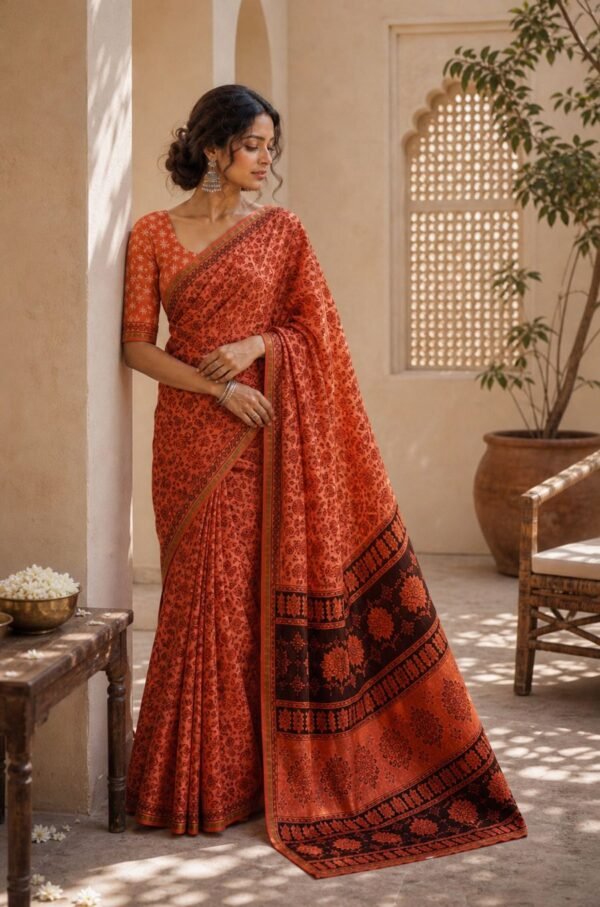
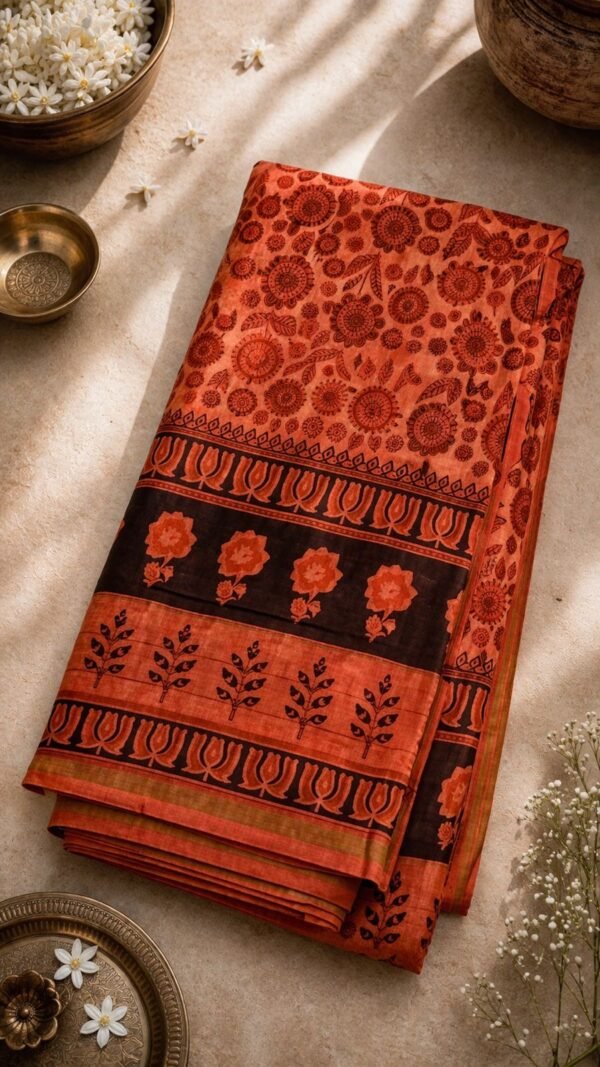
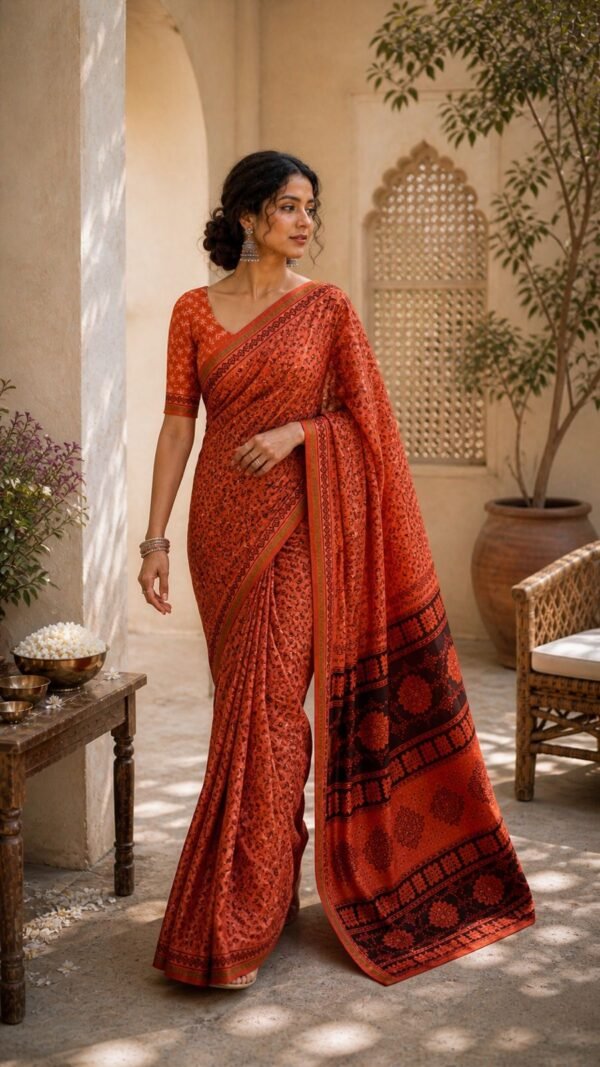
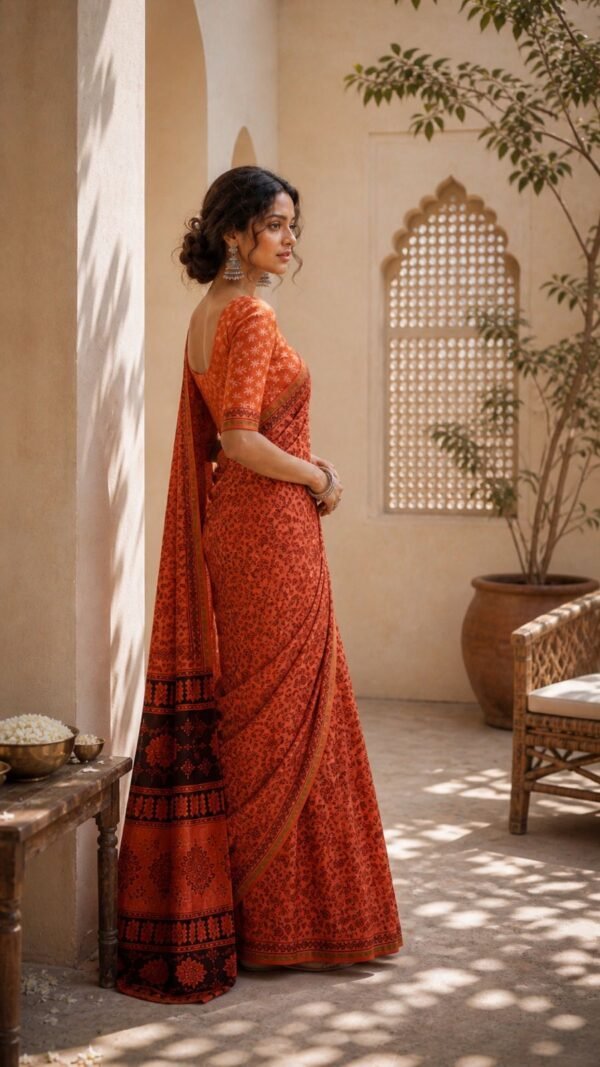
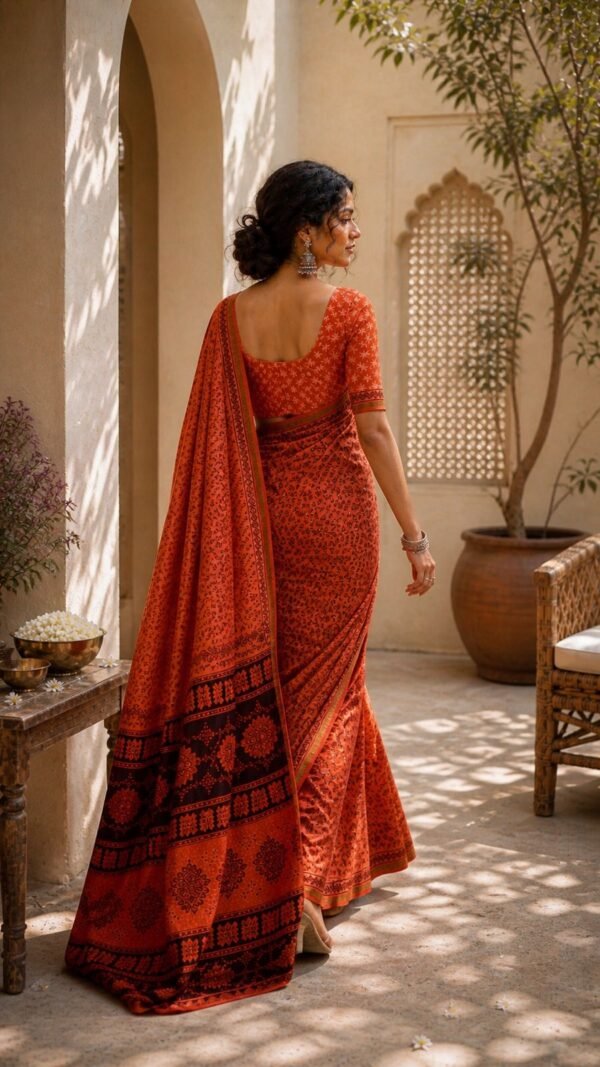
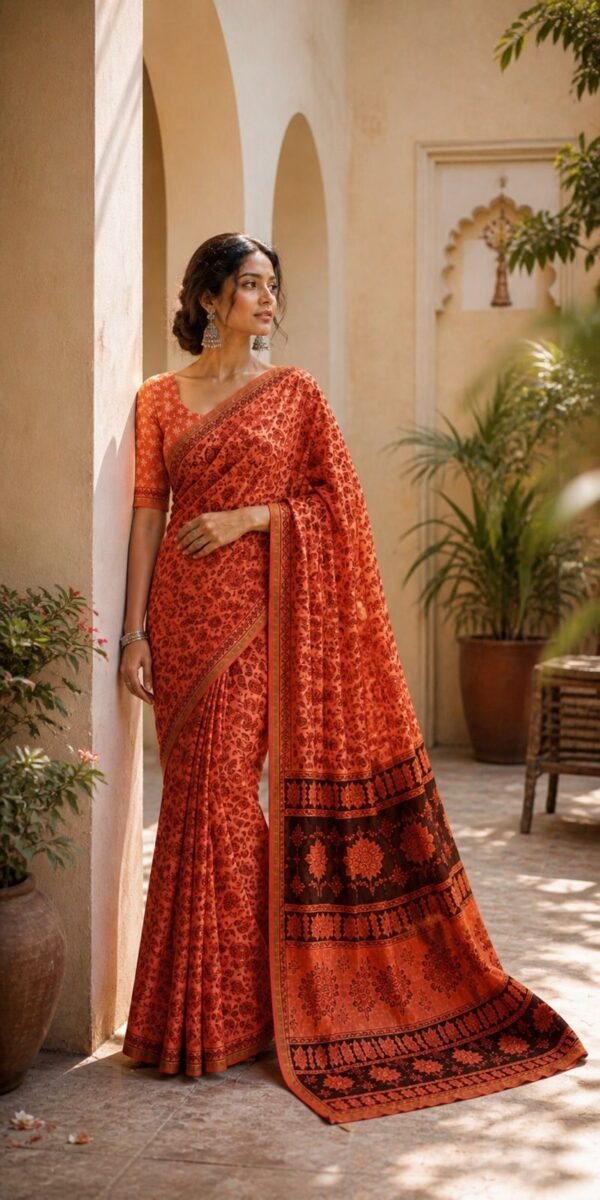
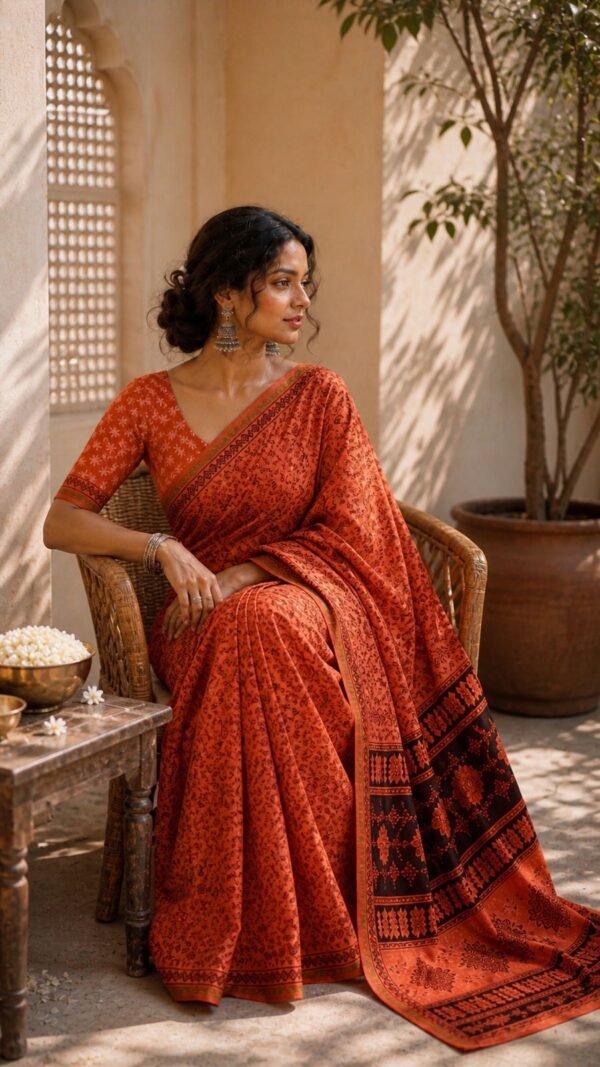
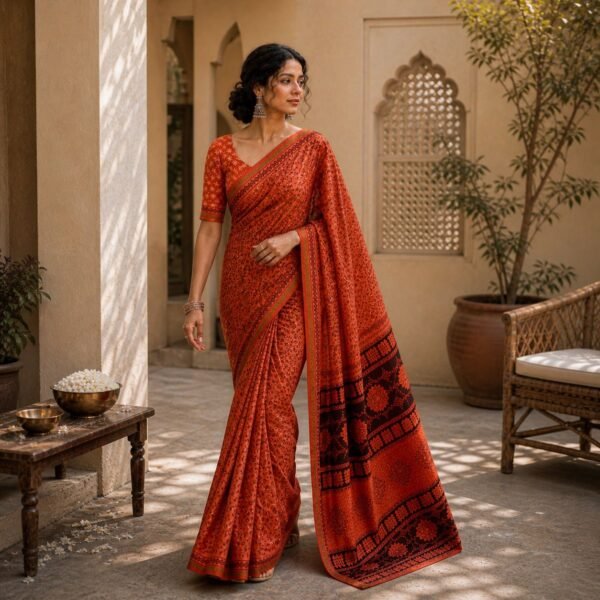

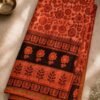







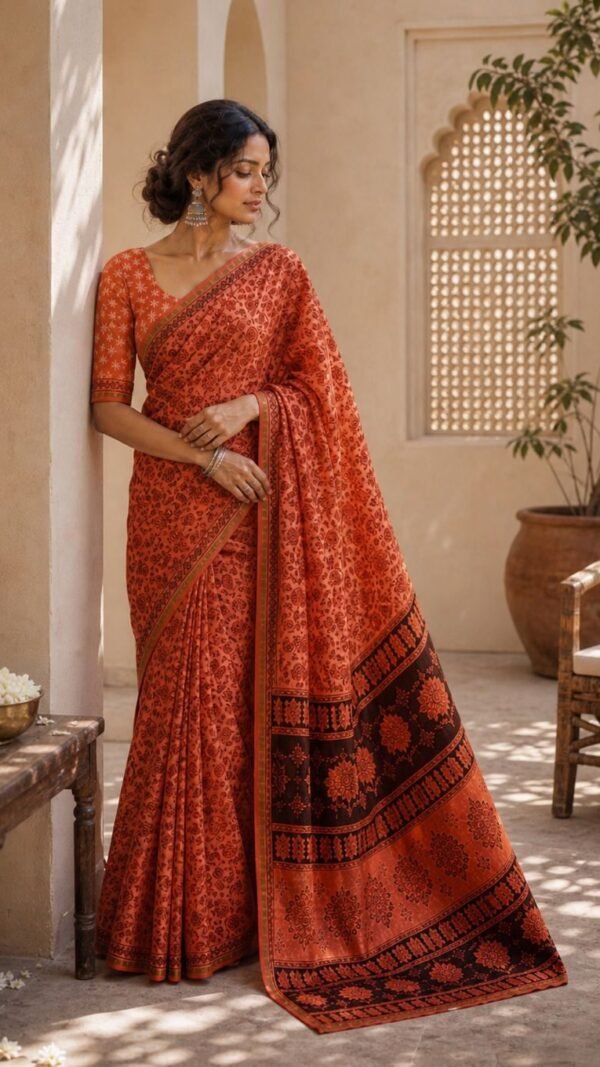
Rust Bagru Block Printed Chanderi Cotton Saree in
Sarees₹3,800.00
& Free ShippingBefore the first block is pressed,
the fabric spends days soaking in a paste of cow dung and castor oil —
an ancient mordant that opens the cotton fibre
to receive the colour permanently.
What you are wearing is not printed fabric.
It is fabric that has been taught to hold colour forever.
The rust on this saree is not a colour that was applied to the surface. It was drawn up from inside the fibre through a centuries-old Bagru dye process that uses iron-rich water, pomegranate rind, and an ancient mordant preparation — the same chemistry the Chippa community of Rajasthan has used for over 450 years to make colour that does not wash out, does not fade, and deepens with age. The Chanderi cotton base brings its own quality: a fine, slightly crisp weave with a natural quiet sheen that makes the rust glow rather than sit flat, and the bold block-printed border — lotus forms, flower heads, leaf sprigs in deep brown-black — frames the body with the unhurried authority of a hand that has pressed this same block ten thousand times.
Bagru is a village thirty kilometres outside Jaipur where the Chippa community — a hereditary caste of block printers — has been practising their craft for over 450 years without a break in the lineage. The most extraordinary thing about Bagru printing is not the blocks, which are beautiful, or the designs, which are precise — it is the dye. The Bagru colour palette comes entirely from what the land and the chemistry of Rajasthan produce: iron left to rust in water for weeks makes the characteristic dark brown-black of the outline dye; pomegranate rind boiled with iron salt makes the warm rust ground; myrobalan — a dried forest fruit — is used as a natural mordant to prepare the fabric. These are not colours chosen from a Pantone chart. They are the colours of the Rajasthan landscape, extracted through processes that have not changed in four and a half centuries.
Before any block is pressed, the fabric in the Bagru tradition goes through a preparation process called syahi-begar: it is soaked in a solution of castor oil and soda ash, then sun-dried, then beaten, then soaked again — a process that takes days and opens the cotton fibre to receive the natural dye permanently. This is why Bagru colours do not fade the way synthetic prints do. They are not sitting on top of the fibre. They have been drawn inside it.
The Chanderi cotton base of this saree was not chosen by accident. Chanderi’s fine, slightly crisp weave — woven by the handloom weavers of Madhya Pradesh — takes the Bagru block print with unusual clarity and depth, the natural lustre of Chanderi cotton making the rust appear to glow rather than simply sit on the surface
- Wash: Hand wash in cold water with a mild detergent. Natural dye colours — including Bagru rust — are permanent but should be treated gently.
- Do not: Never use bleach, strong detergents, or washing powder. These will strip the natural dye chemistry and the colour will never recover.
- First wash: Wash separately — Bagru natural dyes may bleed slightly on the first wash. This is completely normal and will not affect subsequent washes.
- Dry: Dry in shade. Extended direct sunlight will cause natural dye colours to fade over time — this is the nature of all natural dye, not a defect.
- Iron: Medium heat on the reverse side while slightly damp. Iron on the inside to protect the block printed surface.
- What to expect: Natural dye Bagru prints develop a beautiful patina with age and washing — the colour softens and deepens in a way that synthetic prints never do. This is not fading. It is the saree becoming more itself.
- Store: Fold and store in a cool, dry place away from direct sunlight.
| Dimensions | 5.5 cm |
|---|---|
| Saree Length | 5.5 metres |
| Blouse Piece Length | 0.8 metres |

Reviews
There are no reviews yet.