
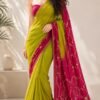
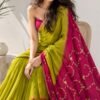

Mehndi Product Name Crepe Saree in Olive Green-to-Magenta Ombre with Lime Green Hand Embroidery
Sarees₹12,000.00
& Free Shipping
Mehndi is the henna paste before it dries.
The specific olive green
that is applied to the bride’s hands
the night before the wedding —
the colour of the celebration
at its beginning. This saree body is that colour.
When the ombre moves toward the pallu,
the olive green becomes magenta,
the body becoming the border.
The embroidery needlewoman chose the same green
for the scrolling vine on the magenta pallu.
The body colour traveled to the pallu
through the embroidery thread.
The mehndi vine on the mehndi-coloured cloth.
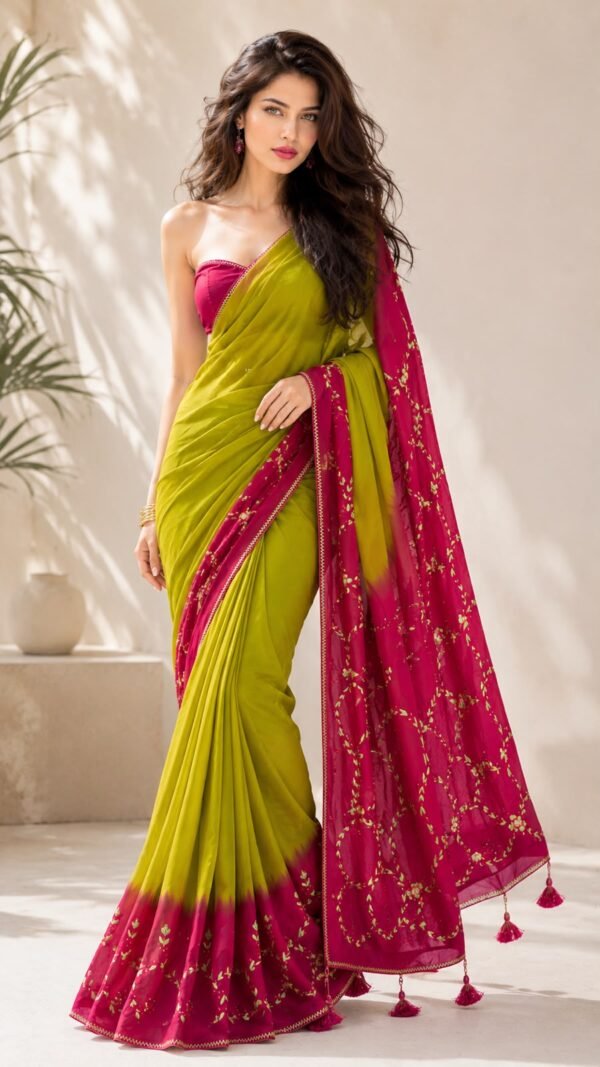
The ombre sarees of Agni and Mehndi share a construction: both begin with a plain body and transition into a contrasting pallu through a continuous dye gradient. What distinguishes Mehndi is the colour relationship and the embroidery logic. Where Agni moved from warm orange to bright magenta and placed gold zari embroidery at the pallu — adding a third metallic colour at the brightest end — Mehndi moves from olive green to hot pink/magenta and embroiders the pallu in the same olive green as the body. The embroidery thread connects the two halves of the saree: the pallu carries the body’s colour back to itself through the vine, the olive green present at both ends of the saree’s journey.
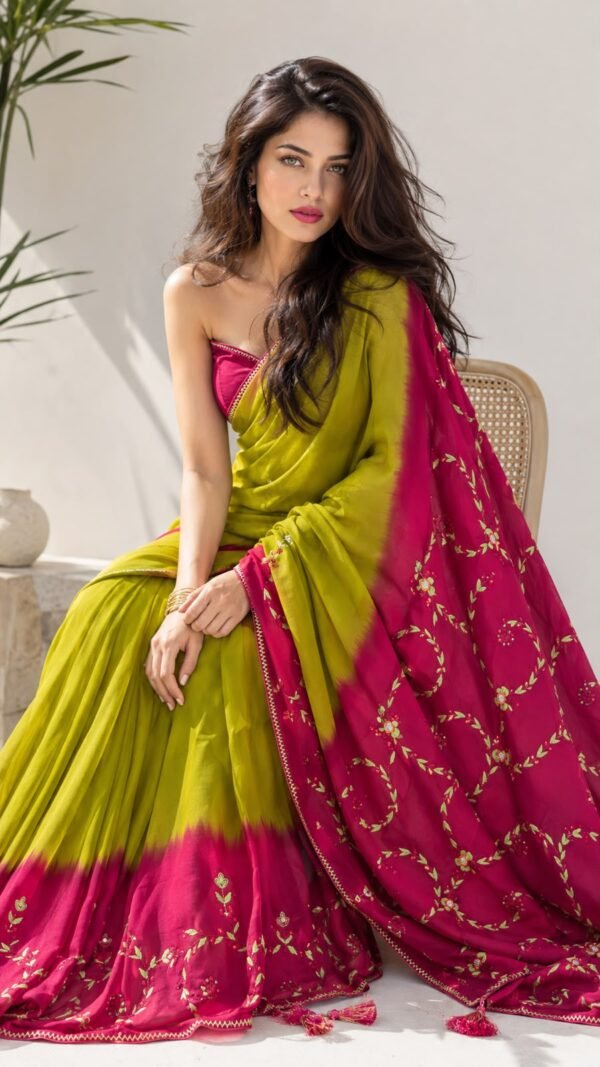
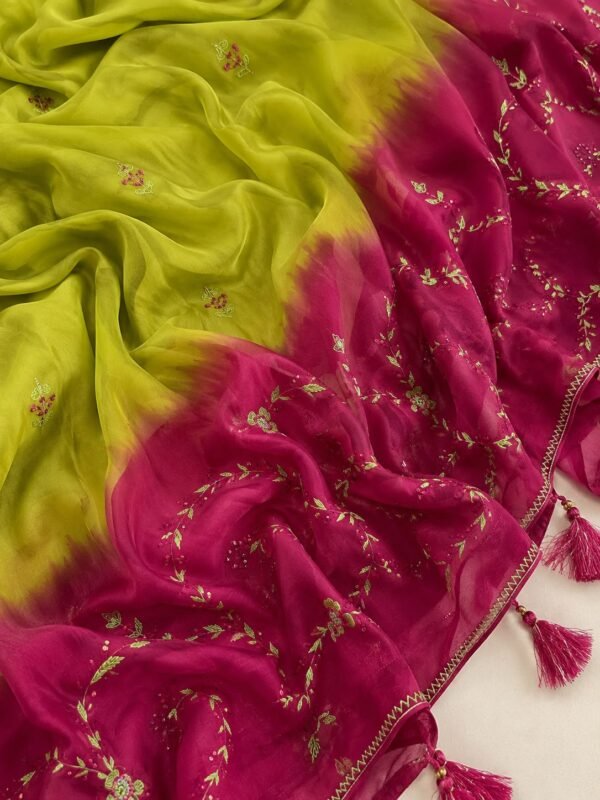
The olive green of the body is the specific shade the Indian tradition calls mehndi — the colour of fresh henna paste before it oxidises to the deep rust of the dried pattern. It is a warm green: not the cool green of foliage, not the bright green of new grass, but the slightly yellow-green of the henna plant’s active compound. On crepe, this mehndi green has the characteristic satin-like surface of the fabric — the pebbled weave holding the dye at full depth, the colour reading as simultaneously warm and luminous. The transition from this mehndi green to the hot pink/magenta is one of the saree’s most striking qualities: the two colours are complementary in the optical sense, each making the other more vivid at the transition zone.
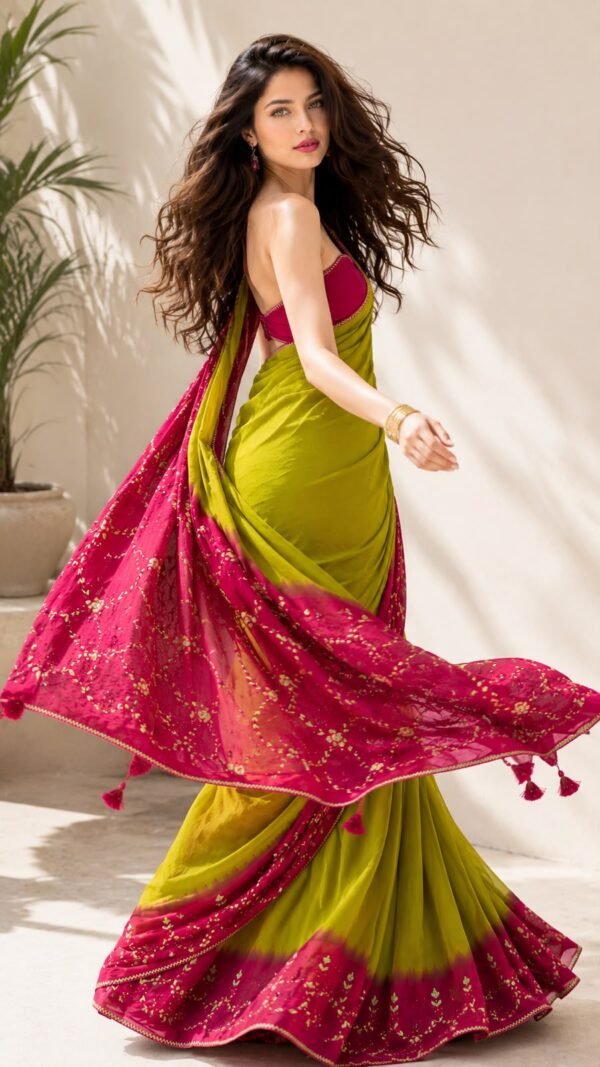
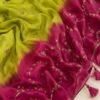
The pallu embroidery is the scrolling vine composition: a continuous trailing vine in the lime/olive green thread, carrying small leaf forms, flowers, and dotted accents across the full magenta surface. The vine’s movement is open and flowing — not the dense coverage of the Chikankari jaal or the structured geometry of the Phulkari border, but the free trailing form of a vine that chooses its own path across the fabric. Small red or maroon accent buti punctuate the vine at its junctions, and scattered sequins catch the light between the embroidered elements. The zigzag/chevron running border at the saree’s long edge carries the same thread vocabulary in a contained border form. Hot pink tassels at the pallu hem complete the composition. The blouse is hot pink/magenta with matching embroidery, the upper half of the composition in the pallu’s colour.
In the reference image, the saree is worn in a contemporary interior: clean white walls, rattan chair, bamboo plant. The mehndi green and the magenta against the white setting read as vivid, festival-adjacent, and completely at ease in a modern space. The name is Mehndi: the henna before it dries, the green that belongs to the celebration’s beginning.
The scrolling vine embroidery on the Mehndi pallu belongs to the same hand embroidery vocabulary as Agni — the flowing line of the vine and its leaf forms carrying across the fabric surface without a fixed geometric grid. The specific characteristic of the Mehndi embroidery is the colour choice: the lime/olive green thread on the hot pink/magenta ground produces a maximum colour contrast between embroidery and ground, the green and the pink’s complementary relationship making each colour appear more vivid in the other’s presence. This vibration between the two colours is what gives the Mehndi pallu its visual energy at a distance.
The design decision to use the body colour as the pallu embroidery thread is the Mehndi saree’s specific contribution to the ombre tradition. In most ombre sarees, the embroidery at the pallu is in a neutral or metallic — gold, silver, white — that does not reference the body colour. Mehndi reverses this: the body colour becomes the embroidery thread, the vine carrying the mehndi green into the magenta and back. The saree has a compositional continuity that the metallic-on-ombre construction does not achieve.
• Wash: Dry clean only. The ombre dye gradient, the hand embroidery, and the sequins all require professional care.
• Ombre gradient: The mehndi green and the magenta transition zone is the most vulnerable area. Water and agitation can shift or blur the gradient. Dry clean protects it permanently.
• Sequins: Handle the pallu with care. Do not catch or rub sequin areas.
• Tassels: The hot pink tassels may release slight colour on first wet contact. Keep away from the body and pale garments when damp.
• Do not: Machine wash, hand wash, wring, bleach.
• Iron: Low heat, reverse side only. Never iron on the embroidered pallu from the front.
• Dry: In shade. Both the mehndi green and the magenta are UV-sensitive.
• Store: Folded in clean tissue paper, embroidered pallu facing inward, away from direct light.
Reviews
There are no reviews yet.