
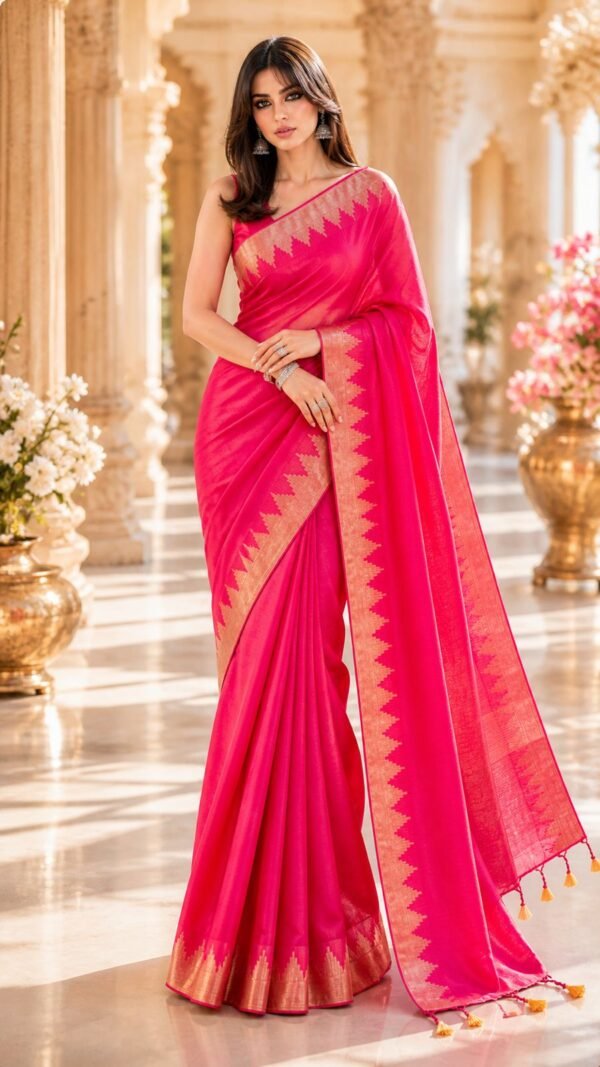
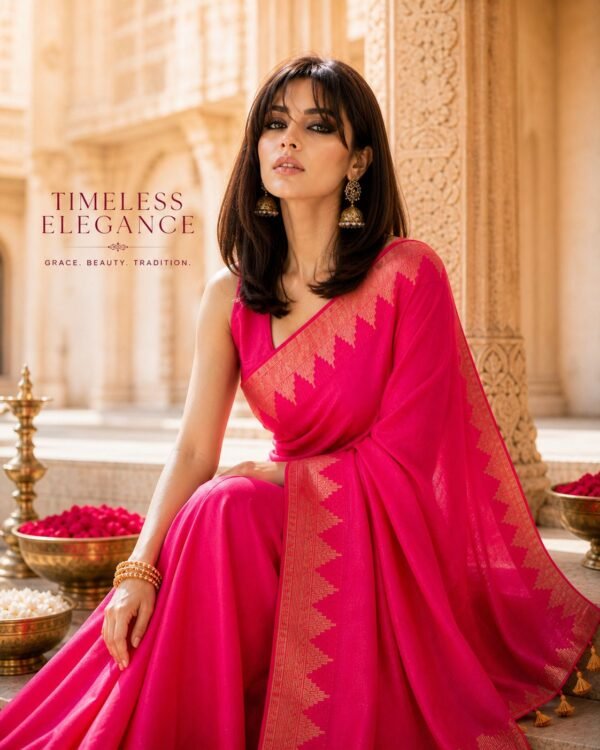
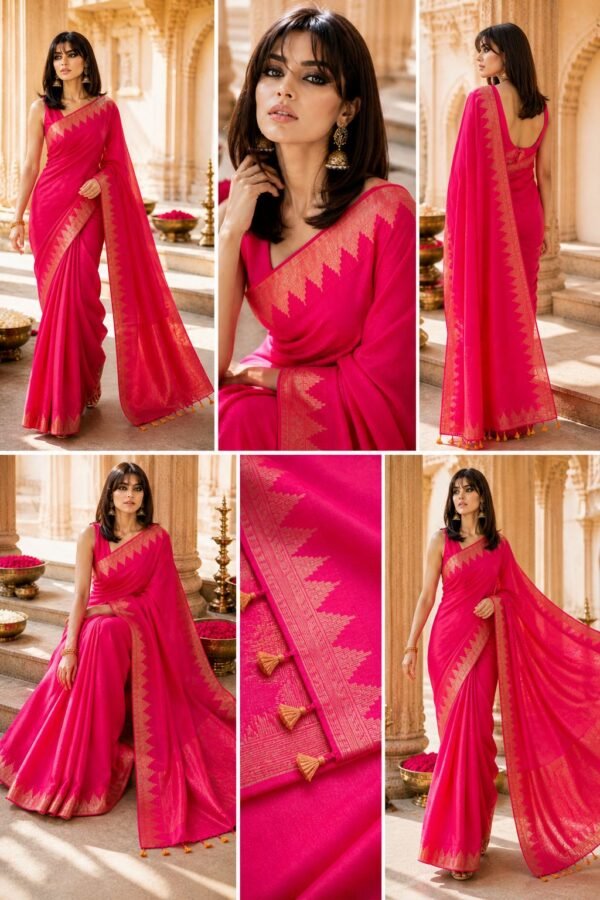


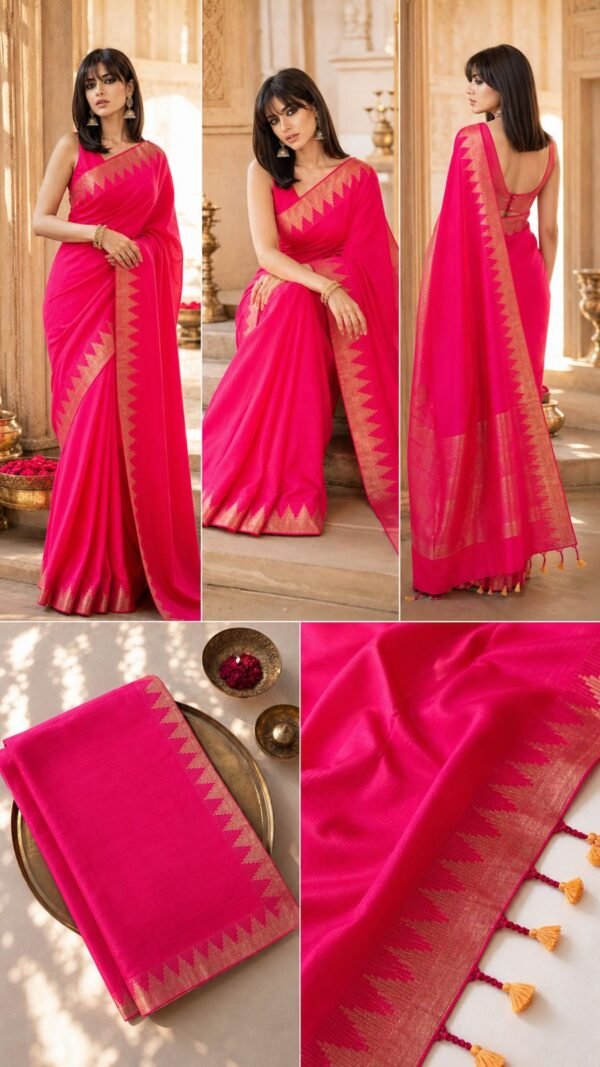
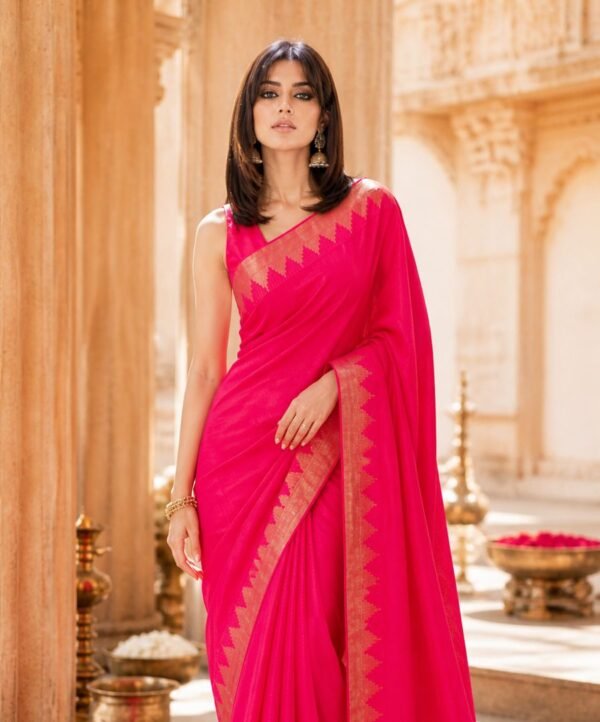
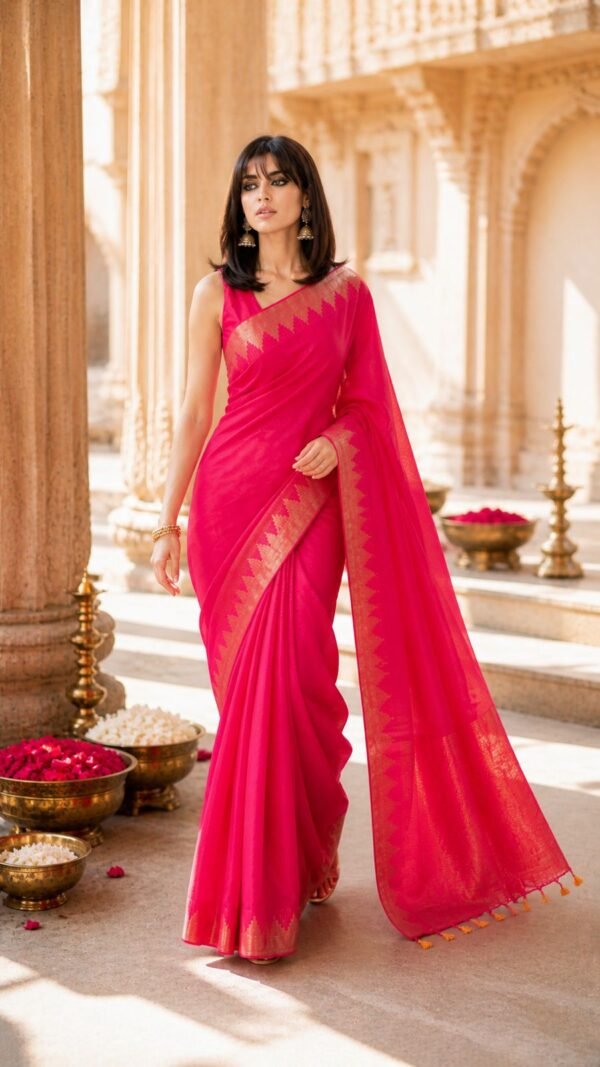











Gulaal Chanderi Cotton Saree in Rani Pink with Gold Temple Border
Sarees₹3,800.00
& Free ShippingGulaal is the pink thrown at festivals.
Pressed into the forehead in blessing.
The pink that means celebration has arrived
and there is nowhere else to be.
The temple border carries the same geometry,
the stonemasons cut into gopurams for a thousand years.
The Chanderi weaver translated that architecture into gold thread,
and built it at the loom, row by row.
The rani pink body asks nothing of you.
The gold temple border has already answered
every question you had.
Chanderi is a small town in Madhya Pradesh that has been weaving fine cotton and silk since the 11th century. Its defining quality is weight — or rather, the absence of it. Chanderi fabric is made to be lighter than it looks. The fine cotton weave carries a natural luminosity, an inherent softness of drape, a fall that heavier cottons cannot replicate. This saree is Chanderi cotton: the tradition’s oldest fabric, in its most contemporary colour.
The body is rani pink — the specific deep magenta that has carried this name in Indian textile culture for as long as there has been a name for it. Rani pink is not a decorator’s pink. It is the pink of gulaal thrown at Holi, the pink of the sindoor box, the pink of the festival that has come and will not be hurried. It is a colour that knows where it is going.
The border is the temple border — the repeating gold zari pattern of flame-tips and rising arrows that the Chanderi tradition has woven at its looms since before the Mughal emperors commissioned their first Chanderi fabric. The same geometry appears carved in stone across the subcontract: temple gopurams, palace doorways, fort arches. The weaver counted the threads for each flame-tip as precisely as the stonemason counted the chisel strokes for each carved one. The border runs the full length of the saree — along the hem, the running border, and forward through the pallu — continuous and exact.
The pallu tassels are bicolour: magenta and gold, the two colours of the saree. They are knotted by hand. A matching blouse piece in rani pink is included, unstitched at 0.8 metres.
Chanderi has been weaving for over six hundred years. The town sits in the Vindhya hills of Madhya Pradesh, and its weavers have made fabric for Rajput courts, Mughal emperors, and every generation of Indian women who has understood what fine cloth means. The Chanderi cotton weave — fine-count cotton in a plain weave that produces its characteristic drape and luminosity — is the foundation on which the town built its reputation.
The temple border on this saree is woven at the loom using gold zari thread. The pattern — repeating flame-tips rising vertically in even sequence — is one of Chanderi’s most ancient border designs, drawn from the same visual vocabulary as the carved stone temple architecture of central India. The weaver sets up the border separately from the body: the zari thread is introduced at the loom in the correct sequence, and the pattern is built one weft pass at a time, the flame-tips accumulating row by row until the border is complete. The precision required to hold the pattern consistent across 5.5 metres of weaving is significant. The border on Gulaal holds.
The tassels at the pallu hem are knotted by hand after the weaving is finished — magenta thread and gold thread together, each tassel weighted and spaced at even intervals. They are the final detail added to the saree by a hand other than the weaver’s. The blouse piece is woven in the same rani pink, the same Chanderi cotton, cut to 0.8 metres and included unstitched.
- Wash: Dry clean recommended for long-term preservation of the Chanderi weave and the gold zari temple border.
- Hand wash: If hand washing: cold water only, mild detergent. Do not soak. The rani pink dye and the zari border both require gentle chemistry and limited water exposure.
- First wash: Wash separately. The deep rani pink may release slight colour on the first wash. Normal for reactive-dyed Chanderi. Will not recur after the first wash.
- Zari border: Do not scrub or wring the border. The gold zari thread is woven in at the loom and is structurally fixed, but rough handling can distort the flame-tip pattern at the border edge.
- Tassels: Wash gently around the tassel knots. Do not pull. Press gently and lay flat to reshape after washing.
- Iron: Low to medium heat on the cotton body, from the reverse side. Avoid ironing directly on the zari border or the tassels — direct heat damages metallic thread.
- Dry: Always in shade. Deep rani pink fades with prolonged sun exposure. The colour in this saree is the point. Protect it.
- Store: Folded in a clean muslin cloth. Keep away from other garments to prevent colour transfer. Humidity tarnishes zari over time — store in a dry, cool place.
| Dimensions | 5.5 cm |
|---|---|
| Saree Length | 5.5 metres |
| Blouse Piece Length | 0.8 metres |
Reviews
There are no reviews yet.