
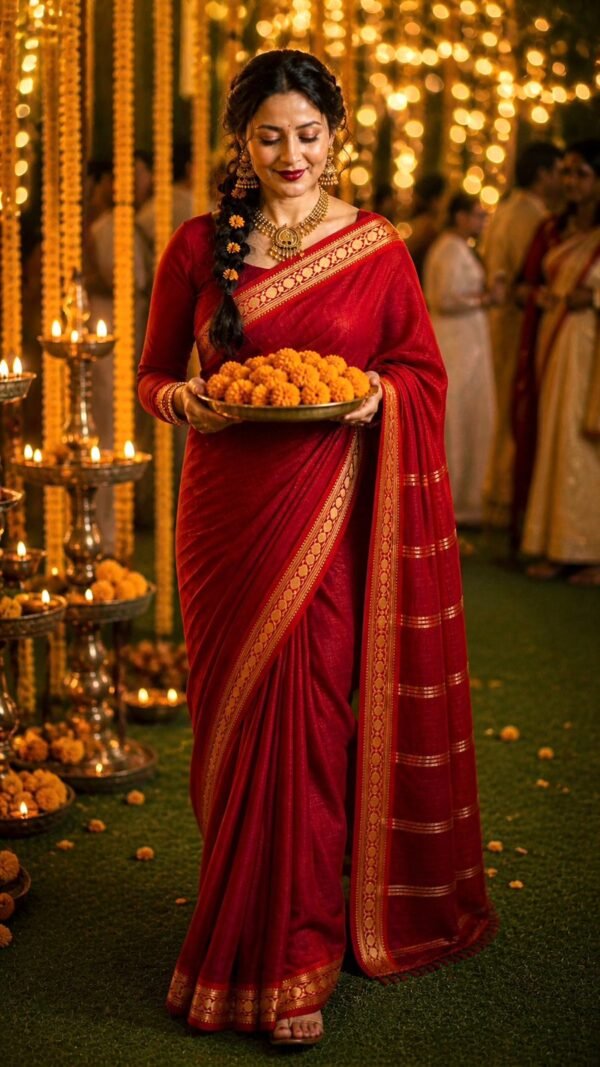
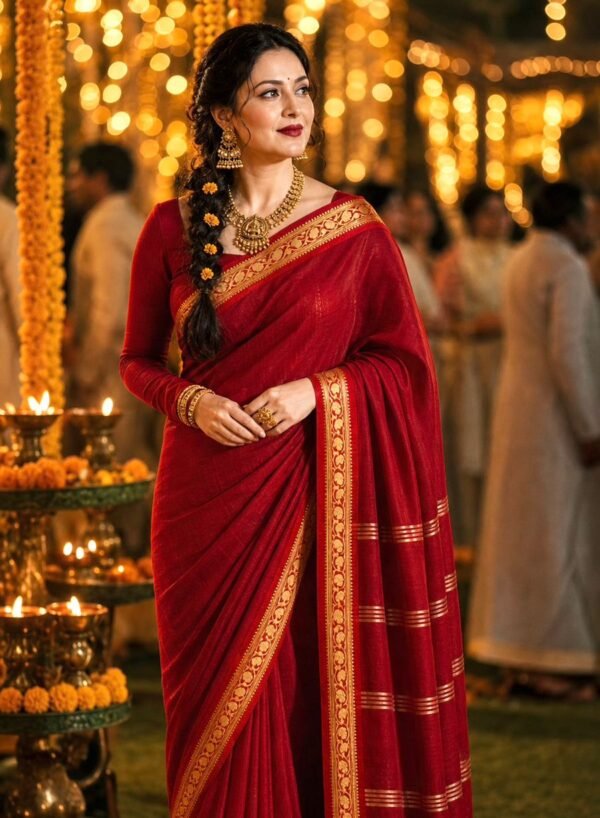
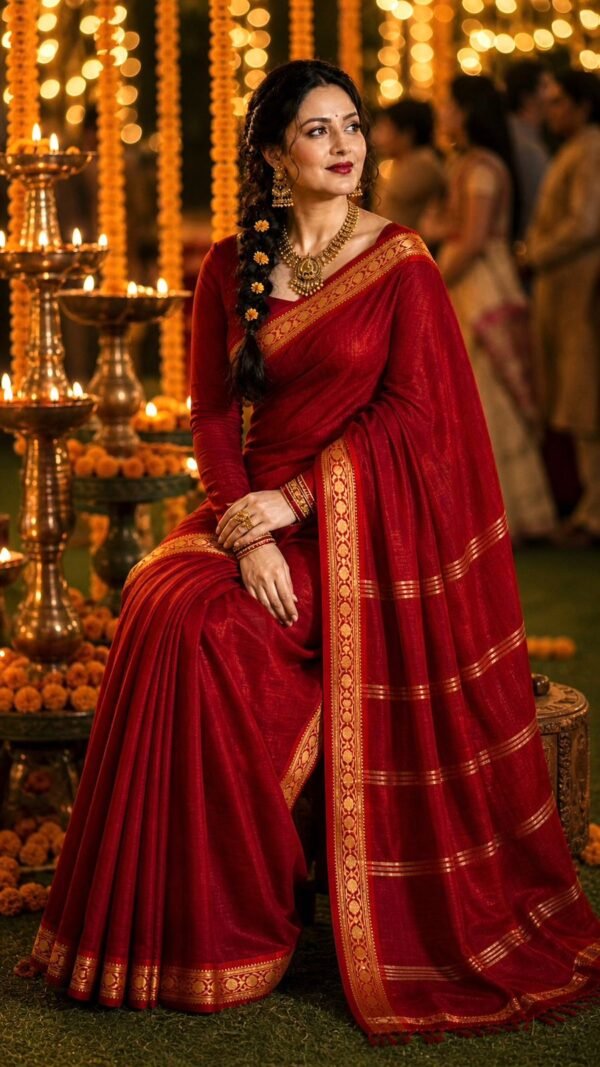
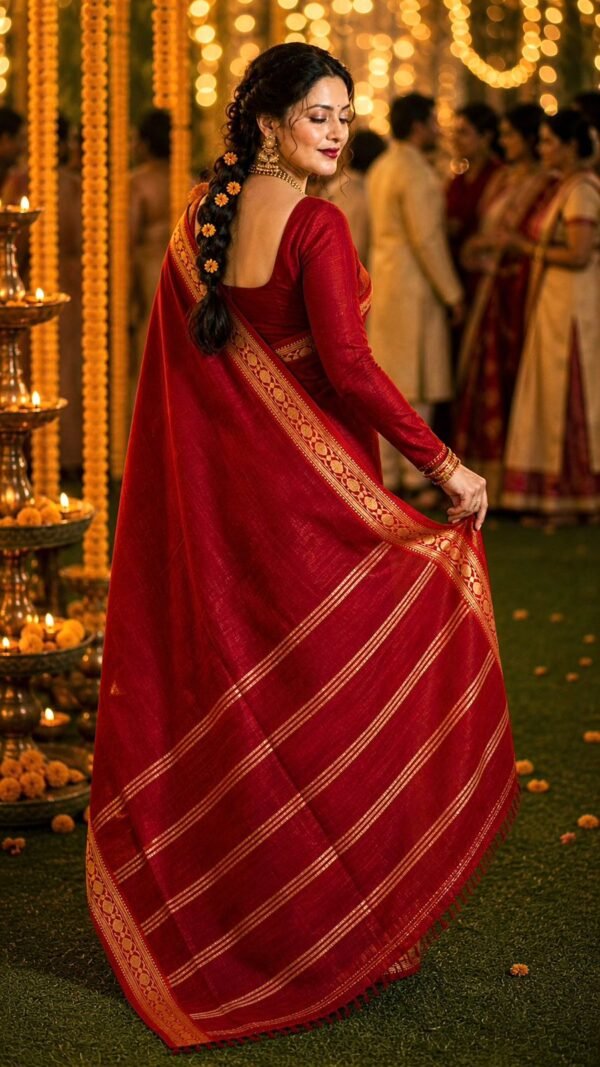
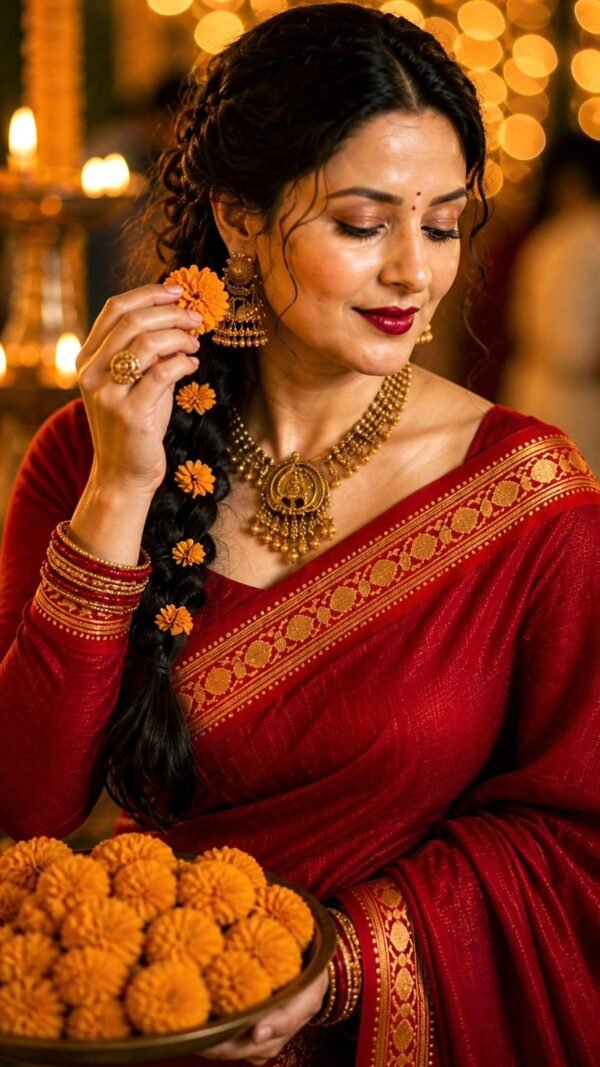
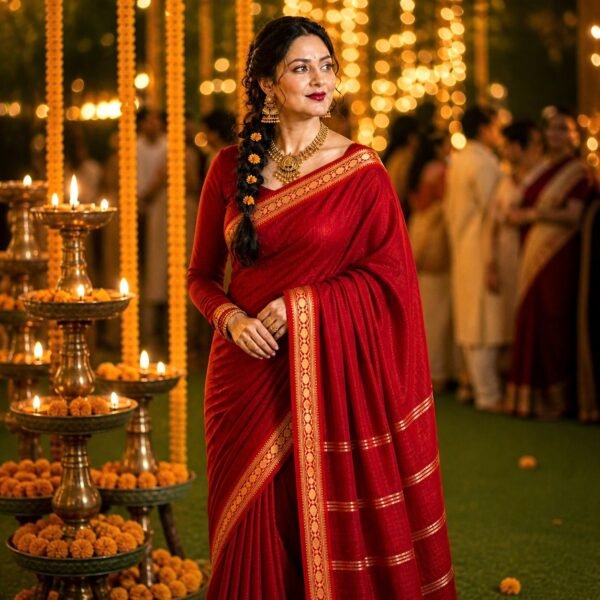







Mercerised Cotton Saree in Deep Crimson with Thread Work Border
Sarees₹2,800.00
& Free ShippingIn Bengal, red is not a colour.
It is a position.
The red of Durga. The red of sindoor.
The red of the border on every Bengali woman’s white sari,
at every ceremony that has ever mattered to her.
The plain body is not emptiness.
It is the silence before the border speaks.
And when the border speaks —
gold silk thread woven in from the very first row,
glowing like a flame, not shining like a mirror —
it says everything the plain body chose not to.
Mercerised cotton is cotton that has been told to hold colour forever — passed through an alkaline bath that opens the fibre and draws the dye inside it, the way bone holds calcium, permanently and completely. This saree carries that crimson from the inside out.The body is plain because the plain body is the design. All the ornament is gathered at the border — gold silk thread woven into the cotton on the handloom, building a floral scroll pattern that does not shine. It glows. Silk thread and metallic zari are different things. One mirrors. One burns. This one burns.The pallu carries the same gold thread forward in horizontal bands — a rhythm that builds quietly to its close, red and gold, the two colours Bengal has used for its most important moments since before anyone was keeping records.
Bengal has been weaving cotton since before Europe had looms. The Dhaka weavers made muslin so fine the Romans called it ‘woven air’. That is the tradition this saree comes from — not as a museum piece, but as a living continuation.
Mercerisation was discovered by John Mercer in 1844 — a process of treating cotton yarn in caustic soda under tension that permanently changes the structure of the fibre. The cotton rounds. It swells. The surface becomes smoother and more reflective. It accepts dye more deeply. It drapes more fluidly. The process does not add anything to cotton. It changes what cotton is.
The crimson in this saree was not applied to the surface. The dye entered the opened fibre and the fibre closed around it. This is why mercerised cotton colours do not fade the way printed colours do. There is nothing on the surface to wear away.
The thread work border is resham — silk thread — woven directly into the fabric at the loom. Not embroidered on after the fact. Not attached. Woven in, from the first row to the last, so that the gold thread is part of the saree’s structure and cannot be separated from it. The weaver of this border was a person who set up the thread count of this specific floral scroll pattern on their loom the way a musician tunes their instrument — before the first note, before the first thread, the whole piece already known.
- Wash: Hand wash in cold water with a mild detergent. Mercerised cotton is robust but gentle washing preserves both the colour depth and the thread work border.
- Do not: Never use bleach or harsh detergents. The deep crimson dye and the silk thread work border both require gentle chemistry.
- First wash: Wash separately — the deep crimson may release slight colour on the first wash. Normal. Will not recur.
- Thread work border: Do not scrub or wring the border. Press gently, rinse gently. The silk thread keeps its lustre with gentle handling.
- Iron: Medium heat on the reverse side. Avoid ironing directly on the thread work — silk thread and direct heat are not friends.
- Dry: Always in shade. This red was drawn into the fibre to last — but direct sun over time will test even the most permanent dye.
- Store: Fold in a clean muslin cloth. Keep away from moisture and humidity, which tarnish thread work over time.
| Dimensions | 5.5 cm |
|---|---|
| Saree Length | 5.5 metres |
| Blouse Piece Length | 0.8 metres |
Reviews
There are no reviews yet.