
Bagiya Kantha Hand-Embroidered Dupatta in Black with Multicolour Floral
Dupattas₹3,800.00
& Free ShippingBagiya means garden.
Not the cultivated garden with its paths and its rules.
The wild one.
The garden that has been growing since before
anyone thought to give it a name.
Every flower on this dupatta was stitched by hand.
Every leaf placed by a woman who had decided
exactly where it was going.
The black ground is not background.
It is night.
And the flowers on it are the ones that bloom in the dark.
- Description
- The Craft Behind This Saree
- Care Instructions
- Description
- Additional information
- Reviews (0)
Kantha is the hand-embroidery tradition of Bengal. The running stitch — the kantha stitch — is the simplest stitch in embroidery: the needle enters the cloth, travels a few threads, surfaces, and enters again. Repeated ten thousand times across a black cotton ground, each stitch placed by hand at the angle the embroiderer chose, building flower by flower, leaf by leaf, bird by bird, the entire garden accumulates from this single repeated motion.
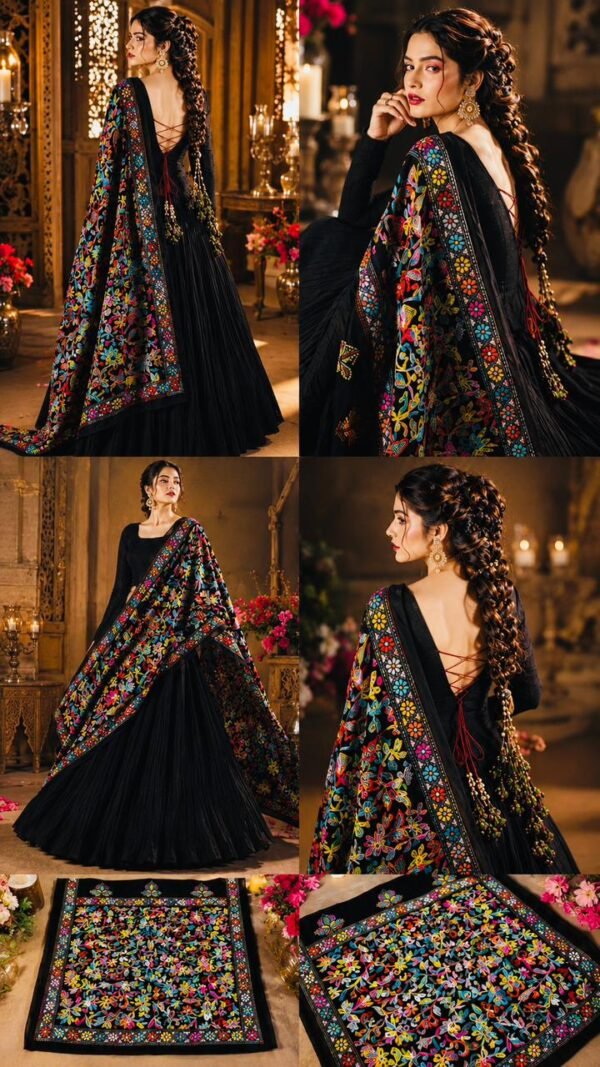
The colour palette is the tradition’s: red, yellow, green, blue, pink, white, orange — every colour the Bengal embroiderer has used since the craft was first recorded. On a white or ivory ground, the Kantha colours read as folk art, warm and accessible. On black, they become something else. The black ground absorbs everything around each colour, making the saturation of each thread visible in isolation. The red is redder. The yellow is more yellow. The blue glows from inside the black the way a lantern glows inside a dark room. Nothing about the colour palette changed. The ground changed everything.
The embroidery covers the full surface of the dupatta — not a border, not a central medallion, not a scattered buti pattern. Full coverage: flowers, butterflies, paisleys, leaves, birds, vines, in a density that leaves no plain black visible from a distance. The motifs are the Kantha vocabulary — the same images the women of Bengal have embroidered on quilts, sarees, and shawls for generations, placed here with complete fluency and complete freedom simultaneously. The embroiderer chose where each element went. The tradition told her what the elements were. The garden that results is both ancient and specific to this one piece.
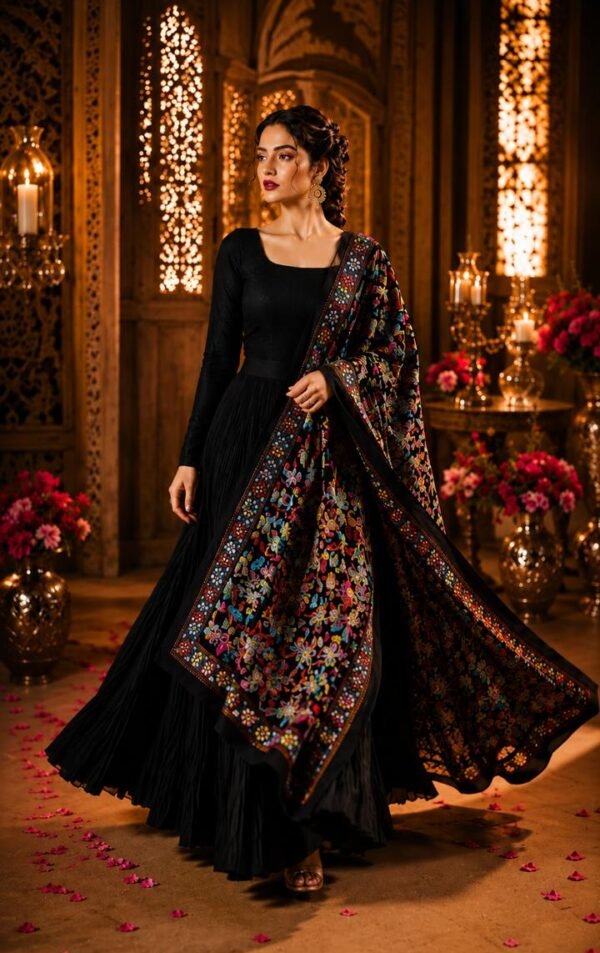
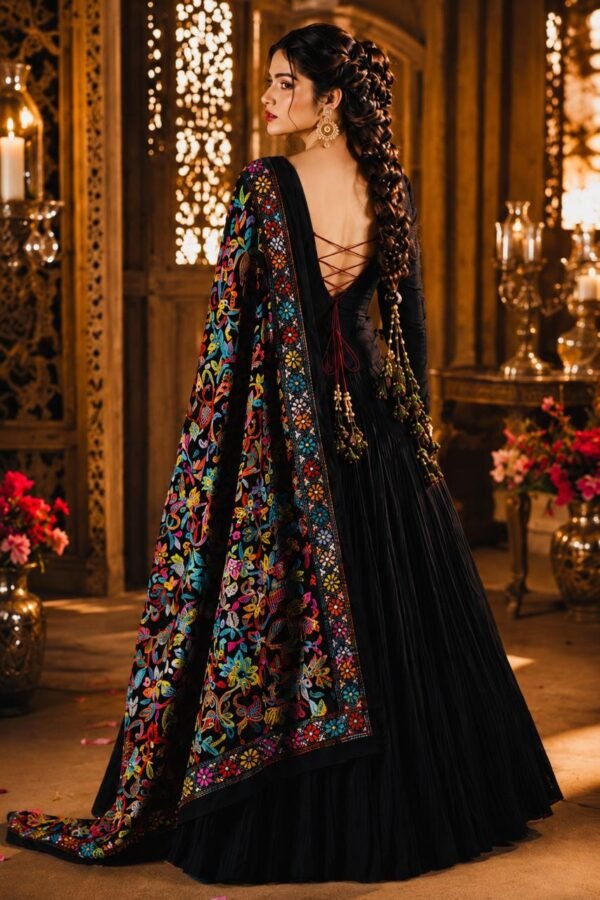
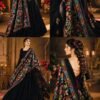
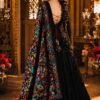
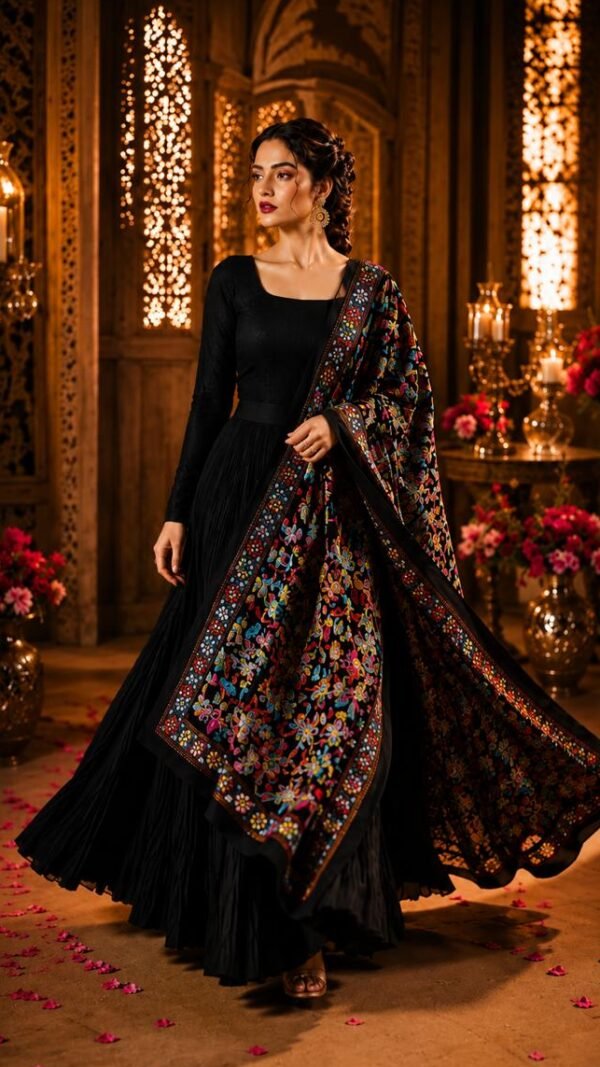
The dupatta is draped over a black full-sleeve saree or suit in the reference images, the embroidered face visible as the outer layer, the black ground reading as depth rather than as absence. In candlelight, the multicolour threads pick up the warmth and the colour palette shifts: the yellow becomes gold, the red becomes deeper, the green darkens. The name is Bagiya: garden, the wild one that has been growing since before anyone thought to give it a name.
Kantha is one of India’s oldest continuous embroidery traditions. The word kantha means patched or mended cloth — the tradition began with Bengali women stitching together layers of worn saris and dhotis to make quilts, using the running stitch to hold the layers together and covering the patched surface with embroidered images. The stitching was the quilting. The embroidery was the structure.
Over centuries the tradition evolved from recycled cloth to purpose-made fabric: fine cotton dupatta, silk shawls, sari pallus embroidered from scratch with the same running stitch that had always held the layers together. The motifs — the lotus, the fish, the sun, the tree of life, the parade of animals, the flowering vine — have remained consistent across the tradition’s history. Each embroiderer works from the same inherited vocabulary. The individual piece is distinguished by placement, density, colour choice, and the specific hand behind it.
The black ground on this dupatta is unusual within the Kantha tradition. Traditional Kantha is worked on white, ivory, or red cotton — the warm colours of the saris that were its original material. Black is a contemporary choice, made by an embroiderer who understood what the dark ground would do to the inherited colour palette. The full-coverage embroidery — motif pressed against motif, no plain black visible from a distance — is the most ambitious Kantha construction: the entire surface must be considered as a composition, the balance of colour and density maintained across the full length and width by eye, by experience, and by the judgment of a hand that has made this kind of piece before. The garden on this dupatta was already complete in the embroiderer’s mind before the first stitch was set.
• Wash: Dry clean strongly recommended. The multicolour Kantha embroidery threads are many different dye lots on a single piece; dry cleaning protects all colours simultaneously.
• Hand wash: If hand washing: cold water only, very mild detergent, absolutely no scrubbing on the embroidered surface. Submerge gently, press water through the fabric by hand, do not rub or wring.
• First wash: Dry clean only for the first wash. The embroidery threads may run if the first wash is not professionally handled. After the first dry clean, careful cold hand washing is acceptable.
• Embroidery: Do not press, scrub, or pull any embroidery thread. The running stitches lie on the surface of the fabric; aggressive handling will pull them loose or distort the tension of the stitch.
• Do not: Wring or machine wash. Machine agitation will tangle and pull the surface embroidery threads. Wringing distorts the cotton ground and loosens the embroidery tension.
• Iron: Iron the plain cotton ground on the reverse side only, on very low heat. Do not iron on the embroidered surface. The embroidery threads are raised from the base fabric; direct heat flattens them and can melt synthetic thread colours.
• Dry: Always flat in shade. Hanging a wet embroidered dupatta puts uneven stress on the stitches at the hanging point.
• Store: Rolled loosely around acid-free tissue, or folded in clean muslin with tissue paper between folds. Never fold along embroidery lines. Store away from light and humidity.
| Dimensions | 5.5 cm |
|---|---|
| Saree Length | 5.5 metres |
| Blouse Piece Length | 0.8 metres |
Related products
-
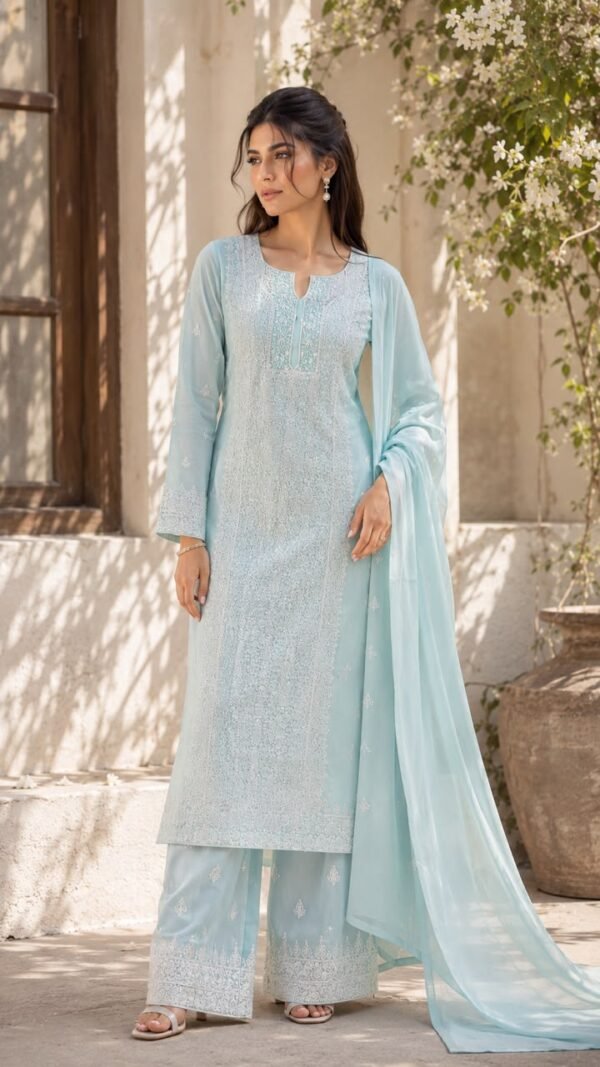
ShabnamChikankari and Kashmiri Kadai Embroidered Suit in Ice Blue
Suits & Kurtas ₹6,800.00 Add to cart
Reviews
There are no reviews yet.