

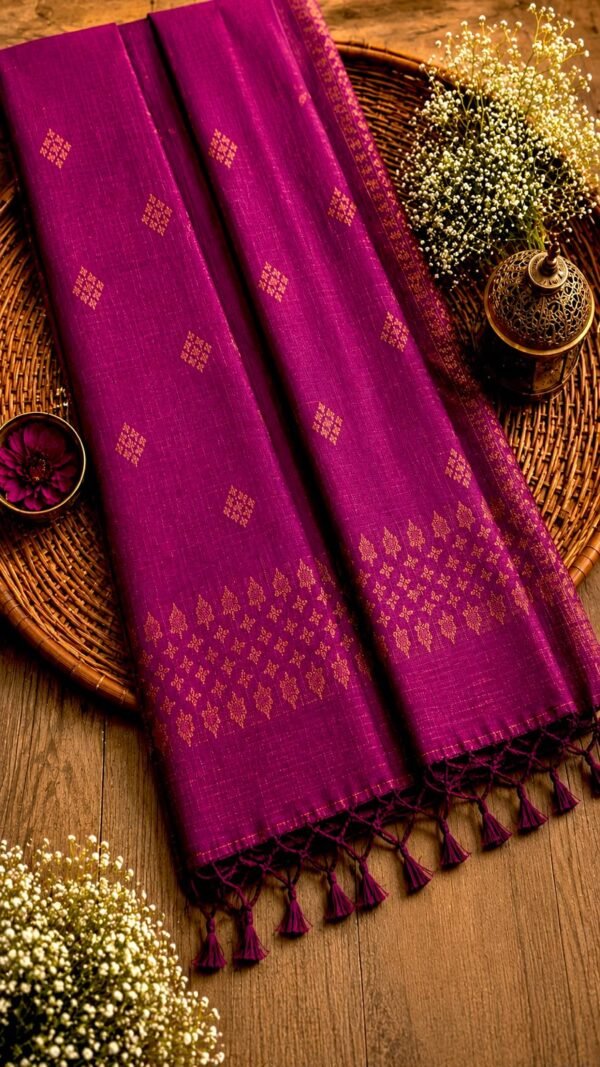




Madhuri Linen Cotton Saree in Wine Purple with Gold Zari Buti and Border
Sarees₹3,200.00
& Free ShippingMadhuri means sweetness.
The sweetness the Sanskrit poets found
in the quality of a thing that does not try.
Wine. Gold. Linen.
Three materials that already know what they are. The buti are gold on wine.
In daylight they are quiet.
In candlelight they come forward,
each one deciding for itself
how much light to hold.
The border does not announce itself.
It arrives at the hem the way all good things arrive —
you notice it after you have already felt it.
Linen cotton is a blend that takes the qualities of two fibres and finds a third thing neither has alone. Linen brings texture: the slight natural matte surface, the visible weave structure, the subtle irregularity of the linen fibre that gives the fabric visual depth without gloss. Cotton brings drape: the softness, the weight that falls cleanly, the breathability. Together they produce a fabric that has the visual weight of a serious textile and the comfort of cotton.
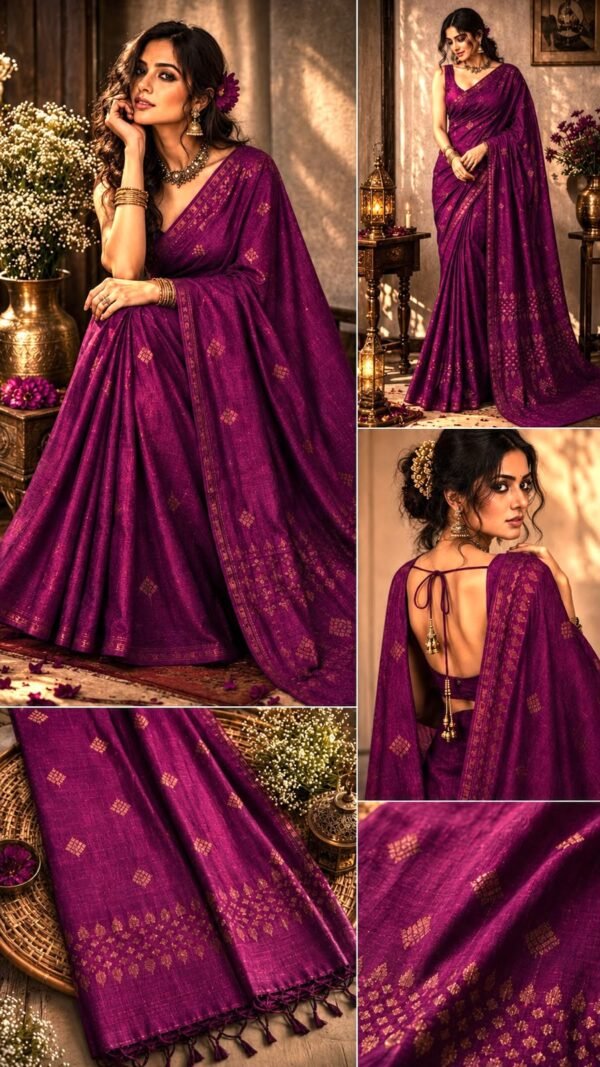
This wine-purple is the colour of the grape at its deepest — not the bright red of the young vintage, but the concentrated depth of something that has had time to become what it is. On a matte linen cotton surface, this colour absorbs light rather than reflecting it. The fabric does not shine. It deepens. In the reference images, the candlelight and lanterns of the warm interior fall across the wine body and each change of angle produces a slightly different reading of the same colour. The depth is always there. The light finds different parts of it.
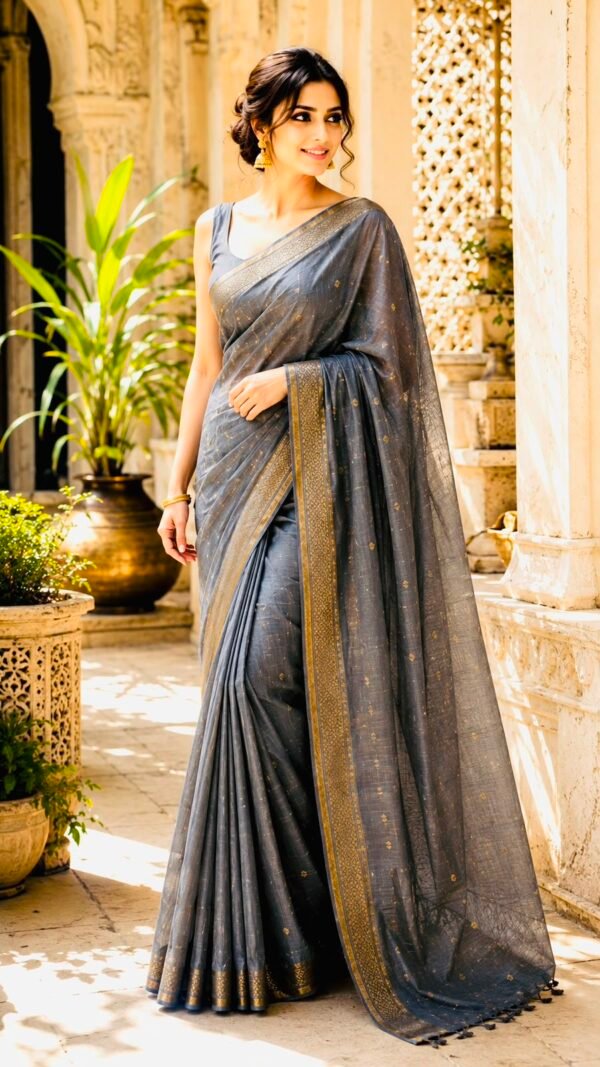
The gold zari buti are supplementary weft motifs: each small geometric diamond-form was built individually into the warp and weft as the fabric was woven, the gold thread introduced at the specific position for each buti, the motif built row by row, then the thread withdrawn. The buti are scattered across the full body — not in a grid, not in a formal repeat, but in a distribution the weaver calibrated by eye across 5.5 metres. On the matte wine ground, the gold does not mirror. It holds. In candlelight it comes forward; in daylight it recedes. The buti are different at every hour.
The woven zari border runs at the hem and the running border, a dense geometric pattern in gold on the wine ground, the border building from the running hem stripe to the full pallu sequence. The pallu carries the border’s full density: close enough together that the pallu end reads as gold-weighted, the wine receding behind the accumulated buti and border work. The blouse piece is matching wine, the same linen cotton, with the open back tie detailing visible in the reference images. The name is Madhuri: sweetness, the quality that does not try.
Linen cotton weaving in Bengal draws on the handloom tradition’s deep familiarity with mixed-fibre constructions. The warp is set with the linen-cotton blend thread in the colour-dyed form; the weaver works from this yarn in the same pit loom construction used for plain cotton, but the linen component changes the hand of the finished fabric. Linen thread has a higher tensile strength than cotton and a lower elasticity: the finished cloth holds its weave structure with more authority, drapes with more body, and develops a soft surface texture as the natural flax fibre in the linen settles into the weave.
The supplementary weft buti require the weaver to interrupt the body weave at each buti position: the gold zari thread is introduced across the weft for the specific width of the motif, the motif built vertically by successive weft passes, then the gold thread is drawn to the back of the fabric and the body weave resumes. Each buti is an individual construction event. For the full body of Madhuri, the weaver built dozens of individual buti, maintaining the distribution calibration across the full length by eye. The matte linen cotton ground means the gold thread sits in relief against a non-reflective surface — the buti read as placed objects rather than as shimmer.
The woven zari border at the hem is a separate element: a dense geometric woven band in gold on the wine ground, built at the border section of the loom using supplementary weft zari in a tight repeat pattern. The border density increases through the pallu: the running hem carries a moderate band, the pallu carries the full sequence. The wine tassels at the pallu hem are hand-knotted after weaving is complete. The blouse piece is cut from the same linen cotton in the matching wine, the linen component giving the blouse the same body and texture as the saree.
• Wash: Dry clean recommended, particularly for the first wash. The gold zari buti and border both benefit from professional care on first wash.
• Hand wash: If hand washing: cold water, mild detergent, no soaking. Linen cotton is robust but the zari buti are supplementary weft — do not scrub the body. Gentle pressure and rinse.
• First wash: Dry clean only for the first wash. The deep wine colour in linen cotton can run slightly on the first wash. After the first professional clean, cold hand washing is acceptable.
• Linen note: Linen cotton is slightly stiffer when new and softens with each wash. The drape improves over time. This is the correct behaviour of the fabric.
• Zari buti: Do not scrub or rub the buti area. The gold supplementary weft threads sit proud of the linen cotton surface; aggressive handling pulls them loose.
• Iron: Medium heat on the reverse side. Linen cotton benefits from ironing while slightly damp for best results — the linen component responds particularly well. Do not iron on the buti or border directly.
• Dry: In shade. The deep wine colour is vulnerable to sustained UV exposure. The linen component also weakens over time under direct sun.
• Store: Folded in clean muslin. Linen cotton does not crease as permanently as plain linen; store with tissue paper between folds for best results. Keep away from humidity.

Reviews
There are no reviews yet.