
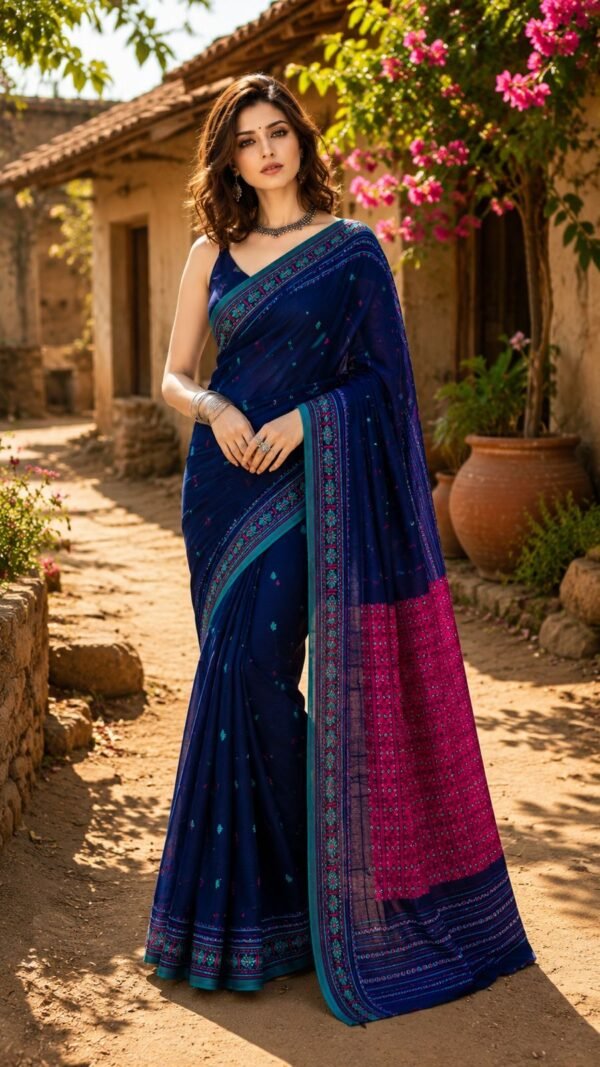
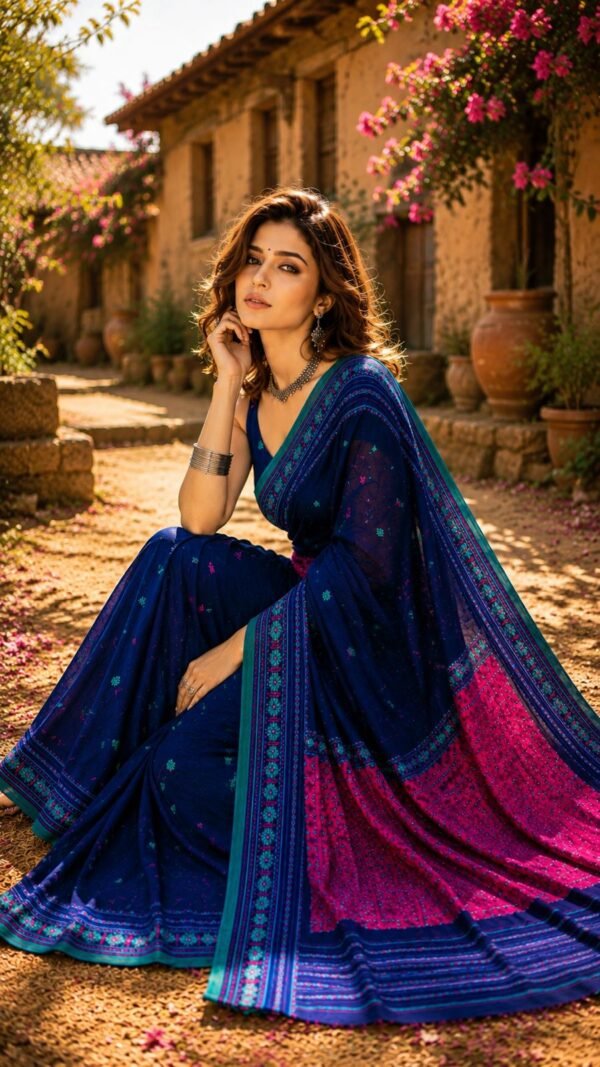
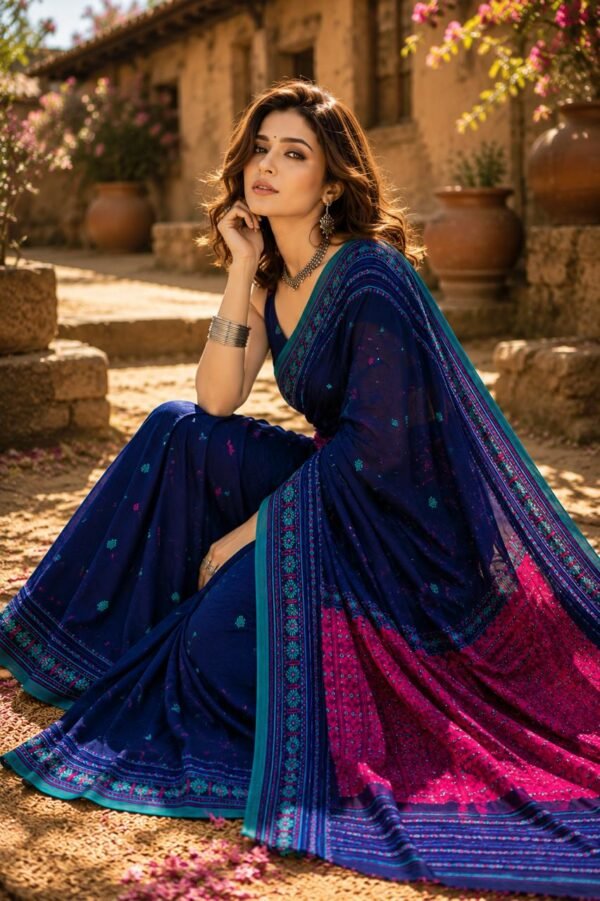
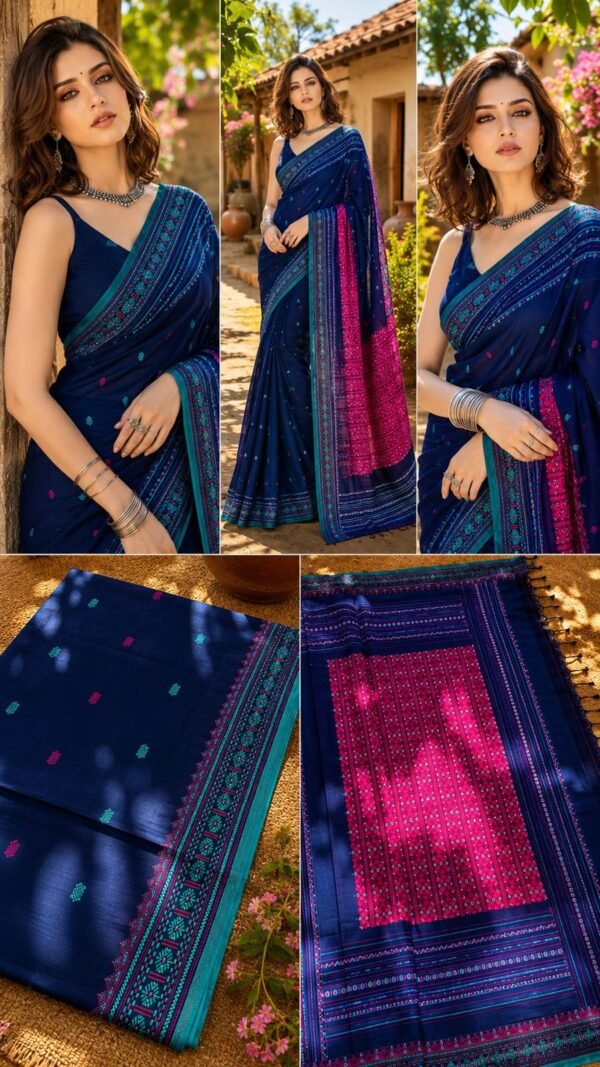
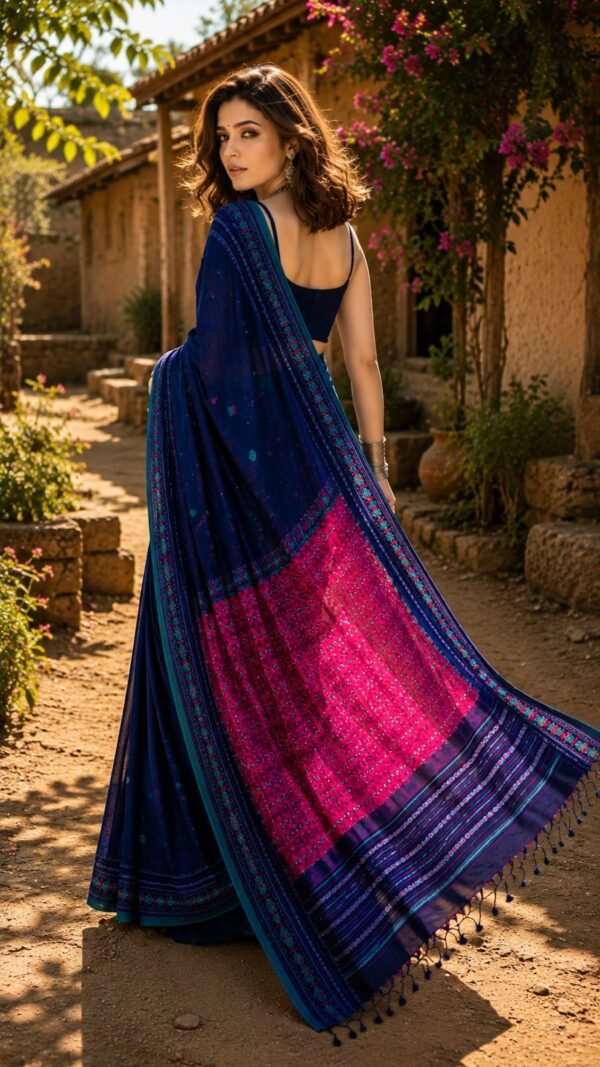
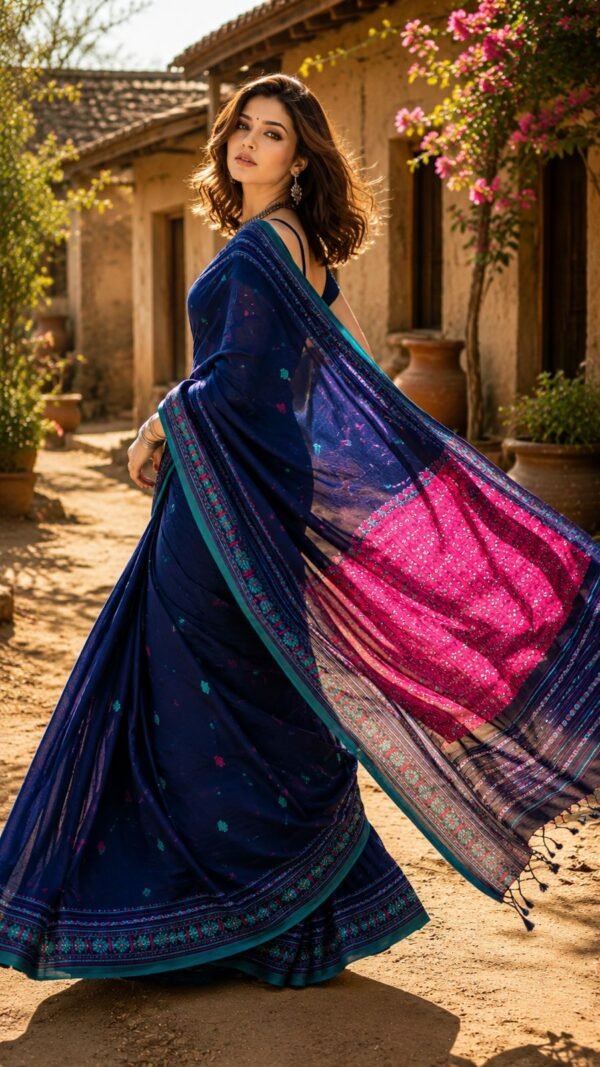
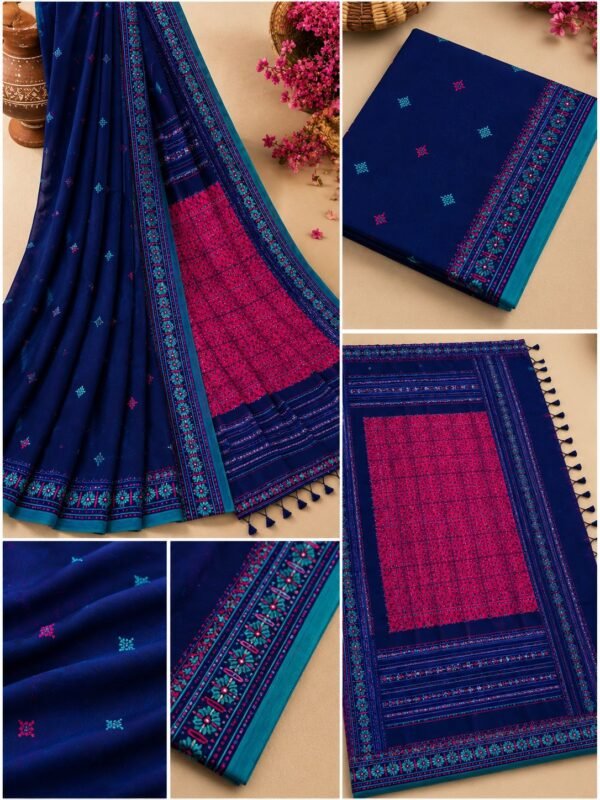
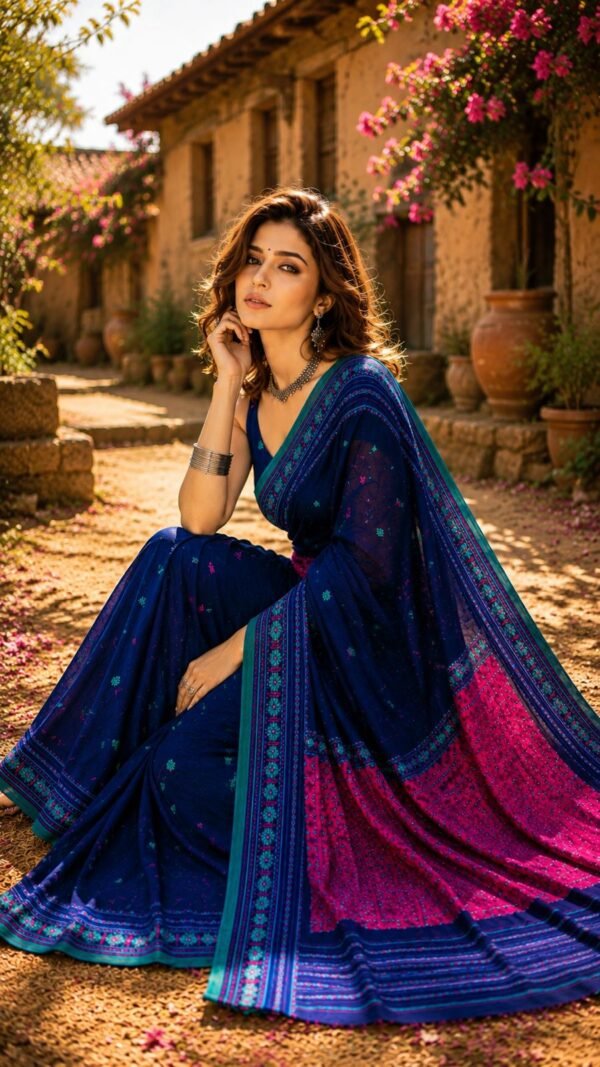


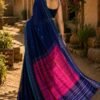
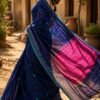
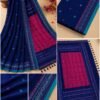

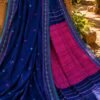
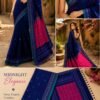
NishagandhaBengal Handloom Cotton Saree in Midnight Navy with Multicolour Buti and Magenta Pallu
Sarees₹2,500.00
& Free ShippingThe nishagandha blooms after dark.
During the day it holds itself closed, unremarkable.
At night it opens completely
and the fragrance is everything.
This blue is the night that made that possible.The buti are scattered across the body the way stars scatter —
each one placed separately,
the whole pattern only visible from a distance.
Then the pallu.
Magenta. Unannounced. Absolute.
The flower, finally open.
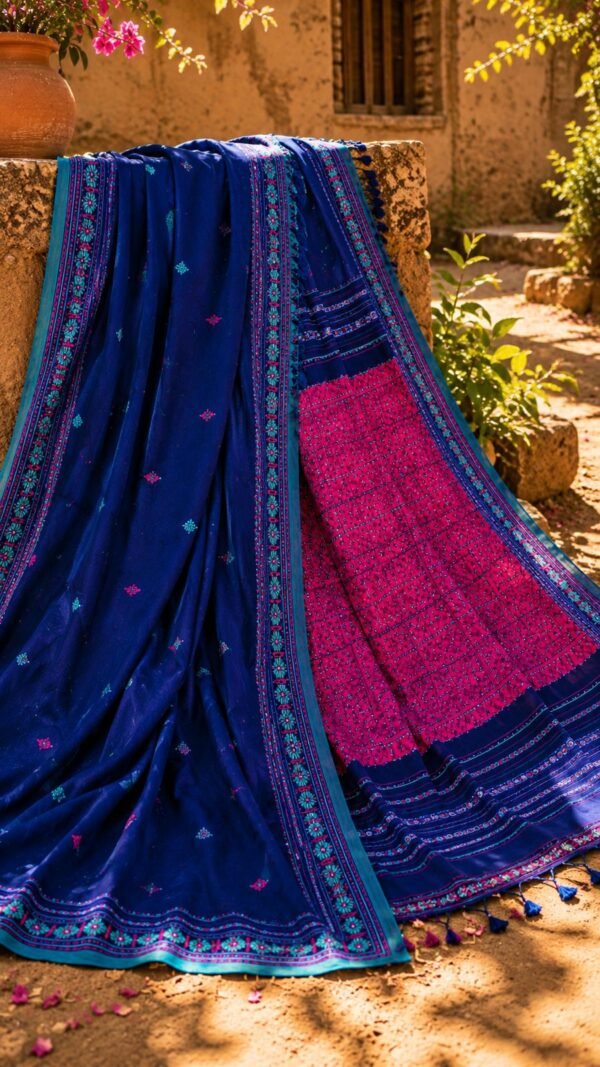
Midnight navy is the deepest functional blue in the Indian handloom palette. Darker than Prussian, deeper than indigo at its most saturated, it is the blue that the eye adjusts to rather than takes in immediately — the blue that requires a moment, and then holds. Bengal handloom cotton carries this particular blue with a matte weight that silk cannot replicate. The colour sits in the fabric rather than on it.
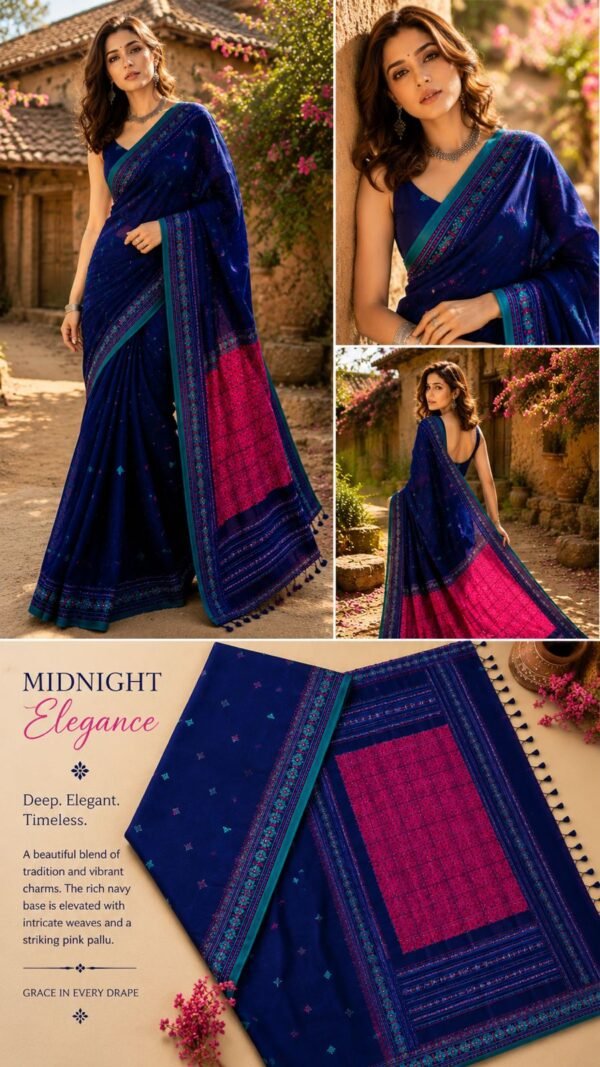
Across the navy body, the weaver has placed multicolour buti — small supplementary weft motifs in pink, teal, and violet, each one built individually into the warp and weft as the weaving progressed. They catch the light the way stars catch it: not steadily, not uniformly, but at the angle the light arrives from. Walk past this saree in a room and the buti change. They are one thing in direct sun, another in shade, a third under artificial light. All three are correct.
The border is teal — a peacock-green that sits exactly between the navy body and the magenta pallu on the colour wheel, and does the work of making the transition possible. It runs as a stripe at the hem and as a framing band into the pallu, carrying a woven geometric pattern in the same multi-colour register as the buti. The border is not decoration. It is architecture.
The pallu is magenta. Not a transition, not a gradation — a full stop. The navy body ends. The magenta begins. The teal border is the only sentence between them. On the body, the buti bloomed small and scattered. On the pallu, the entire ground changes colour and the woven geometric grid covers the full surface. The navy tassels at the pallu hem hang like the last line of a poem that ends before you expect it to. The name is Nishagandha. The night-blooming tuberose. The flower that holds everything until the dark is deep enough.
Bengal’s handloom cotton tradition has a specific category for sarees with contrasting pallus: the ‘contrast pallu’ or ‘paar’ saree, where the pallu is woven in a different colour and often a different weave structure from the body. This is not a shortcut or a compromise — it is a deliberate compositional decision with its own logic. The body is one conversation. The pallu is another. The border is the doorway between them.
For Nishagandha, the weaver set up the loom with midnight navy as the primary body colour and introduced the supplementary weft buti — multicolour motifs in pink, teal, and violet — individually across the body weaving, building each small motif by hand as the fabric progressed. The buti placement is not random, though it reads that way; the weaver maintains a distribution count across the width and length of the fabric to ensure the scatter stays even. Too many buti in one area and the body feels cluttered. Too few and it reads as plain. The calibration is invisible when it is working correctly. On this saree it is working correctly.
The pallu section shifts: the teal border band frames the transition, the navy weft is replaced by magenta, and the supplementary weft work changes from scattered buti to a full-coverage geometric grid that fills the entire pallu surface. The magenta geometric pallu is a completely different weave register from the navy buti body. The weaver made both, on the same loom, in the same session. The navy tassels at the hem are attached by hand after weaving, each one knotted and weighted individually.
- Wash: Hand wash in cold water with a mild, colour-safe detergent. The navy, teal, and magenta are three distinct dye lots in one fabric — gentle washing protects all three.
- First wash: Wash separately. The deep navy may release slight colour on the first wash. Normal for this depth. Will not recur. The magenta pallu may also run slightly on the first wash — wash separately from all other garments.
- Buti care: Wash gently around the buti area. The supplementary weft threads sit proud of the base weave; do not scrub.
- Tassels: Handle gently around the navy tassel knots. Do not pull or wring. Press and reshape gently, lay flat to dry.
- Do not: Machine wash or use bleach. Three dye colours and supplementary weft work both require gentle chemistry.
- Iron: Medium heat on the navy cotton body and magenta pallu. Iron from the reverse side. Avoid direct ironing on the buti and the geometric pallu weave — the supplementary thread sits raised and direct heat flattens it permanently.
- Dry: Always in shade. Midnight navy and deep magenta are both vulnerable to long-term sun fading. The depth of both colours is worth protecting.
- Store: Folded in clean muslin. Keep away from other garments to prevent colour transfer, particularly from the magenta pallu section.
Reviews
There are no reviews yet.