





Katha Cotton Saree in Midnight Navy with Kalamkari Folk Print Pallu
Sarees₹3,400.00
& Free ShippingKatha means story.
It means the narrative that was already happening
before you arrived,
that will continue after you leave,
that has been told so many times
the telling itself has become the tradition. The midnight navy body is the sky
before the story begins.
The Kalamkari border is the story itself:
elephants carrying their riders,
peacocks with their tails extended,
the folk figures who have been in this picture
since the 10th century.
The woman wearing this saree
is not watching the story.
She is wearing it.
Kalamkari is the art of the pen on cloth: the word means ‘pen work’ in Persian, and the tradition involves drawing, painting, or printing directly onto cotton using a pen-like instrument called a kalam. In the Srikalahasti tradition, a trained artist draws the full design freehand onto the cotton with the kalam, then fills the forms with natural dyes through multiple stages of resist and dye application. In the Machilipatnam tradition, carved wooden blocks produce the same motif vocabulary more rapidly. Both traditions produce the characteristic earthy colour palette of Kalamkari: rust, ochre, white, black, and indigo on the cotton ground.
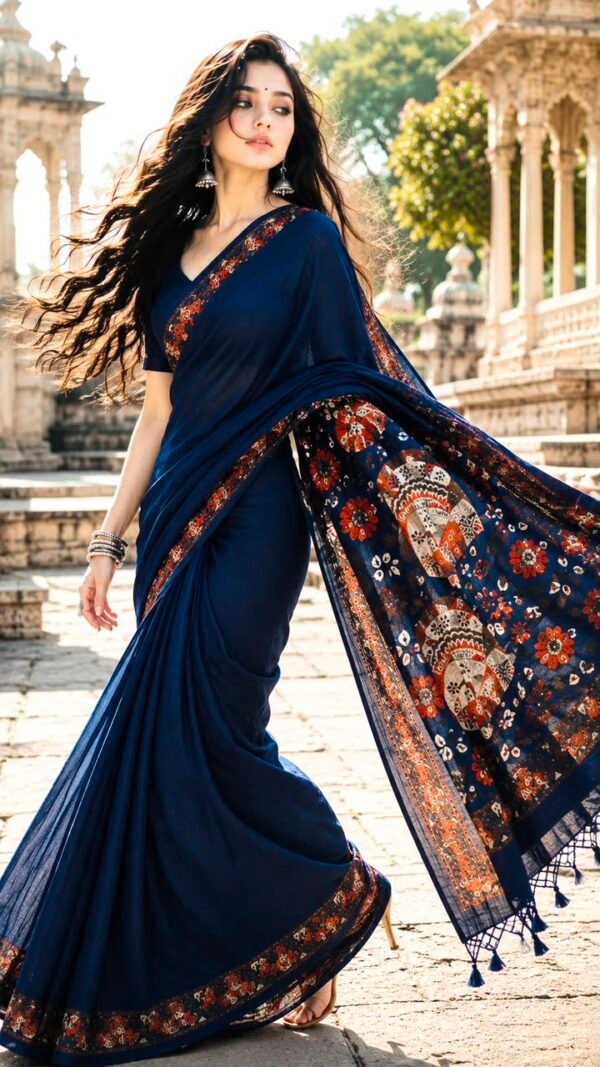
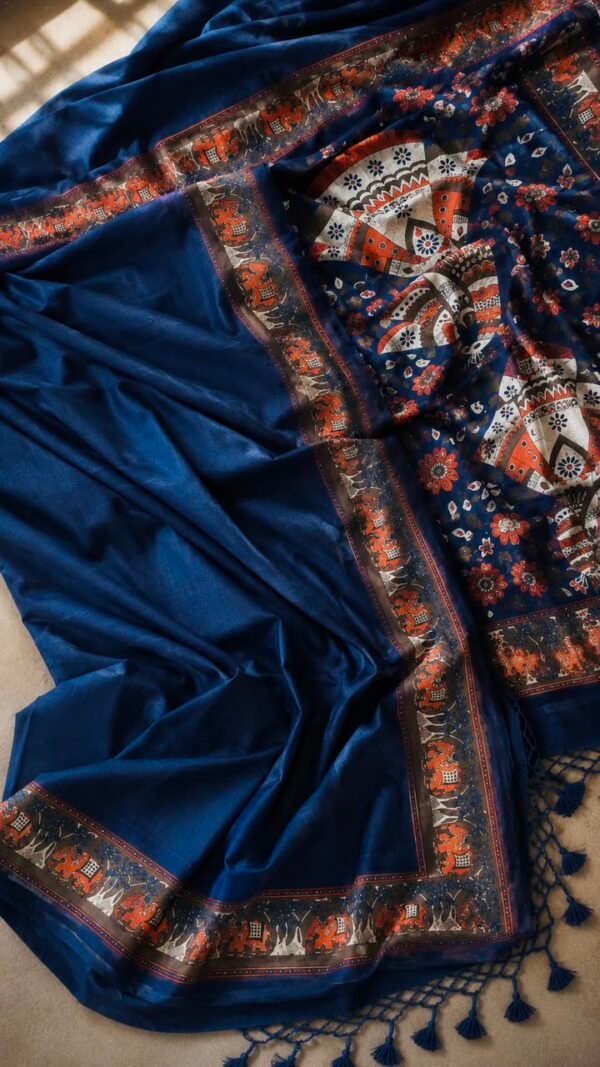
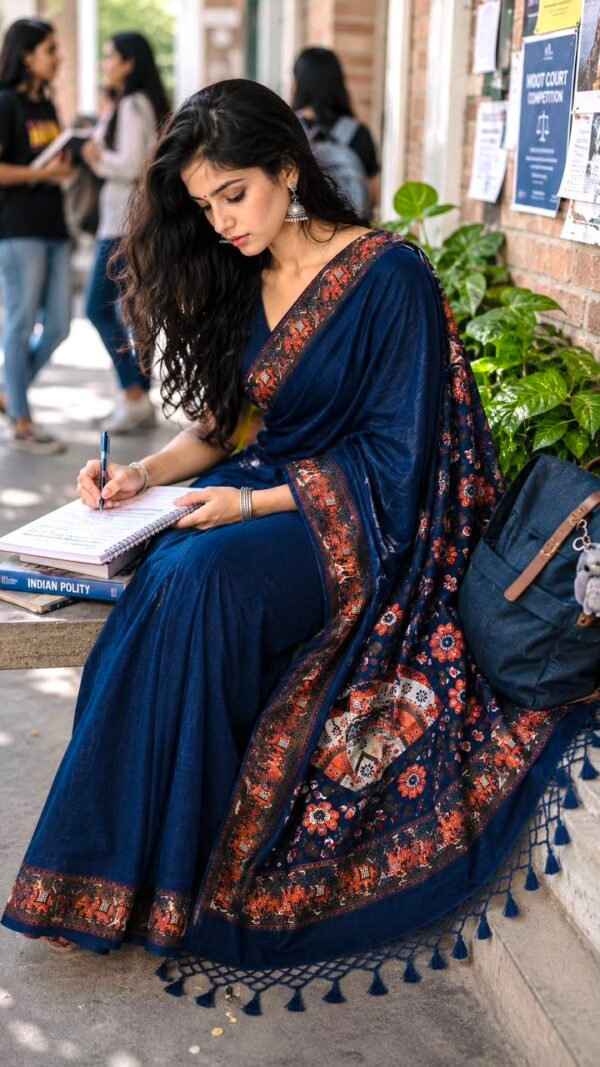
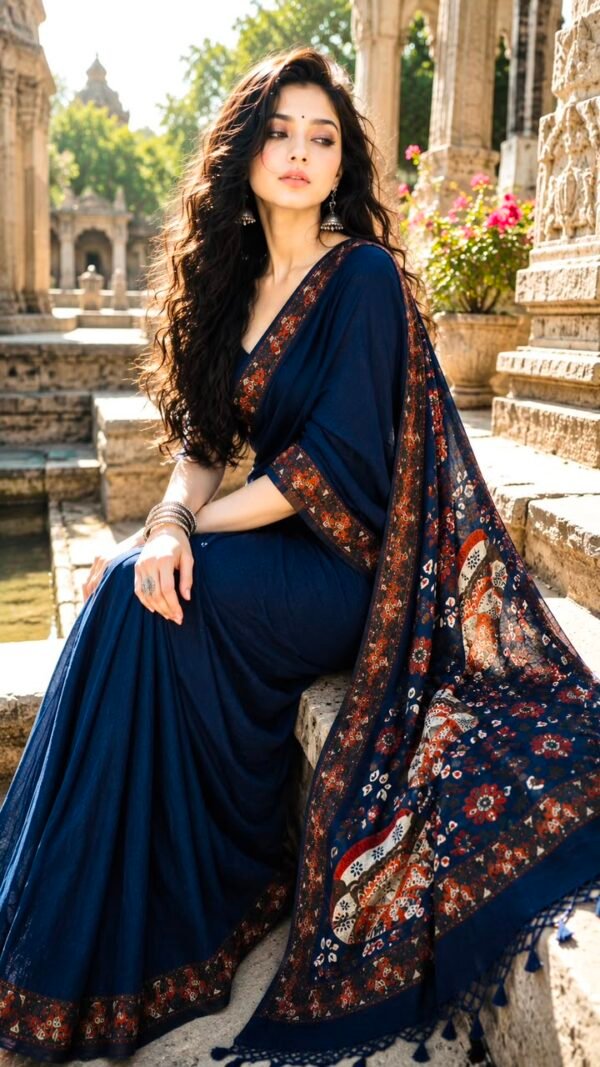
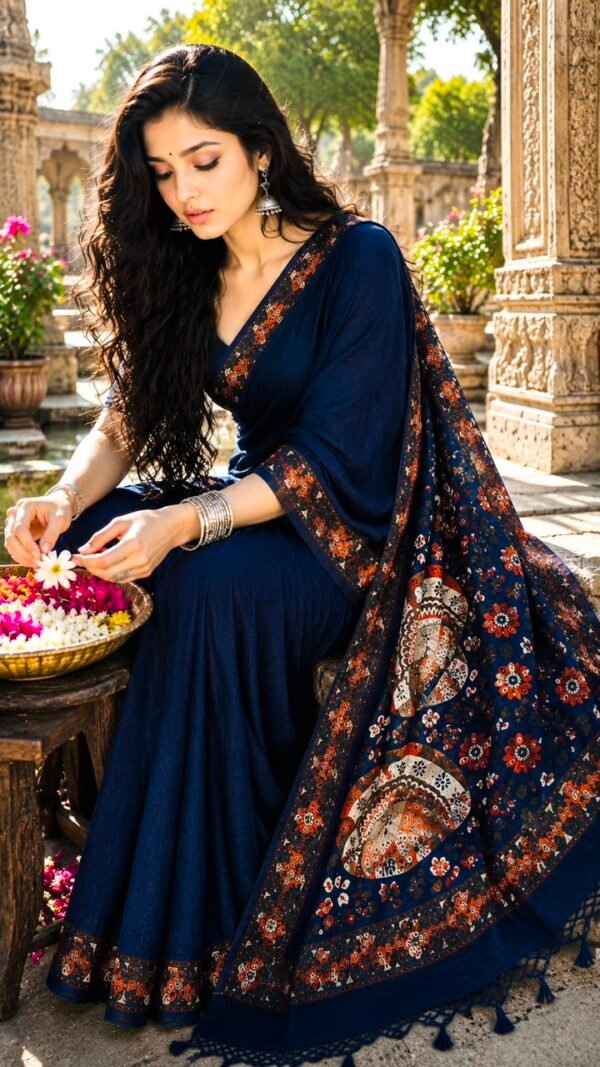
The midnight navy body of this saree is plain cotton at its deepest: not mercerised, not printed, just the navy dyed into the cotton body and the weave visible as a faint texture in the fabric. On this navy ground, the Kalamkari border carries the full visual weight of the saree. The print vocabulary is the Kalamkari folk register: elephants with their riders and decorated headpieces, peacocks with their tails in full display, stylised folk figures in the traditional postures of Andhra narrative art, and floral medallions that appear in Kalamkari designs as far back as the tradition has been recorded. The colours are the Kalamkari palette in the folk tradition: rust-red, ochre-orange, cream-white, and deep indigo, applied on the navy cotton ground with the characteristic dense coverage that makes the border read as a tapestry rather than a print.
The running border carries the same motif vocabulary in a compressed band along the full saree hem: the folk elements in smaller scale, the colours at the same density. At the pallu, the print expands to full coverage: the motifs filling the complete pallu surface, the elephants and peacocks and folk figures occupying every inch of the navy ground. The pallu is the full katha — the complete story, told at maximum density. The navy tassels at the pallu hem are the border’s final punctuation.
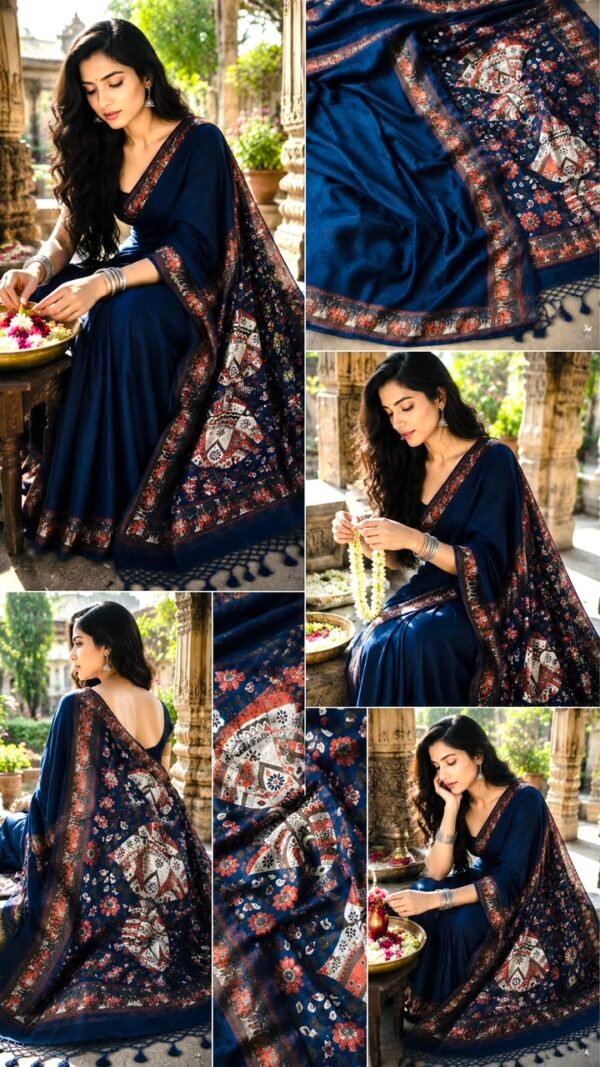
In the reference images, the woman is stringing a jasmine garland in a Rajasthani temple colonnade. The hands focused on the garland, the Kalamkari pallu falling behind her, the carved stone columns on either side. The setting is the most contemplative in the collection. The name is Katha: story, the narrative that has been told so many times the telling itself has become the tradition.
Kalamkari has been practised in Andhra Pradesh since at least the 10th century CE, and the tradition’s roots in the region are considerably older. The Srikalahasti school, in the town of the same name near Tirupati, produces hand-drawn Kalamkari: the artist draws directly onto the prepared cotton with the kalam, building the composition freehand, figure by figure, from the artist’s complete knowledge of the motif vocabulary. The Machilipatnam school, in the coastal town of the same name, produces block-printed Kalamkari using carved wooden blocks to stamp the same folk vocabulary onto the cotton in the same earthy dye palette.
The motif vocabulary is the property of the tradition. The elephant, the peacock, the tree of life, the folk figure, the floral medallion — these have appeared in Kalamkari work continuously since the tradition began. Each artist working in the tradition knows the same vocabulary and produces their own version of the same characters. A Kalamkari elephant has a specific posture, a specific level of decoration, a specific relationship to the border frame that contains it. These conventions are learned through apprenticeship and transmitted without formal documentation. They survive because the tradition survives.
The navy cotton base of this saree is an unusual choice for the Kalamkari tradition, which has historically used white, ivory, or cream cotton as the ground. The navy ground makes the rust, ochre, and cream of the Kalamkari palette appear differently from how they read on white: the rust deepens toward terracotta, the cream approaches warm white, the ochre is more golden. The Kalamkari artist who designed this border understood how the navy ground would shift each colour and calibrated the palette accordingly. The navy tassels are cut from the saree’s own cotton, knotted after the printing is complete.
- Wash: Dry clean recommended for long-term preservation of the Kalamkari print colours, particularly the rust and ochre tones on the navy ground.
- Hand wash: If hand washing: cold water, mild detergent, no soaking. The multiple dye colours in the Kalamkari print require gentle chemistry.
- First wash: Dry clean only for the first wash. The rust and ochre Kalamkari colours may release on the first water wash. After the first professional clean, careful cold hand washing is acceptable.
- Print: Do not scrub the printed border or pallu. Kalamkari dyes are applied to the cotton surface and the mechanical abrasion of scrubbing degrades both the colour and the print definition.
- Navy body: The midnight navy cotton body is stable but will run slightly on first wash if hand-washed without dry cleaning first.
- Tassels: Handle the navy tassels gently. Press gently and lay flat to dry.
- Do not: Machine wash or bleach.
- Iron: Low heat on the reverse side. Avoid ironing on the Kalamkari print surface directly.
- Dry: In shade. Both the navy body and the Kalamkari print colours are UV-sensitive over extended exposure.
- Store: Folded in clean dark muslin. Tissue paper between the folds that cross the print zones.

Reviews
There are no reviews yet.