



SaumyaCotton Block Print Suit Set with Kota Doria Dupatta
Suits & Kurtas₹3,600.00
& Free ShippingThe kurta carries one garden.
The palazzo carries another.
The block printer chose two different prints,
two different grounds,
and placed them together with the certainty
that both gardens have always known each other.
The Kota Doria dupatta is the morning light
that falls across both.
Fine enough to be transparent.
Present enough to change everything it falls on.This is a suit for a woman at a desk.
Or a woman at a window.
Or a woman who is both,
depending on the hour.
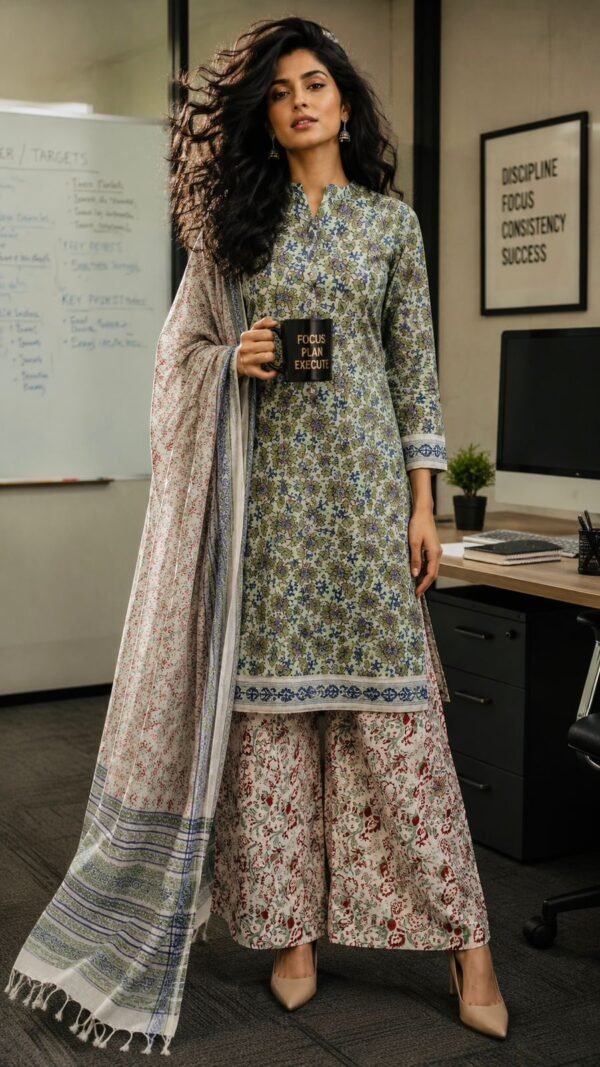
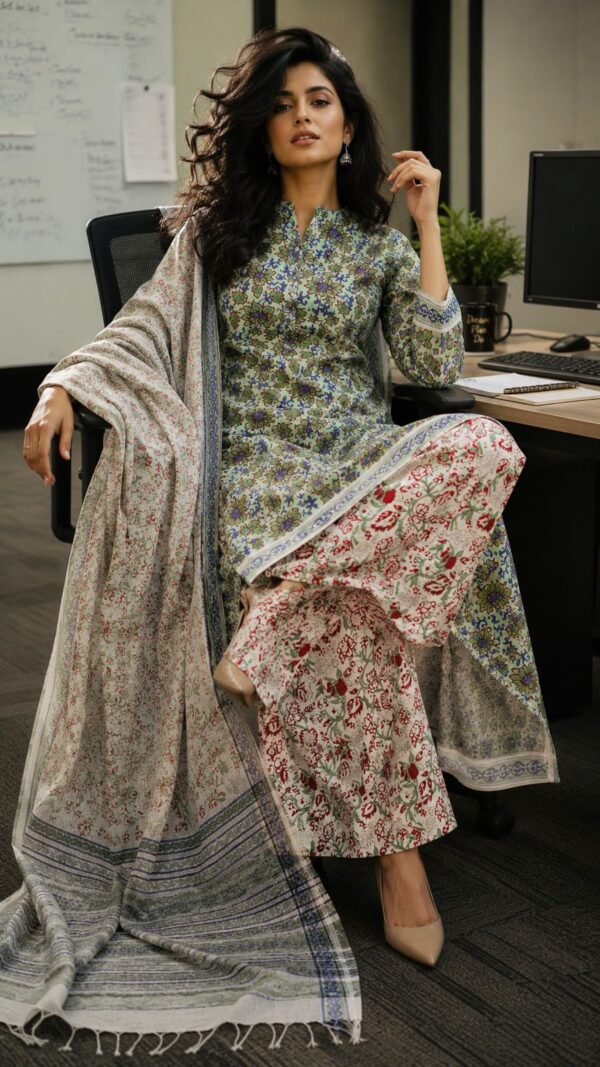
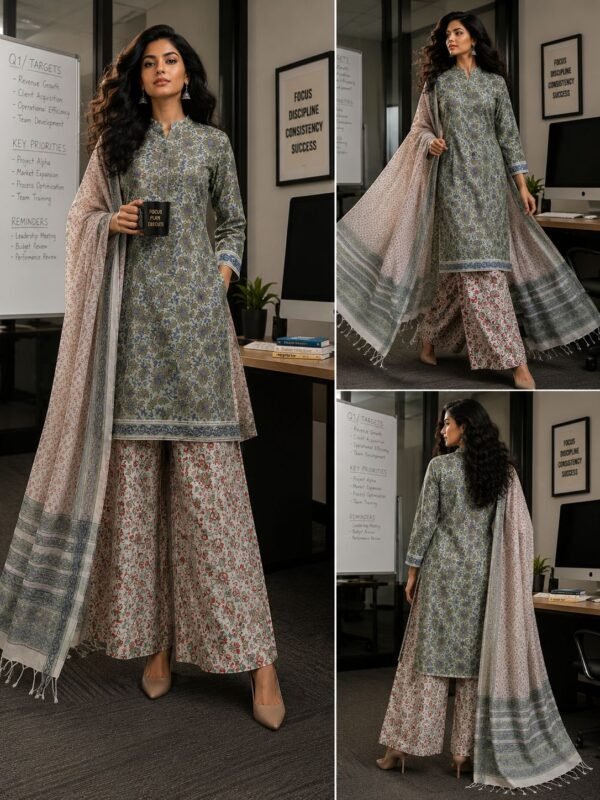
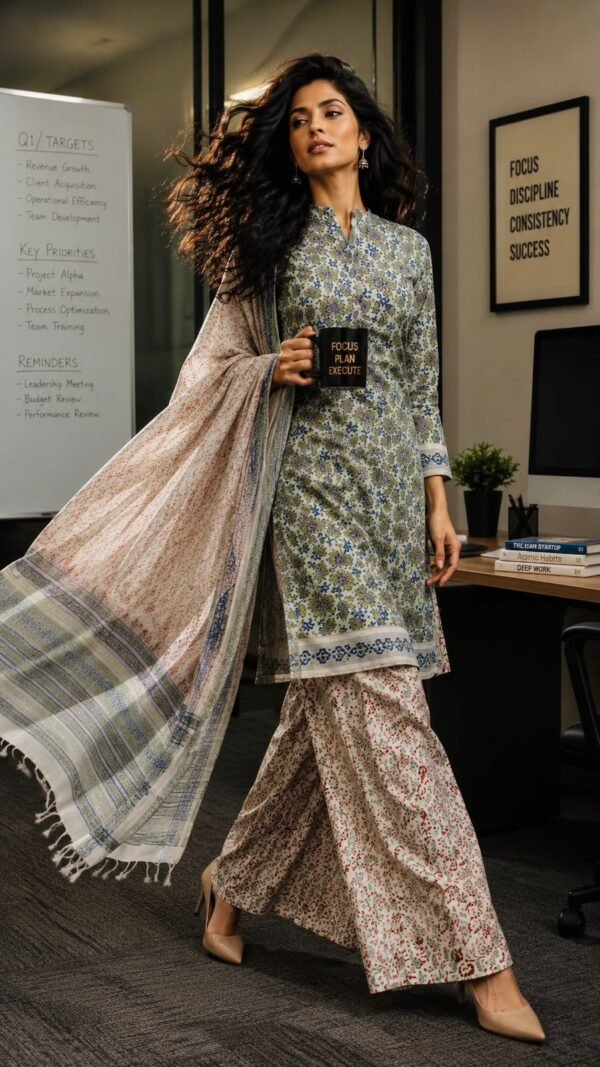
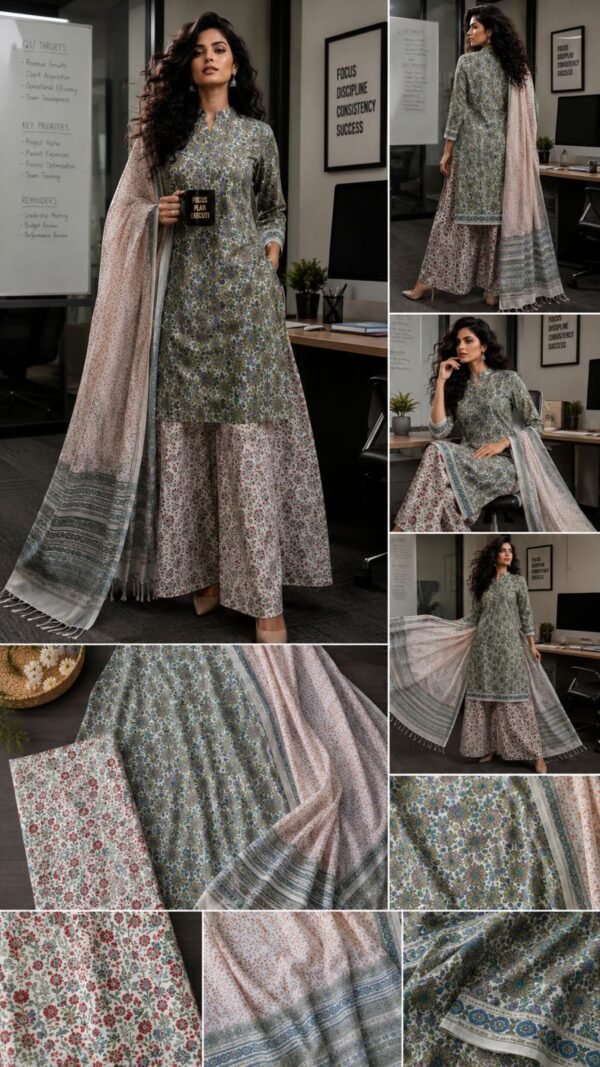
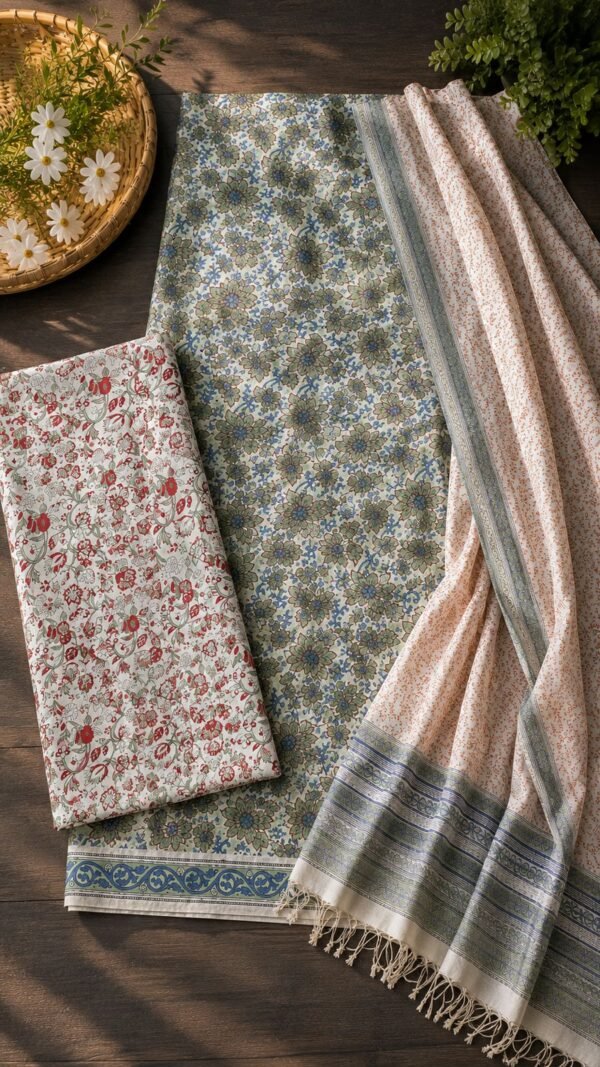
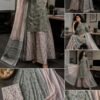
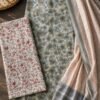
Two block prints, two grounds, one suit. The kurta fabric is sage-olive cotton with a dense all-over floral print: small multicolour flowers — red, blue, yellow, green — packed close together across the full fabric body, the sage ground barely visible between them. The palazzo fabric is blush-ivory cotton with a sparser, more open floral print: the same family of motifs at a lower density, the ivory ground carrying more weight in the composition. The two prints are coordinated without being matched. They belong to the same garden. They are not the same part of it.
This kind of mix-print coordination is a specific block printing judgment: the printer who produced both fabrics understood that the eye accepts two different prints from the same palette as a single composition if the colour family is held consistent and the density differential is intentional. The kurta is dense; the palazzo is open. The kurta reads as texture; the palazzo reads as pattern. Together they create a visual rhythm that a single all-over print cannot produce: something to look at up close and something different to look at from a distance.
The Kota Doria dupatta is woven in Kota, Rajasthan — a weaving town whose name is synonymous with one specific fabric. Kota Doria is characterised by its woven square checks, visible in the fabric close-up as a regular grid produced by alternating cotton and silk threads in the warp and weft. The fabric is light, crisp, and semi-transparent — the border print visible through the body in the reference images as a shadow behind the drape. The dupatta’s printed border coordinates with the suit palette: the same botanical colour family, the same block-print vocabulary. The fringe tassels at the short ends are plain white — the lightest possible ending for the lightest possible fabric.
The model in the reference images holds a coffee mug. She is at a whiteboard. The motivational poster behind her reads FOCUS DISCIPLINE CONSISTENCY SUCCESS. This suit belongs in that room. It also belongs at the wedding this woman attends on Saturday. The name is Saumya — the quality of gentle, present light. The kind that does not announce itself. That simply makes everything around it more visible.
Block printing on cotton is one of India’s oldest surface print traditions. The printer works with carved wooden blocks — each block carrying one colour, one element of the design — pressing them onto the fabric in sequence to build the full pattern. For the floral prints in this set, the printer worked with multiple blocks: one for the flower head, one for the stem and leaf, one for the colour fill. Each impression placed by eye and by registration pin, the full pattern assembled one block at a time across the full cloth length.
The mix-print coordination of the kurta and palazzo fabrics is a design decision made before the printing began. The block printer chose the two palettes, the two densities, and the two ground colours with the knowledge that they would be worn together. The sage-olive ground and the blush-ivory ground are from the same earthy colour family; the two floral print densities are calibrated so neither fabric overwhelms the other when worn as a set. This kind of coordination requires the printer to hold both fabrics in mind simultaneously while designing each one separately. It is more demanding than a matched print and more interesting to wear.
Kota Doria is a weaving tradition specific to Kota district in Rajasthan. The defining characteristic — the woven square check pattern produced by alternating cotton and silk or cotton and zari threads at regular intervals in both warp and weft — makes the fabric light, slightly crisp, and with a natural translucency. The dupatta in this set is printed with a botanical border after weaving, using block printing in the same palette as the suit fabrics. The white fringe tassels at the ends are the dupatta’s only unprinted element. On Kota Doria, they are correct.
Cotton Kurta and Palazzo Fabrics
- Wash: Hand wash each piece separately in cold water with a mild detergent. The sage and blush grounds are different dye lots; keep them separate, especially for the first wash.
- First wash: Wash each piece separately from all other garments. Both prints may release slight colour on the first wash — normal for block-printed cotton at these colour depths.
- Iron: Medium heat on the reverse side. Block print cotton irons well from the back; direct ironing on the print side over time affects the colour vibrancy.
- Dry: In shade. Both the sage and the blush grounds are susceptible to UV fading over extended exposure.
Kota Doria Dupatta
- Wash: Dry clean recommended for the Kota Doria dupatta. The cotton-silk weave structure and the block-printed border both benefit from professional care.
- Hand wash: If hand washing: cold water, very gentle pressure, no wringing. The Kota Doria’s crispness is a property of the weave structure; rough handling softens it permanently.
- Iron: Low heat on the reverse side. The Kota Doria has a slight natural crispness; high heat removes it permanently.
- Tassels: Handle the white fringe tassels gently. Lay flat to dry; do not pull the tassel strands.
- Store: Store all three pieces together in clean muslin. Keep the Kota Doria away from direct weight or pressure to preserve its natural drape.
Related products
-
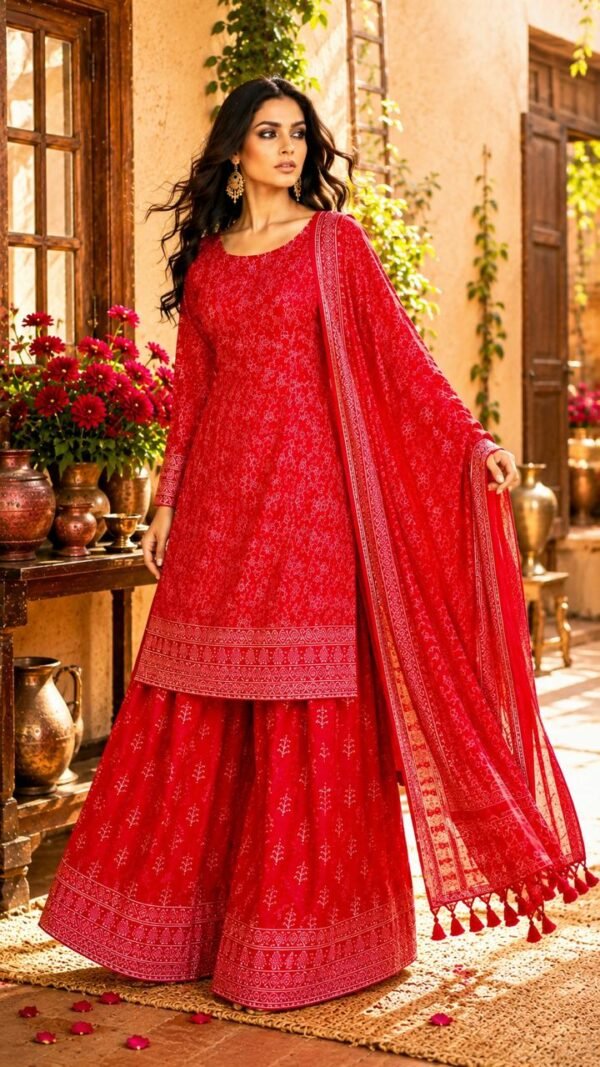
Gulmohar Chanderi Kurta and Cotton Sharara Suit Set in Crimson with Zari Border
Suits & Kurtas ₹4,200.00 Add to cart
Reviews
There are no reviews yet.