
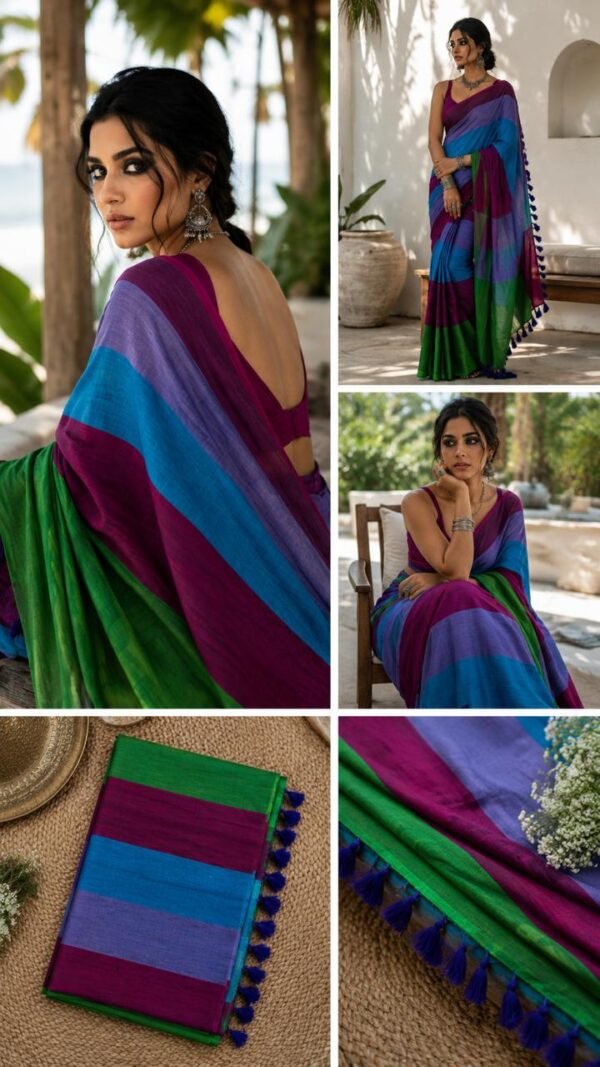
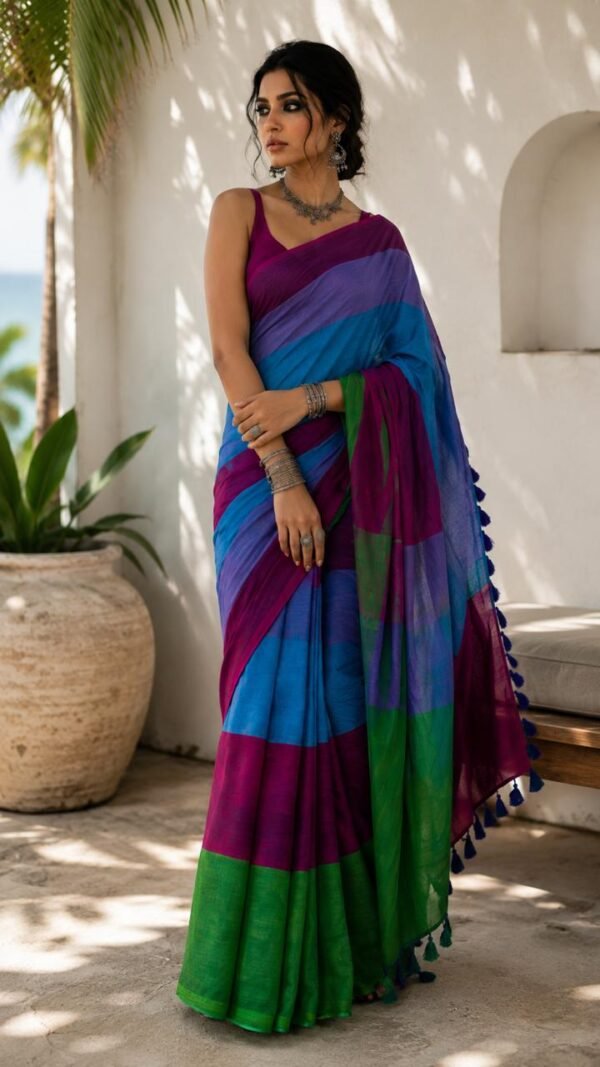
Mul Cotton Saree in Four-Colour Block Stripe with Navy Pom-Pom Border
Sarees₹2,400.00
& Free ShippingAntariksh is the Sanskrit word for the space between stars.
Not sky. Not night. The depth between.
The navy that has no bottom.
Mul cotton takes dye the way space takes light —
completely, deep into itself,
holding nothing at the surface.
.The crimson is the horizon.
The line at the edge of all that depth
that tells the eye where the saree ends
and the woman wearing it begins.
The tassels move.
Everything else holds still
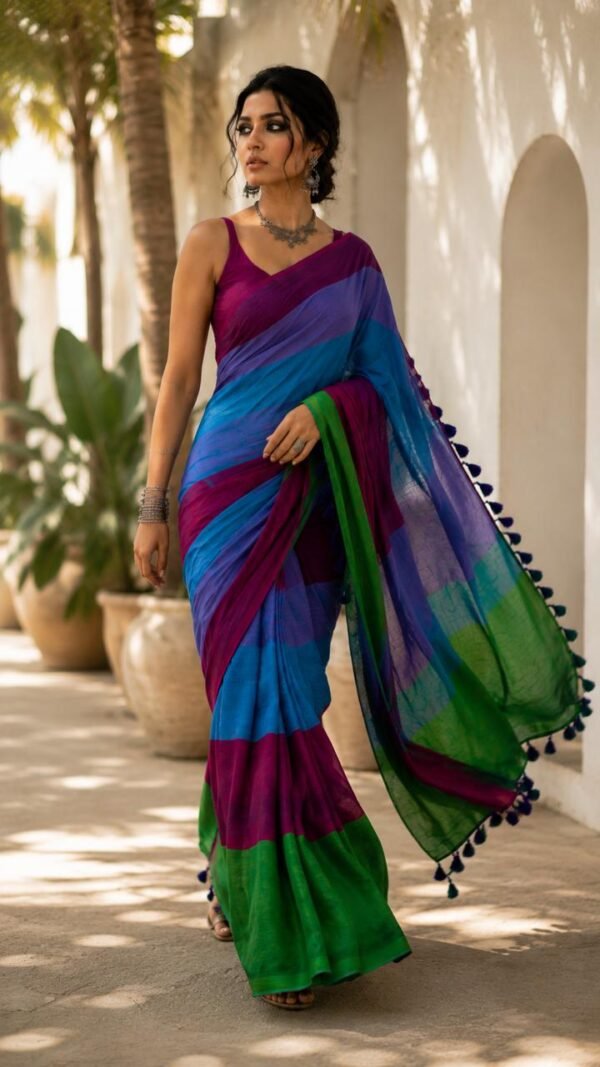
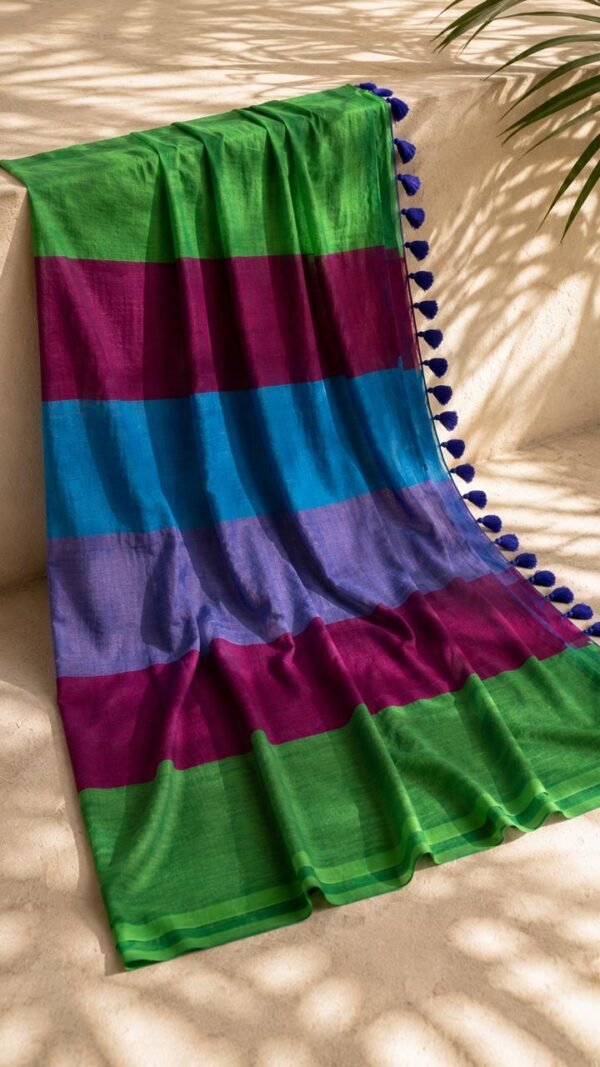
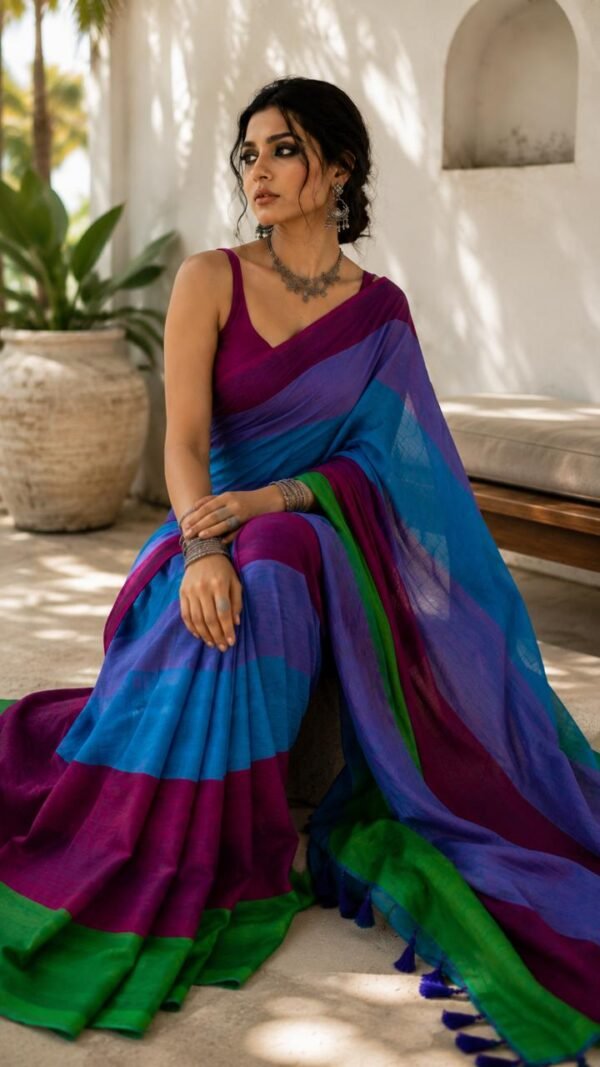
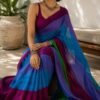
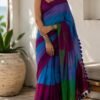
Mul cotton is Bengal’s lightest weave tradition — the fine-count, loosely constructed cotton that the Mughal emperors called woven air, so light the weavers counted threads individually and the finest counts reached 1,800 per inch. This saree is woven from that cotton: four wide weft stripes in forest green, deep magenta, sky blue, and soft lilac, on a base so light it responds to the air around the woman wearing it before she has moved.
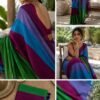
The colours are nature colours at their full saturation. Forest green is the canopy in full monsoon, the dark green that holds the most light. Deep magenta is the hibiscus and the bougainvillea, the colour of the flower that blooms in full sun and does not apologise for itself. Sky blue is the specific blue of coastal afternoon, the blue over white architecture when the air has salt in it. Soft lilac is the distance: the blue of hills seen from far away, the lavender of late afternoon shadow. The four colours were chosen the way the landscape chooses its colours — without consultation, with complete certainty.
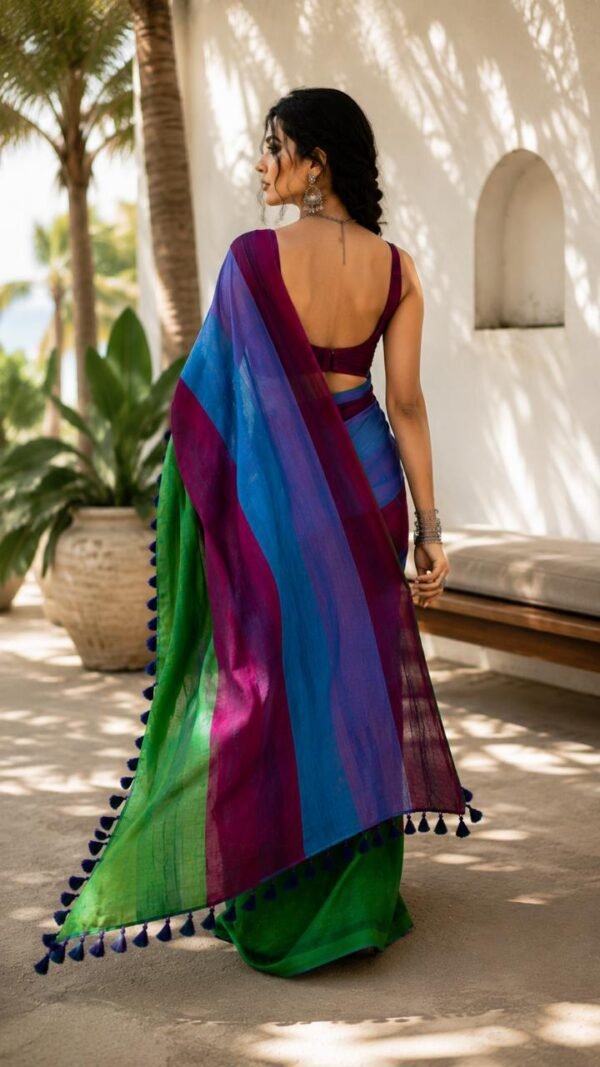
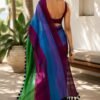
Mul cotton takes dye deep into the fibre rather than holding it at the surface. The stripe colours in this saree are not on the fabric; they are inside it. In open sunlight, the four bands each read at their full depth. In shade, they deepen further. The cotton is light enough that the stripe drapes in wide, loose folds when the saree is worn — the reference images show the four-colour sequence falling across the back in full, uninterrupted bands, each colour visible simultaneously as the pallu extends. A heavier cotton would hold the stripe in pleats. Mul cotton lets it flow.
The navy pom-pom trim at the pallu hem runs the full pallu width as a dense border — small spherical pom-poms in deep navy, anchoring the lightest fabric in the collection at its most visible edge. The name is Tarang: wave, the movement that carries everything forward. Mul cotton is the fabric that makes that movement possible. The wave begins at the first thread and does not stop until the pom-poms reach the hem.
Bengal’s mul cotton tradition descends from the Dhaka weavers who made the finest cotton cloth in the world for the Mughal court. Mul — fine-count, loosely woven, air-light — is constructed by counting individual threads at counts the hand can barely hold, weaving them in a plain weave so open the finished fabric is translucent. The Mughals called the finest version “woven air.” This saree is the inheritor of that tradition: not the museum piece, not the royal commission, but the living cotton that carries the same lightness into four saturated colours for a woman who goes outside in it.
Weft colour-block stripe on mul cotton requires the weaver to balance a technical tension: the wide stripe demands an even, confident weft change at each colour boundary, but mul cotton’s fine count means the tension across the warp must be maintained with particular precision. A heavier cotton absorbs small tension variations. Mul does not. Every inconsistency shows. The four-colour boundaries on this saree are clean — the colour change happens at a single thread row, the boundary reads as a precise line rather than a blurred zone — because the weaver maintained the warp tension correctly across each stripe change. That is not a given with mul cotton. It is a discipline.
The navy pom-pom trim at the pallu hem is attached by hand after the weaving is complete. Each pom-pom is individually formed and attached at even intervals, creating a dense decorative border along the full pallu width. On mul cotton, the trim carries particular visual weight because it is the densest element in a very light fabric — the eye goes to it immediately. The weaver understood this. The navy against the four stripe colours at the hem is the final compositional decision. It was made before the loom was set.
• Wash: Hand wash in cold water with a very mild, pH-neutral detergent. Mul cotton is fine and light; it requires the gentlest handling in the collection.
• First wash: Wash separately in cold water. The deep magenta and the forest green may release slight colour on the first wash — normal for saturated dyes in mul cotton. Will not recur.
• Do not: Wring, scrub, or machine wash. Mul cotton is a fine-count weave; wringing distorts the plain weave structure permanently. Machine agitation breaks down the thread at the fine count.
• Pom-pom trim: Handle the pallu pom-pom trim section with particular care. Do not soak the trim. Press gently after washing, reshape the pom-poms, and lay flat to dry. Do not pull the pom-pom strands.
• Iron: Low heat on the reverse side. Mul cotton’s fine weave is heat-sensitive — high heat causes the thread to fuse and the drape to stiffen. Iron gently and briefly.
• Dry: Always in shade. The four stripe colours are each deeply saturated; prolonged direct UV exposure fades them. Mul cotton also weakens under sustained sun exposure over time.
• Store: Folded in clean muslin. Keep away from other garments. Mul cotton’s fine weave can catch on rough surfaces — store with no pressure on the folded fabric and away from moisture.
| Dimensions | 5.5 cm |
|---|---|
| Saree Length | 5.5 metres |
| Blouse Piece Length | 0.8 metres |
Reviews
There are no reviews yet.