

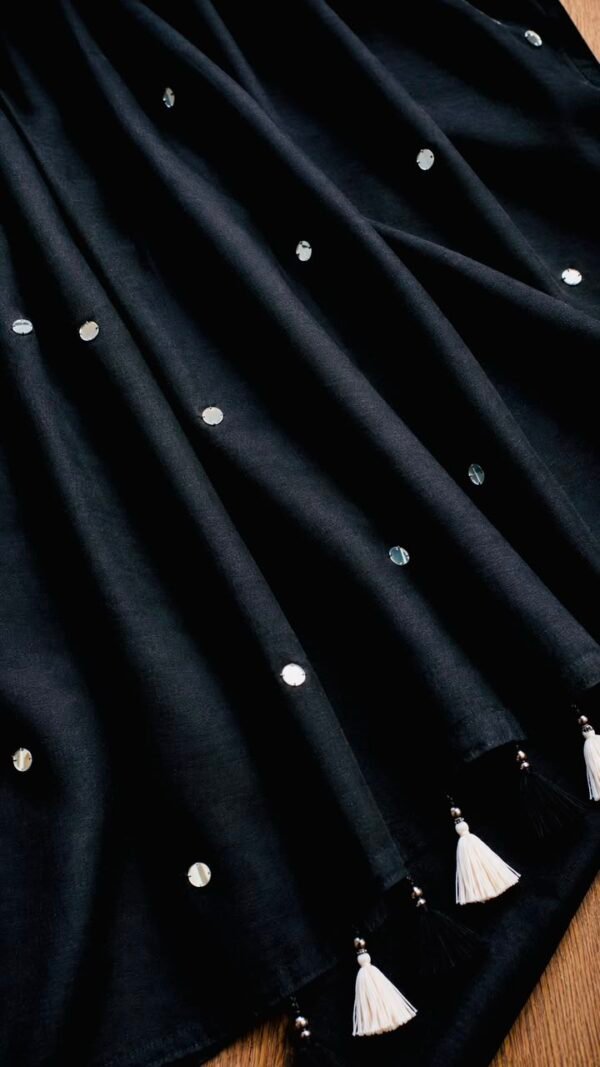












Sitara Mul Cotton Saree in Black with Silver Sitara Buti and Black Tassels
Sarees₹4,000.00
& Free ShippingSitara means star.
The Persian word for the point of light
in the field of dark. Mul cotton is the lightest fabric in the collection.
Woven air, the Mughals called it.
This black mul is the night itself,
the specific night that is light enough
to move when the woman moves.
Each silver sitara was placed by hand.
Each one a decision about where the star goes.
The sky the craftsperson made
is distributed across 5.5 metres of black cotton.
You wear the sky.
The sky moves when you move.
Mul cotton is the collection’s lightest fabric. The Mughals called the finest Bengal cotton ‘woven air’ and the Dhaka weavers who made it counted individual threads at counts that approached translucency. This black mul is woven from fine-count cotton in a plain weave so open the fabric drapes in the soft, floating folds visible in every reference image — the fabric responding to the smallest movement of the body wearing it. In the candlelit interior of the reference images, the black mul moves with the ambient warmth, the fabric settling at one angle and shifting at another. There is no other cotton in the collection this light. The body of this saree breathes.
Sitara work is the application of small circular mirrors or metallic discs to cloth — the word sitara means star in Persian, and the tradition of using mirror work in Indian textiles is deeply associated with the Mughal court and the embroidery traditions of Gujarat and Rajasthan. Each silver sitara on this saree is an individual disc applied to the black mul surface and secured by hand. The discs are not woven in, not printed, not attached mechanically. Each one is placed at a specific position by the craftsperson’s judgment of distribution. The scattering pattern visible across the body is neither random nor gridded — it is calibrated, the spacing giving each sitara enough black ground to read as individually placed rather than collectively applied.
In the reference images, the shoot is the most elaborate in the collection: a Mughal-inspired interior with carved filigree arches, gilded antique frames, Persian carpet, rose petals on the floor, candelabras. The woman wears a large silver chandbali earring, a maangtikka with silver chain, stacked silver bangles from wrist to elbow, and a silver waist belt. The jewellery is entirely silver — the only colour other than the red lips and the black mul. In this interior, the silver sitara mirrors catch the candlelight individually, each disc holding a separate point of amber warmth in the black fabric. The candlelit interior is the right setting for this saree because candlelight is what the sitara mirrors were designed for.
The black tassels at the pallu hem are individually knotted, dense, and clustered. They are the same black as the mul body — the darkest element in a saree that is already the darkest in the collection, placed at the hem to tell the eye where the fabric ends. The name is Sitara. Each silver mirror on this black cotton is a star that was placed before the garment was finished, waiting for the light to arrive and confirm its position
Mirror work — shisha or sitara in different regional traditions — is one of the oldest decorative textile techniques in India. The Kutch and Saurashtra traditions of Gujarat are the best-known centres of shisha embroidery, where small circular mirrors are stitched onto cloth with a surrounding ring of buttonhole stitches that hold the mirror in place without adhesive. In sitara work, the disc is typically applied with a different securing method — the disc edges held by thread or adhesive rather than by enclosing embroidery stitches — producing a cleaner, more graphic appearance with the silver disc reading as a complete circle rather than as a surrounded form.
The placement of the sitara buti across the full body of this saree is the craftsperson’s composition. There is no template for the distribution — the craftsperson works across the full 5.5 metres of black mul cotton, placing each disc at the position that maintains the scattering pattern without repetition. For a 5.5-metre saree, this means hundreds of individual placement decisions, each one made in the context of the placement decisions already made and the decisions still to come. The finished distribution must read as natural scatter at a distance and as deliberate placement at close range. That dual reading is the standard the placement must achieve.
Mul cotton as the base for sitara work is a specific choice. The lightness of the fabric means the sitara discs add a perceptible weight — the mul body without the discs is almost weightless; with them, the weight is distributed as the pattern is distributed. In movement, the disc weight creates a subtle counterpoint to the fabric’s own lightness: the mul moves easily, the discs provide small moments of resistance at each sitara position. The fabric moves around the discs; the discs move with the fabric. The black tassels at the pallu hem are cut from the mul body and individually knotted to the hem at the finishing stage.
• Wash: Dry clean only. The combination of mul cotton and individually applied sitara discs makes professional dry cleaning the only safe care method. Do not hand wash.
• Sitara mirrors: The silver discs are applied to the mul surface and secured at their edges. Water immersion and handling will loosen the securing adhesive or thread over time. Each sitara that detaches cannot be reattached with the same precision at home.
• Do not: Hand wash, machine wash, wring, or submerge. Any of these will dislodge sitara discs permanently.
• Handling: Handle the saree by its edges rather than by the body. Grabbing the mul body in areas with dense sitara concentration can pull the securing stitches.
• Iron: Do not iron at home. Professional pressing on a padded surface, from the reverse side only, is the correct method. Direct heat on the sitara discs permanently damages both the disc surface and the mul beneath.
• Tassels: Handle the black tassels gently. Do not pull. If a tassel comes loose, secure it with a needle and matching thread rather than adhesive.
• Dry: If the saree is dampened at any point, lay flat in shade immediately. Do not hang.
• Store: Rolled around acid-free tissue paper — do not fold. Folding concentrates pressure on the sitara discs at the fold lines, which can dislodge or scratch them over time. Store in a clean dark cloth bag, away from pressure, light, and humidity.



Reviews
There are no reviews yet.