









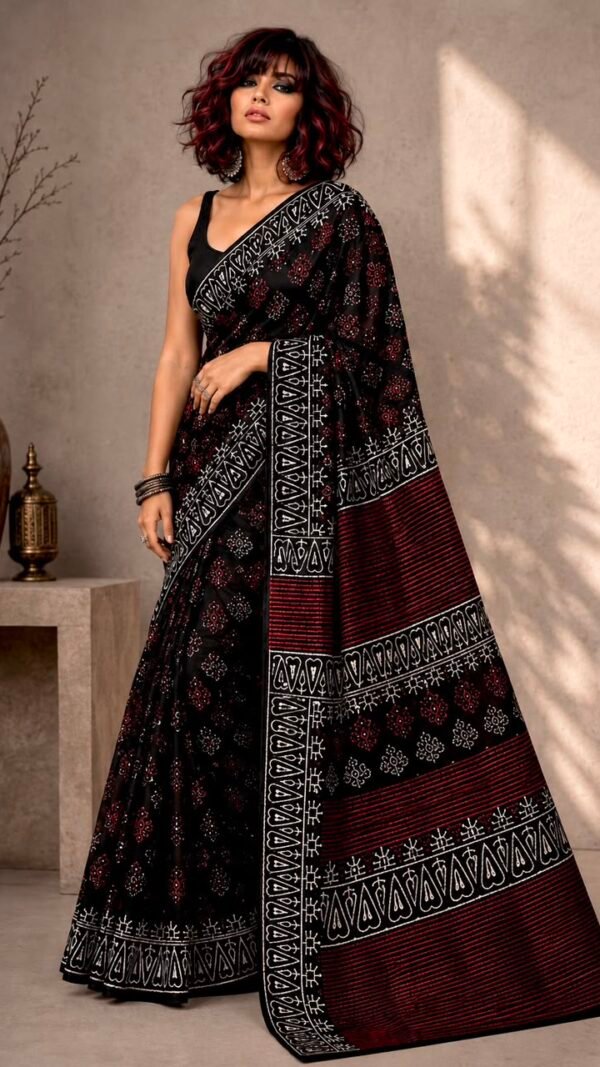
Rati Bagru Block Print Cotton Saree in Black with Cream and Red Floral Buti
Sarees₹3,400.00
& Free ShippingRati is the Sanskrit word for the deep reddish earth,
the colour the soil holds after the rain has passed.
The Bagru printers have been working with this earth
for five hundred years.The cream flowers are the places
where the dabu resist touched the cotton first.
The black came later, everywhere else.
The flower is what survived the dye.The red overprint arrived last,
after the black had settled,
placing the warmth back into the centre
of everything the black had covered.
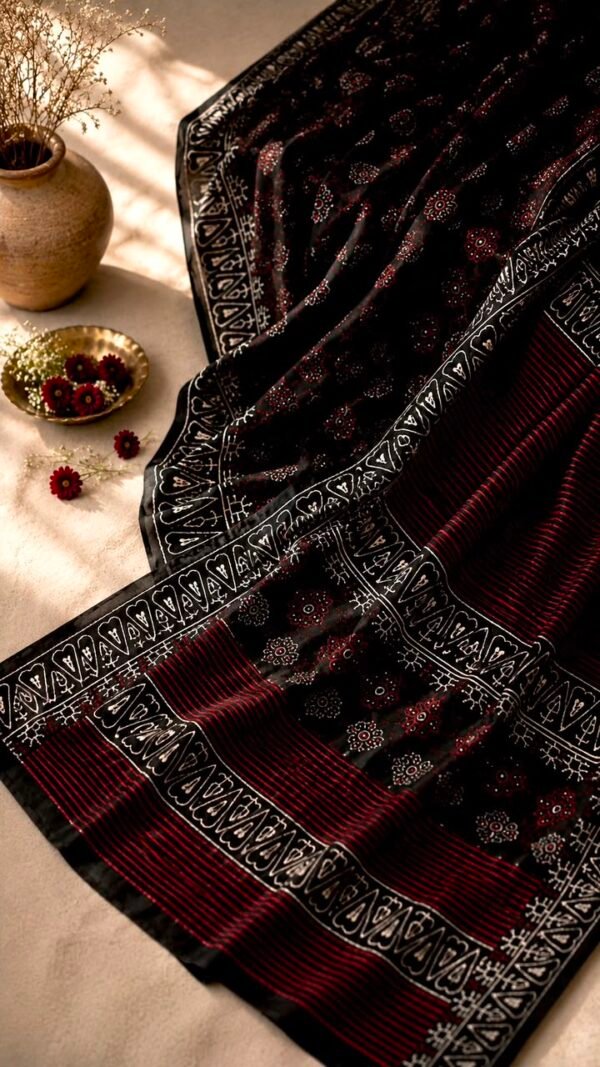
Bagru printing begins with the earth. Before any colour is applied to the cotton, the Bagru printer mixes a dabu resist from clay, gum, and wheat chaff — a thick paste that blocks the dye from reaching the fabric wherever it is applied. The paste is pressed onto the cotton using carved wooden blocks, transferred in the pattern of the flower buti, and allowed to dry. Only then is the fabric submerged in the dye bath. The dye reaches the unprotected cotton — the black ground — but is blocked wherever the dabu resist was applied. When the resist is washed away, the cream flower shapes remain: the original colour of the cotton, protected by earth from the dye bath, now visible as the cream buti against the black.
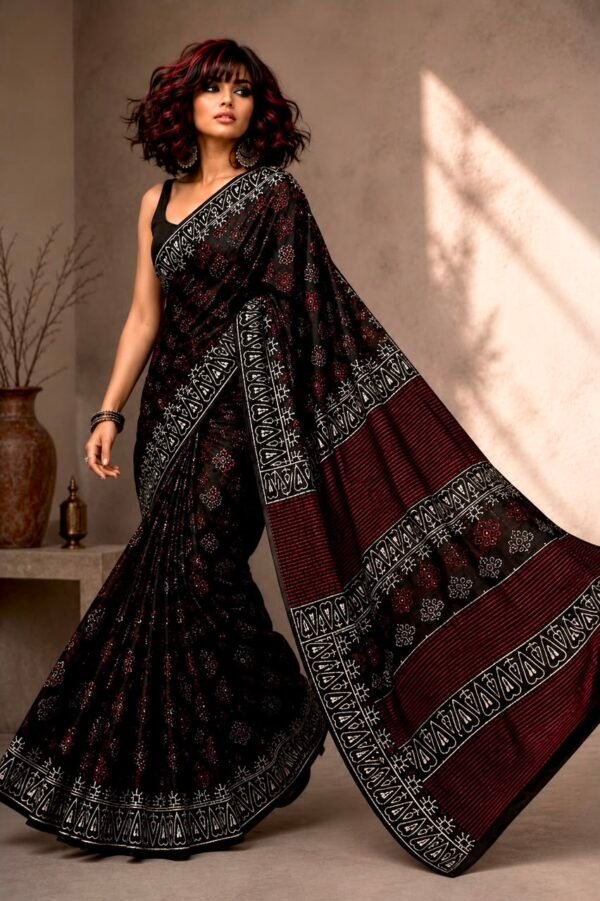
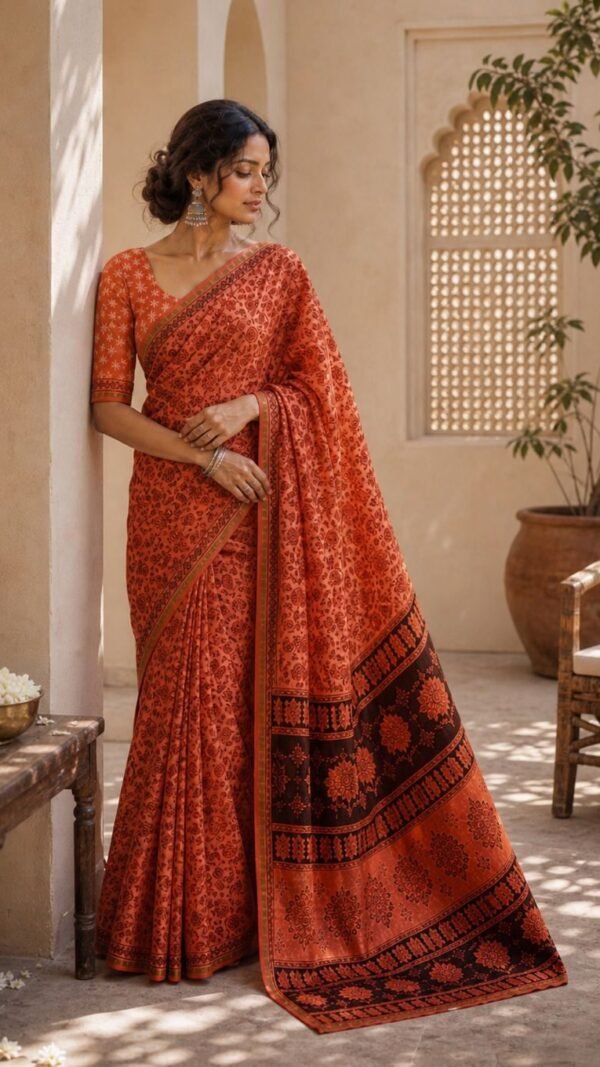
The all-over buti print on this saree covers the full 5.5 metres of the cotton body. Each buti is a small floral form in the Bagru vocabulary — a stylised flower with geometric petal forms and a central dot, the same motif that has appeared in Bagru printing since the tradition began. The density of the buti distribution means the black and the cream are present in roughly equal proportion across the body surface: neither colour dominates, neither retreats. The balance is the composition.
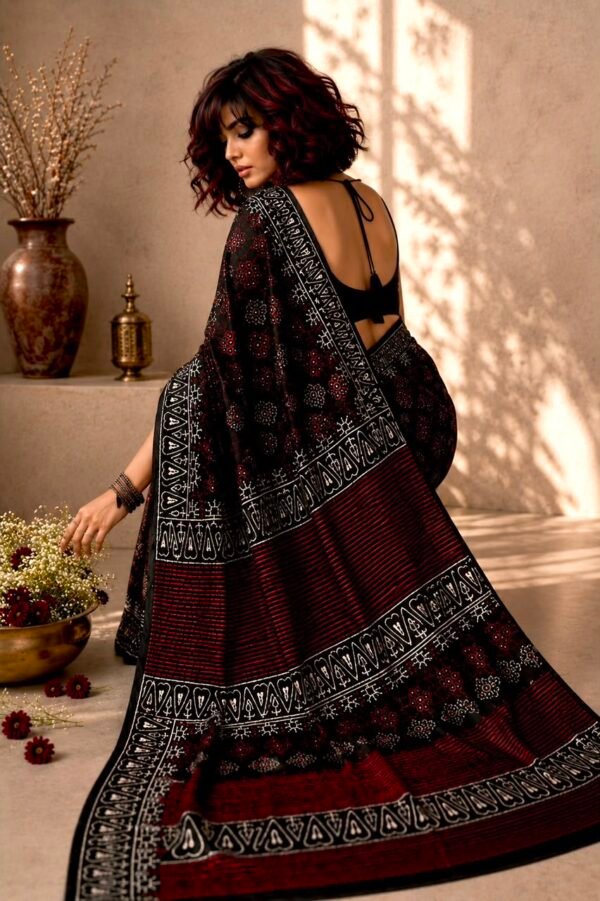
The red overprint is the third dye stage: after the dabu resist and the black dye, the Bagru printer applies a second dye in the red registers, either through overprinting with a separate block or through a second dye bath with targeted resist. The red appears in the centres of the cream buti and in the red horizontal stripe section of the pallu, adding the earthy warmth that is the Bagru palette’s defining quality. The geometric triangle border in cream runs the full length of the running border and returns as the pallu’s framing element. The Bagru tradition’s colour palette — black, cream, and red — is the palette of the specific Rajasthani earth and dye tradition: earthy, direct, completely resolved.
In the reference image, the woman is seated in a minimal contemporary interior with a brass bowl of white gypsophila and scattered red flowers at her feet. The white flowers and the red flowers are the exact colours of the Bagru print — cream and red on black. The stylist understood the palette and put it on the floor. The name is Rati: the deep reddish earth, the colour the soil holds after the rain has passed, the colour the Bagru printers have been working with for five hundred years.
Bagru is a small town eighteen kilometres from Jaipur. The chhipa printing community has practised block printing there for over five hundred years, using a vocabulary of wooden blocks, natural dyes, and resist techniques that have been maintained across generations. The Bagru tradition is distinguished from the Sanganer block printing tradition (also near Jaipur) by its reliance on the dabu resist: a mud paste made from clay, gum arabic, and wheat chaff that is applied to the fabric before the main dye bath, blocking colour from the protected areas and creating the characteristic cream-on-ground resist zones.
The black dye used in Bagru traditionally comes from iron-based dyes — the fabric treated with a ferrous mordant before dyeing, which produces the characteristic Bagru black that is slightly warm rather than optically cold. The cream of the dabu resist zones is the cotton at its natural, undyed colour; on Bagru black, this cream reads slightly warmer than the same cotton would read against a lighter ground. The red overprint in the Bagru palette comes from the alizarin or madder red tradition — the same earth-derived red that appeared in Bagru printing before synthetic dyes were available and that continues in the natural dye Bagru tradition today.
The carved wooden blocks used in Bagru printing are made by specialist block-carvers in Pethapur, a village near Gandhinagar in Gujarat. Each block carries one element of the design — the dabu resist block, the black ground block, the red overprint block — and is used for years or decades before being replaced. The blocks for this saree’s buti pattern are in the standard Bagru floral vocabulary; their wear pattern — the very slight variation in impression depth from block to block — produces the characteristic Bagru texture visible in the print close-up: each buti slightly different from the last, the hand-pressure variation creating the surface life that machine printing cannot replicate.
• Wash: Hand wash in cold water with a very mild detergent. Natural or vegetable dye Bagru prints are particularly sensitive to alkaline detergents.
• First wash: Wash separately in cold water. The black ground and the red overprint may each release slight colour on the first wash. Normal. Keep away from all light fabrics permanently.
• Bagru dyes: If this saree uses natural/vegetable dyes, treat as you would any natural dye textile: cold water only, no sunlight drying, mild acid-neutral detergent. Natural dye Bagru fades gracefully with age; the fading is considered part of the textile’s life.
• Do not: Machine wash, bleach, or use harsh detergents. All three degrade Bagru dye colours rapidly.
• Iron: Medium heat on the reverse side. Direct ironing on the Bagru print face over time affects the colour depth.
• Dry: In shade. Bagru dye colours — particularly the red and the cream — are UV-sensitive.
• Store: Folded in clean dark muslin, away from light. Keep away from light-coloured fabrics permanently.
Reviews
There are no reviews yet.