
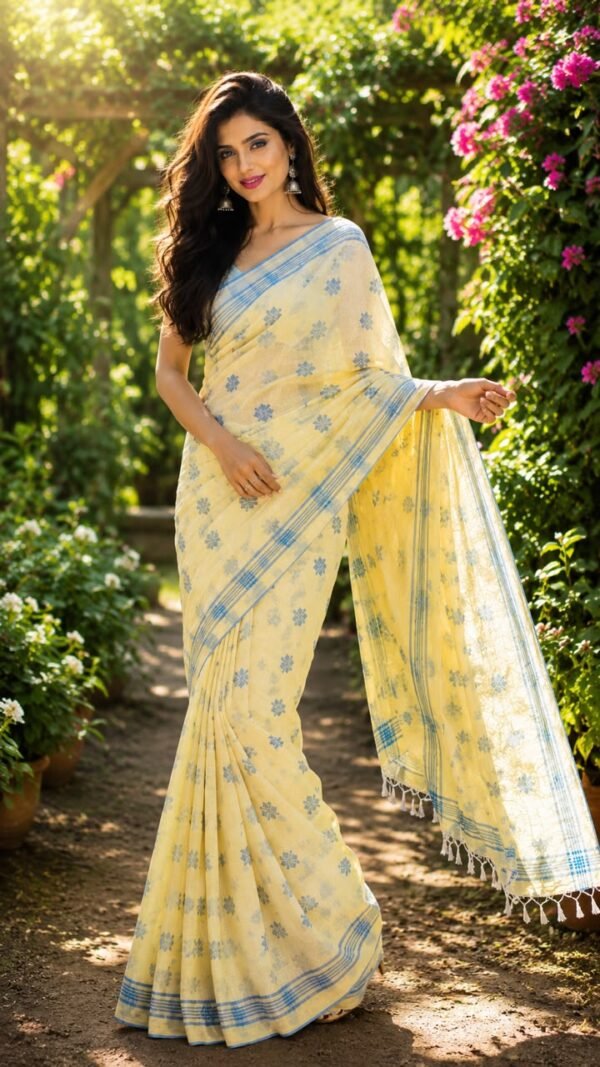
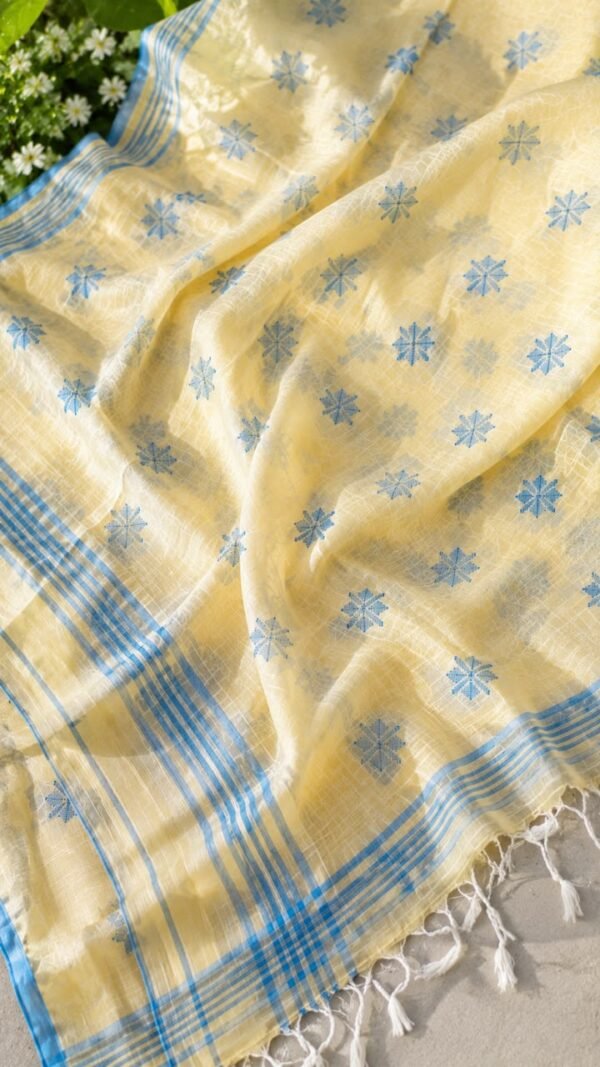
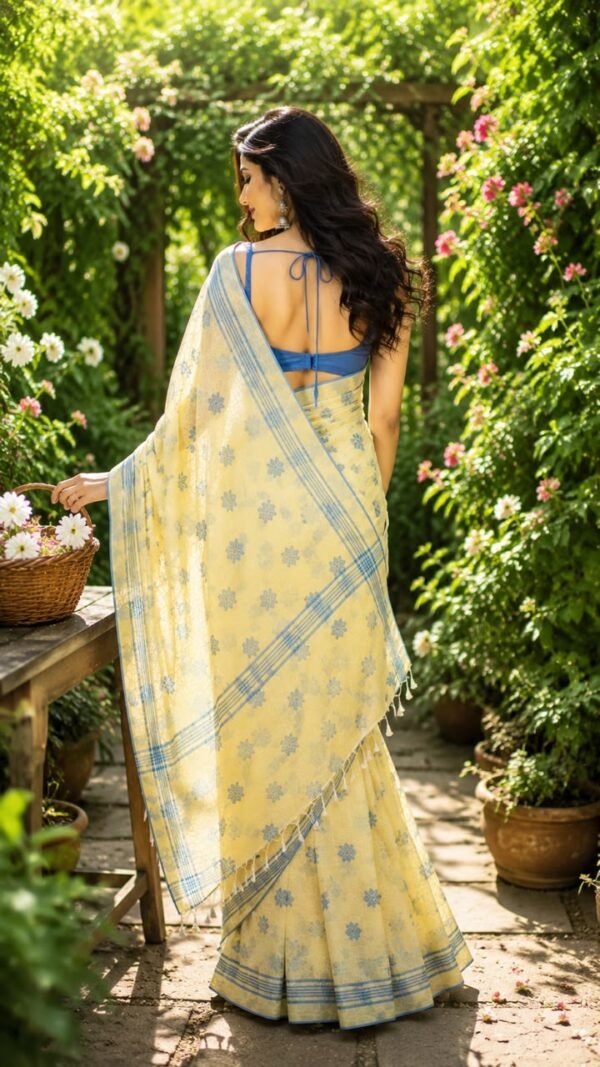
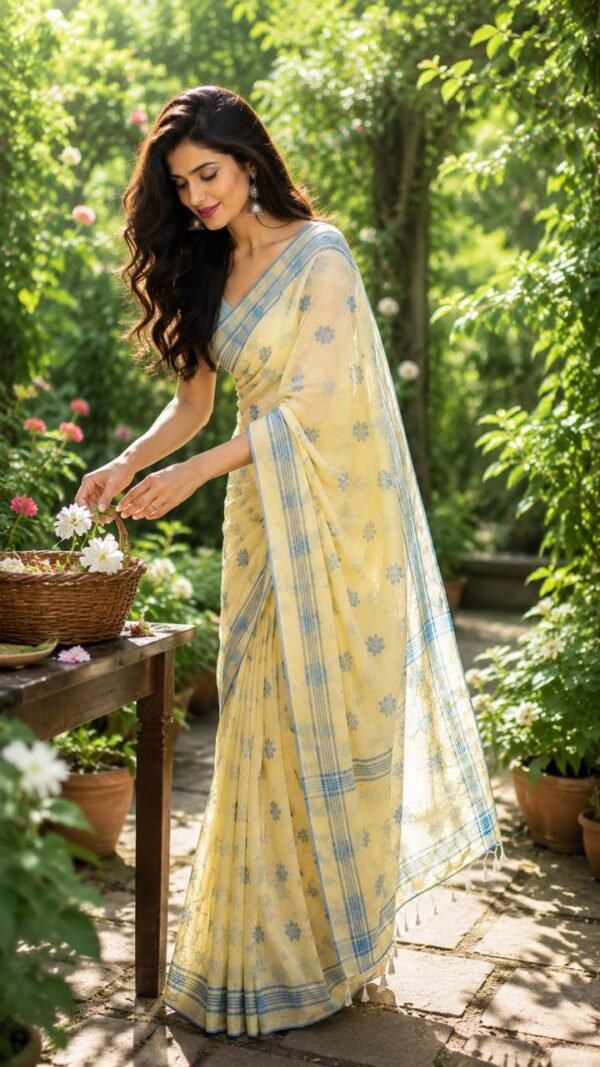

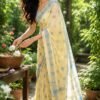
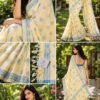

Cotton Khadi Cotton Saree in Lemon Yellow with Blue Woven Buti and Stripe Border
Sarees₹2,800.00
& Free ShippingChampa is the flower.
The magnolia of the Sanskrit poets,
the one they compared the beloved’s fingers to,
the one that blooms lemon-cream
and fills the room before you see it. The khadi body is soft.
Not the stiff khadi of a new garment.
Soft already, the way khadi gets
after the first few washes,
when the hand-spun thread has settled.
The blue buti are scattered.
Each one a geometric flower
placed by the weaver with the same certainty
that a garden places its flowers:
seemingly without plan,
completely without accident.
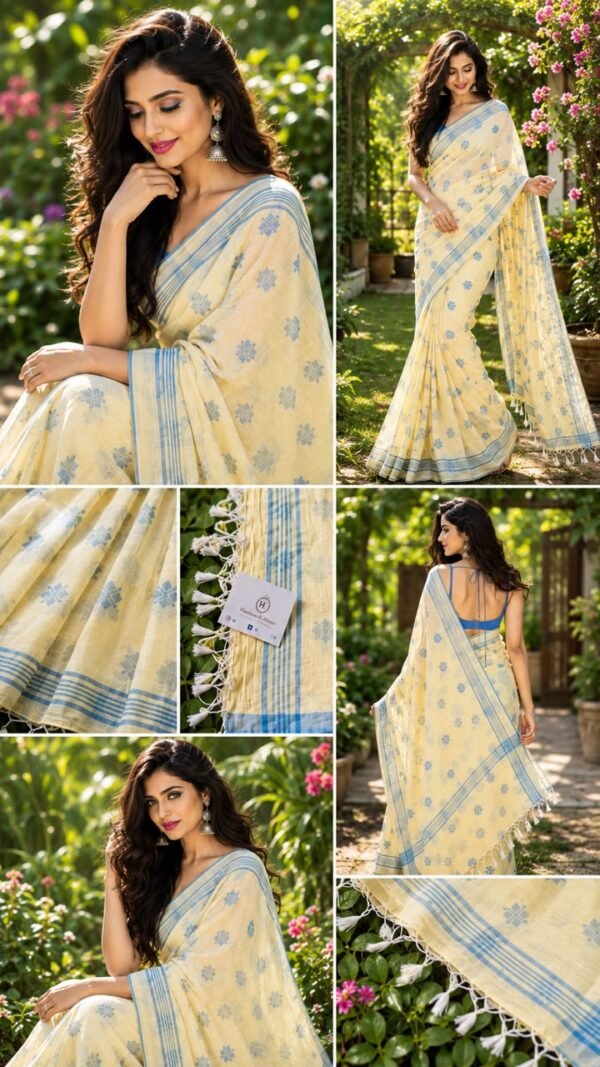
The client’s instruction for this saree is specific: soft. Khadi cotton can be stiff — a freshly woven, freshly dyed khadi saree has the characteristic slight stiffness of the new fabric, the hand-spun thread at its firmest. But khadi also softens faster and more completely than machine-spun cotton: after the first few washes, the hand-spun variation in the thread settles, the slight irregularities in the weave relax, and the fabric drapes with a quality that machine-spun cotton cannot replicate. This khadi was prepared for softness: the lemon yellow ground has the settled quality of khadi that has been washed and finished before leaving the weaver, the drape in the reference images falling in the loose, fluid folds of broken-in khadi rather than the structured pleats of new fabric.
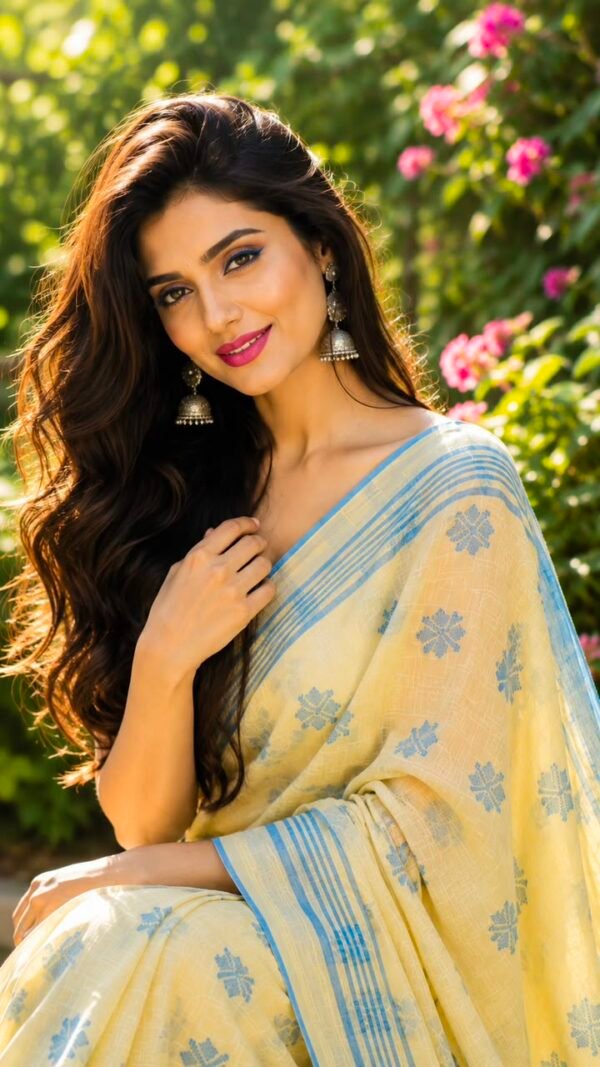
The lemon yellow is the colour of the champa flower in full bloom: the specific warm cream-yellow that sits between ivory and gold, the colour that is present without demanding attention. On the hand-spun khadi, this yellow carries the natural variation of the fibre — each thread slightly different from its neighbours, the yellow reading as a living, warm surface rather than a flat dyed ground. In the rose garden of the reference images, this yellow sits with the pink and red roses without competing: it is a garden colour, the colour of a different flower in the same composition.
The blue buti are woven supplementary weft motifs: each small geometric form built individually into the warp and weft as the fabric was woven, the blue thread introduced at each buti position and built row by row. The motif is geometric — a snowflake or floral cross form in the blue supplementary thread, visible at close range as a precise, small construction and reading as a scattered blue element at the distance of wearing. The distribution across the full body is the weaver’s calibration. The blue stripe border runs the full hem and running border as multiple thin parallel stripes in cornflower blue, the same colour family as the buti. The white tassels at the pallu hem are individually knotted at even intervals: the lightest element in a composition of warm lemon and cool blue.
The reference images were shot in a rose garden with a stone archway covered in climbing roses. The lemon khadi in this green and floral setting reads as the garden’s own colour. The blue buti catch the light slightly differently from the khadi ground, each one a small cooler point in the warm yellow. The name is Champa. The lemon-cream flower the poets have been describing for two thousand years. This is that yellow.
This is the third khadi saree in the Hastkaar-E-Khaas collection, joining Dhoop (Saree 27) and Vasanta (Saree 47). All three share the fundamental craft of khadi: hand-spun thread, handloom weaving, the natural variation of human hands in both processes. What distinguishes Champa is the presence of woven buti across the full body — a construction that requires the weaver to interrupt the body weave with supplementary thread at each buti position, building each small motif individually before resuming the plain weave body.
The buti construction sequence: at each buti position, the weaver introduces the blue supplementary thread across the specific weft passes that build the motif, passing the blue thread over and under specific warp threads to create the geometric form row by row. When the buti is complete, the supplementary thread is drawn to the back of the fabric and the plain lemon yellow body weave resumes. Each buti is a separate construction event. For the full body of Champa, the weaver built dozens of individual buti across 5.5 metres, maintaining the distribution by eye.
The softness of this khadi is a product of both the thread preparation and the finishing process. Hand-spun khadi thread can be spun at different tensions and counts; the softer khadi uses a finer count and lower tension, producing a thread that settles faster after the first few washes. The finishing process — washing and pressing the saree before it leaves the weaver — begins the softening process that the garment continues with each wearing. A khadi saree that arrives soft has been prepared with care. It will continue to improve.
- Wash: Hand wash in cold water with a mild detergent. The lemon yellow and the blue buti are each a different dye lot; cold water and gentle handling protect both.
- First wash: Wash separately in cold water. The lemon yellow and the blue buti and border may each release slight colour on the first wash. Keep away from light fabrics.
- Softness: This khadi arrived soft. To preserve that softness, avoid hot water, machine washing, and harsh detergents. All three stiffen hand-spun khadi over time.
- Buti: Wash gently through the buti-covered body. The supplementary weft threads sit slightly raised; avoid scrubbing directly on the buti positions.
- Tassels: Handle the white tassels gently. Press lightly after washing and lay flat to dry. Keep away from the blue border and buti sections when wet to prevent colour transfer onto the white tassel threads.
- Do not: Machine wash or bleach. Machine agitation affects the softness of the khadi and can cause the buti threads to shift.
- Iron: Medium heat from the front while slightly damp. Khadi responds well to front ironing and the heat with moisture preserves and enhances the soft drape. Avoid ironing the buti directly.
- Dry: In shade. The lemon yellow is UV-sensitive; sun-drying will shift the colour toward cream over time.
- Ageing note: Champa will continue to soften with every wash. The lemon yellow will settle into a slightly deeper cream tone over time — the natural ageing of khadi. The softness improves. The buti will remain crisp if the saree is cared for gently.
Reviews
There are no reviews yet.