
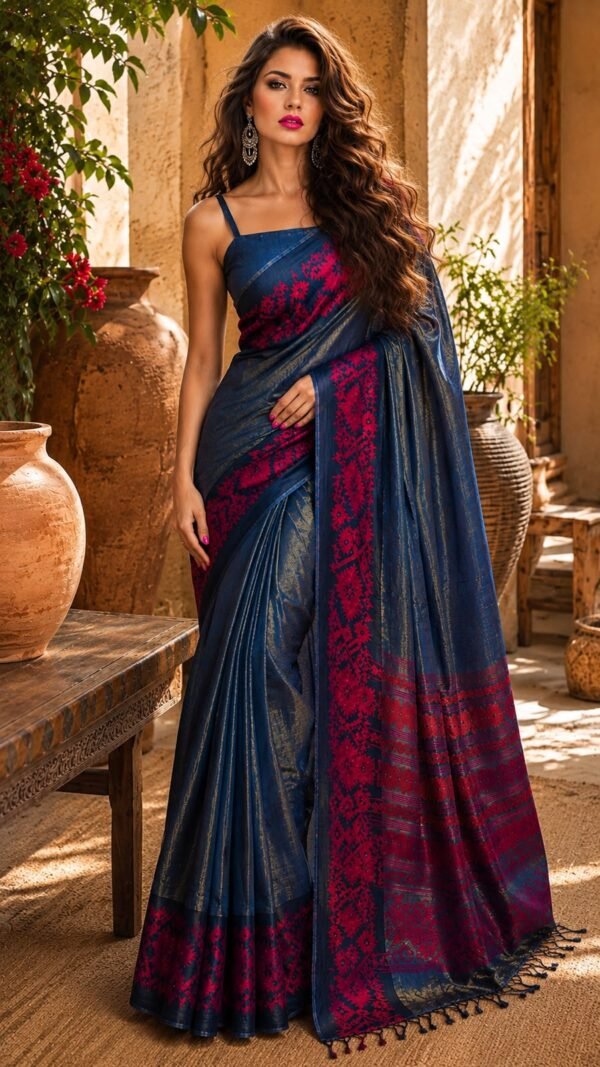
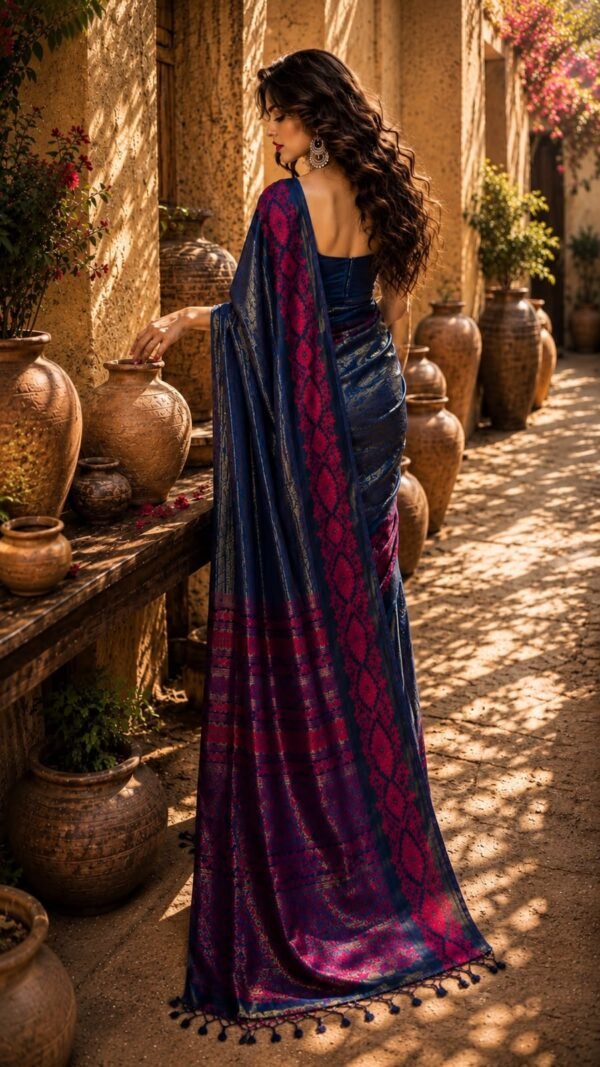
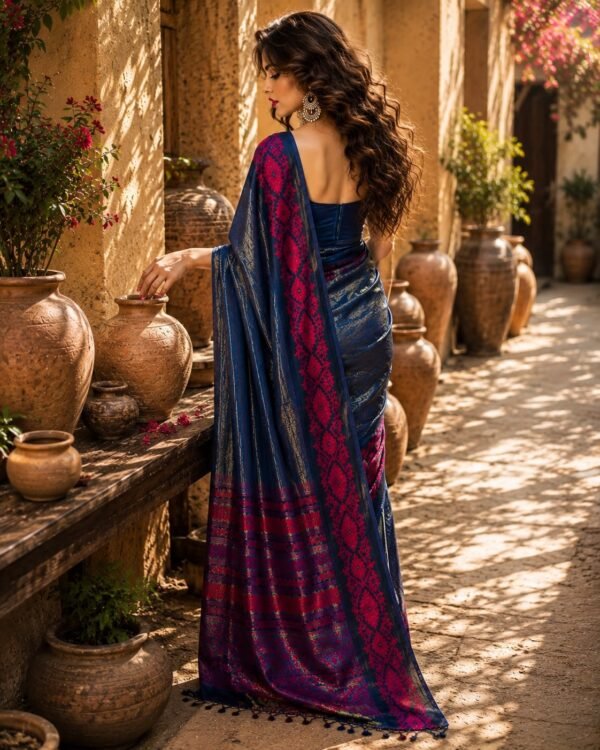
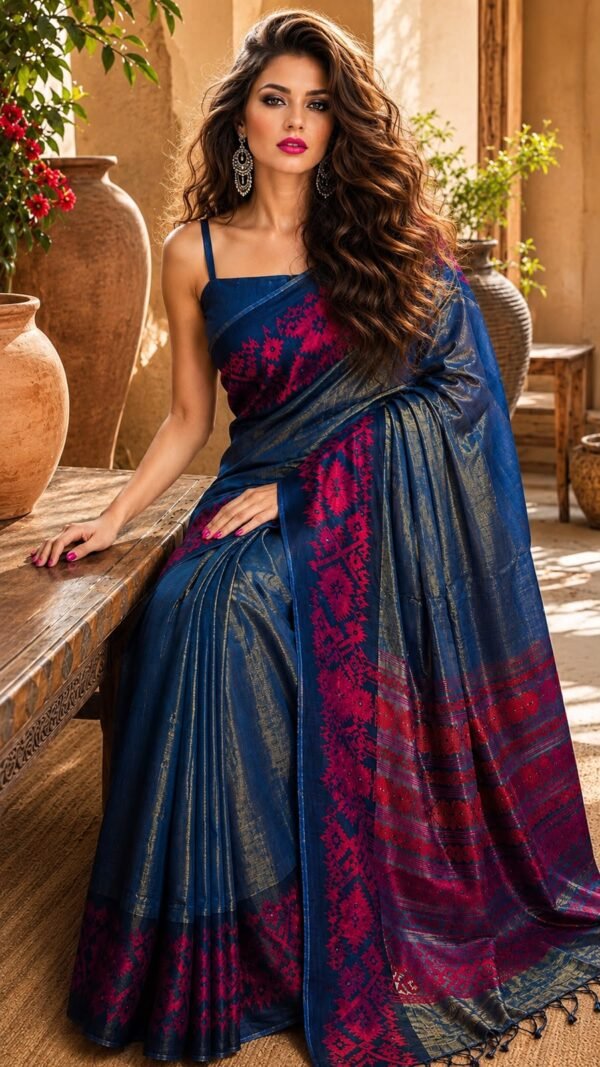
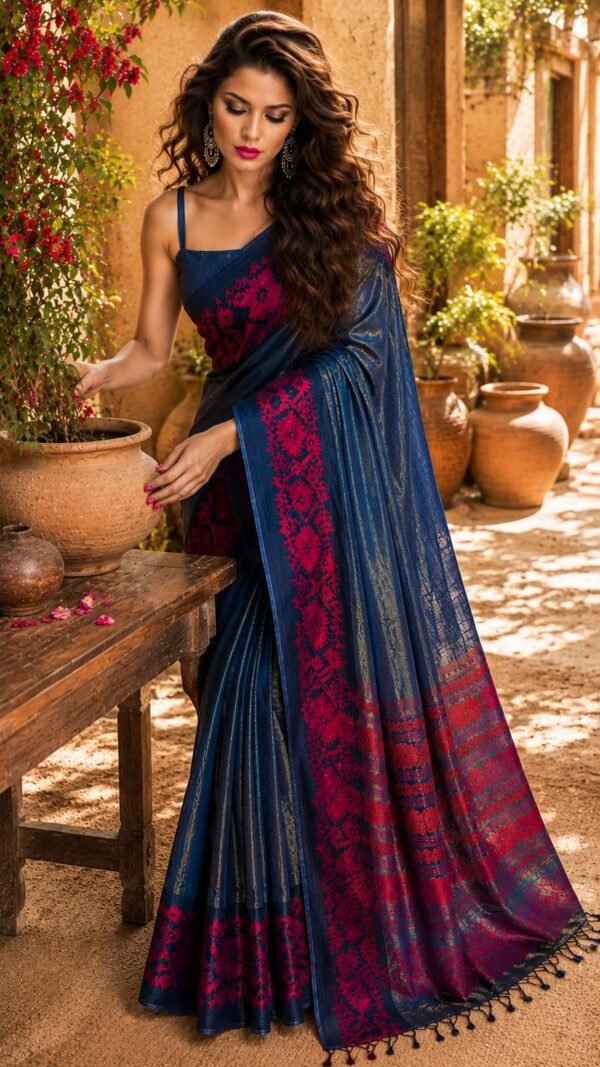





Neelam Linen Saree in Navy Blue with Zari Body and Crimson Resham Border
Sarees₹3,000.00
& Free ShippingNeelam is the sapphire.
The Sanskrit poets called it
the colour of the sky after a storm —
the blue that is too saturated to be ordinary,
the blue that has come through something. The zari runs through the linen body quietly.
Line by line, vertical, holding the blue together
the way a frame holds a painting.
The crimson border is not decoration.
It is the answer the blue has been building toward.
Two colours that have nothing in common
except that they are both completely certain.
Linen gives navy its best possible ground. The natural matte texture of the linen fibre means the colour does not shine or reflect — it absorbs. This navy is the blue you see through, not the blue you look at. The linen surface gives it interior depth: the colour reads differently at different distances, in different light, at different angles of the body wearing it. The zari self-stripe running vertically through the body adds the single metallic element the linen alone cannot provide — a fine grid of gold lines that catch the light at the angle the linen absorbs it.
The zari is structural rather than decorative. The fine vertical gold lines run through the full body of the fabric at regular warp intervals, visible in direct light as a continuous geometric grid across the navy linen and barely visible in shade. The linen body breathes between these lines. The gold holds the fabric together optically without dominating it. The result is a body that looks plain from a distance and reveals its architecture up close.
The border is crimson resham — silk thread, not metallic thread, not zari. Resham on linen produces a specific contrast: the silk thread has a natural lustre that reads as warm against the matte linen ground, and the crimson against the navy is one of the oldest colour arguments in Indian textile tradition. The border carries a dense geometric pattern built in the supplementary weft technique: the crimson thread introduced across the weft at each design row, building the geometric form row by row. The border runs the full hem and into the pallu, the crimson building in density as the pallu progresses to its end.
The black tassels at the pallu hem are small, evenly spaced, and weighted. Against the crimson border, they read as the border’s full stop. The name is Neelam: sapphire, the blue stone, the blue the poets said comes through something. This saree has come through something. The crimson at the edge is the proof.
Linen sarees are woven in Bengal from linen yarn — the spun fibre of the flax plant, historically grown in West Bengal and Bihar — on the same pit looms used for cotton. Linen weaving requires greater warp tension than cotton: the linen fibre is stiffer and less elastic than cotton thread, and the loom must be dressed with greater precision to maintain even tension across the full warp width. The finished linen fabric is heavier than equivalent cotton, more structured in its drape, and carries the natural matte texture that is the fibre’s defining quality.
The zari self-stripe is introduced into the warp alongside the linen thread at regular intervals: the gold zari thread running the full length of the fabric in the warp direction, the linen filling the spaces between. The stripe is built into the architecture of the fabric from the first thread. In the finished saree, the vertical gold lines are evenly spaced across the full body width, consistent from the first centimetre to the last. The weaver set this consistency before a single weft thread was thrown.
The crimson resham border is supplementary weft work: the silk thread introduced across the weft rows at the border position, building the dense geometric pattern row by row. Resham — silk thread — is softer and warmer than zari metallic thread; the crimson silk on the navy linen reads as a different quality of red from what metallic thread produces. Silk carries its colour with the warmth of the fibre itself. The border on this saree is not metallic. It is living crimson on structural blue. The black tassels at the hem are knotted by hand after the weaving is complete.
• Wash: Dry clean recommended for long-term preservation of the linen structure, zari stripe, and crimson resham border.
• Hand wash: If hand washing: cold water, mild detergent, do not soak or wring. Linen is robust but the crimson resham border requires gentle handling — silk thread dyes can bleed in warm water.
• First wash: Dry clean only for the first wash. The crimson resham may run slightly in the first wash if hand washed in water warmer than cold. After the first professional clean, careful cold hand washing is acceptable.
• Resham border: Do not scrub the crimson border. The resham thread is silk — softer than the linen ground and vulnerable to abrasion. Handle gently through the border section.
• Tassels: Handle the black tassels gently. Press gently, reshape, lay flat to dry.
• Linen note: Linen is naturally stiffer when new and softens with each wash. The drape of a new linen saree improves after the first few washes. This is the correct behaviour of linen.
• Iron: Medium heat on the linen body, slightly damp, from the front — linen responds well to front ironing while damp and the heat brings out the natural texture. Avoid ironing on the crimson resham border directly; iron the border from the reverse side on low heat.
• Dry: In shade. The deep navy and the crimson are both UV-sensitive over extended exposure.
• Store: Folded in clean muslin. Tissue paper between folds. Keep away from humidity, which can affect both the linen structure and the silk resham thread.

Reviews
There are no reviews yet.