
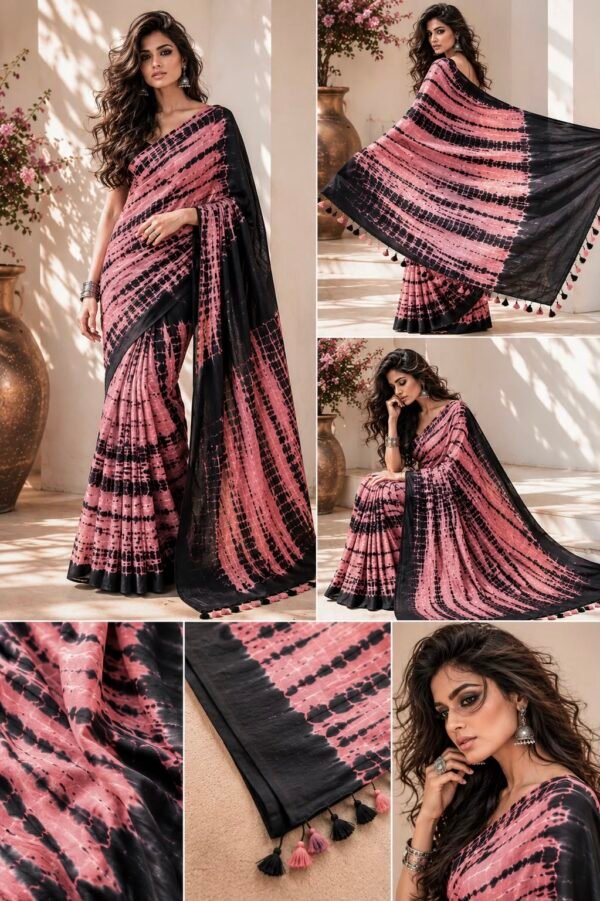




Sayam Mul Cotton Saree in Dusty Rose with Shibori-Print Black Pattern
Sarees₹2,200.00
& Free ShippingSayam means evening.
The specific hour between the orange of sunset
and the full arrival of the dark.
The sky at sayam is exactly this colour:
the dusty rose that holds the warmth
before the dark advances into it.
The shibori pattern is the dark advancing.
Horizontal band after band,
the black moving up from the hem
the way the night moves up from the horizon.Mul cotton is woven air.
At sayam it is the lightest garment
in the warmest light.
The shibori moves with it.
The evening moves with her.
The second shibori saree in the collection differs from the first in every dimension except the technique. Varsha was the grey and navy of a monsoon sky: cool, interior, the pattern of rain on still water. Sayam is the dusty rose and black of the evening sky: warm, dramatic, the pattern of night advancing in horizontal bands from below. The dye chemistry is the same resist principle in both — the fabric tied or clamped at the resist positions before the dye bath, the pattern appearing when the resist is removed. The colour relationship is completely different.
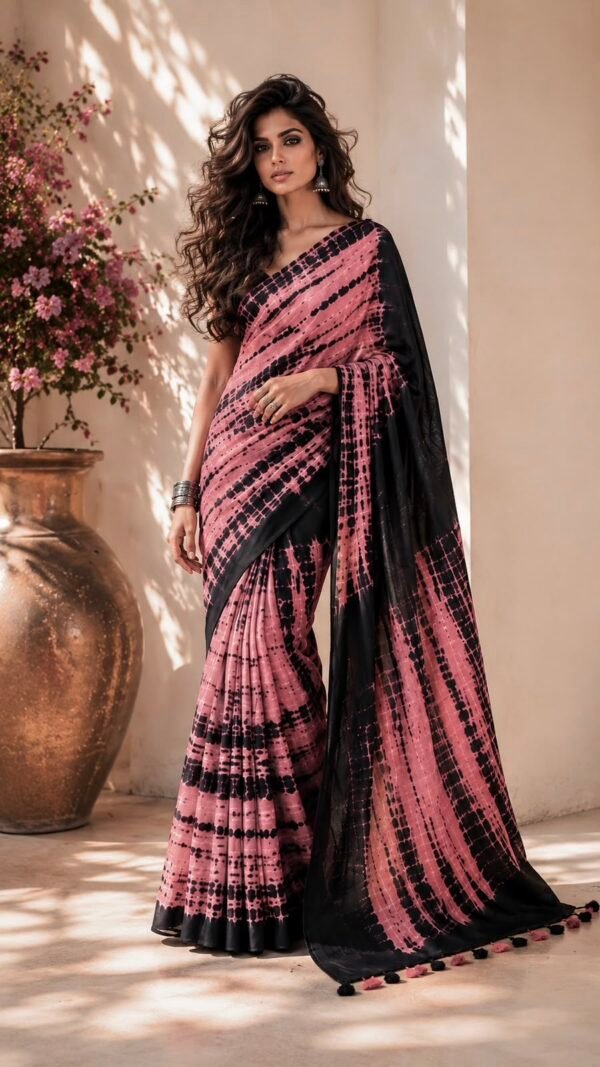
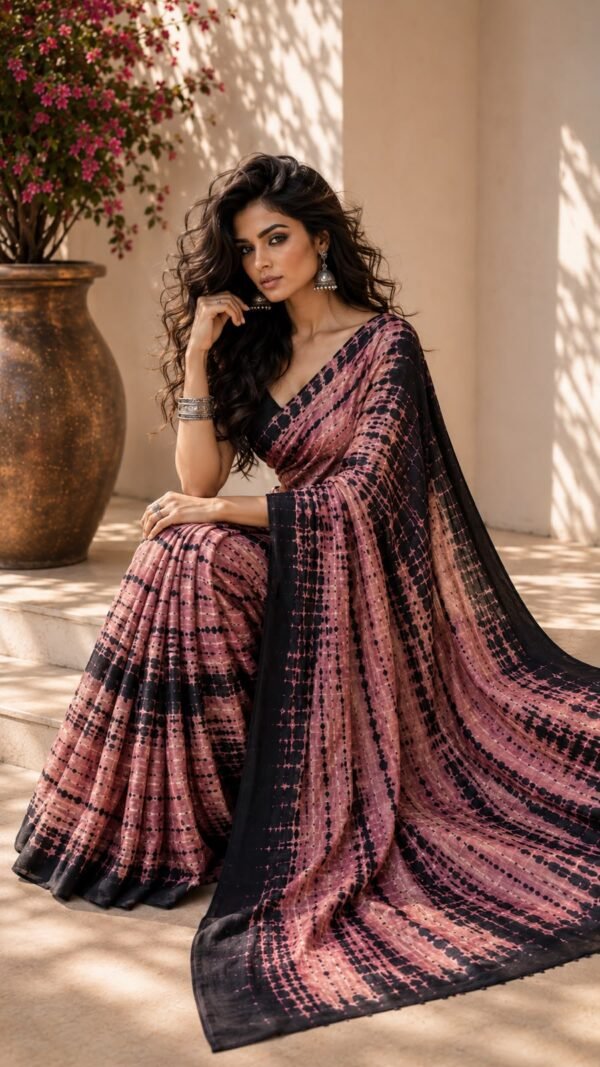
The dusty rose ground is the mul cotton at a specific warm pink: not the hot pink of Rani, not the coral of Phool, but the muted, slightly terracotta-adjacent rose that the sky holds in the half-hour after sunset when the orange has dispersed but the warmth has not yet left. On mul cotton, this specific dusty rose has a quality of translucency: the fine-count open weave of mul allows the light to pass through, the colour reading as slightly warm and internally lit rather than as surface colour. In the reference image, the afternoon light through the terracotta courtyard and the dappled shadow of the overhead foliage play across the mul in exactly the quality of light the colour was dyed for.
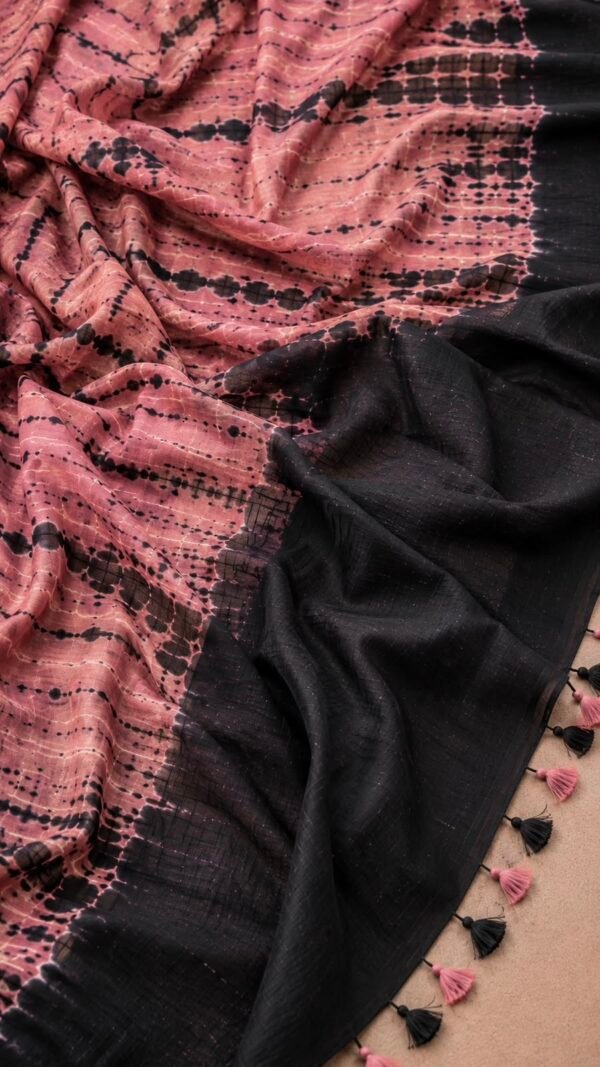
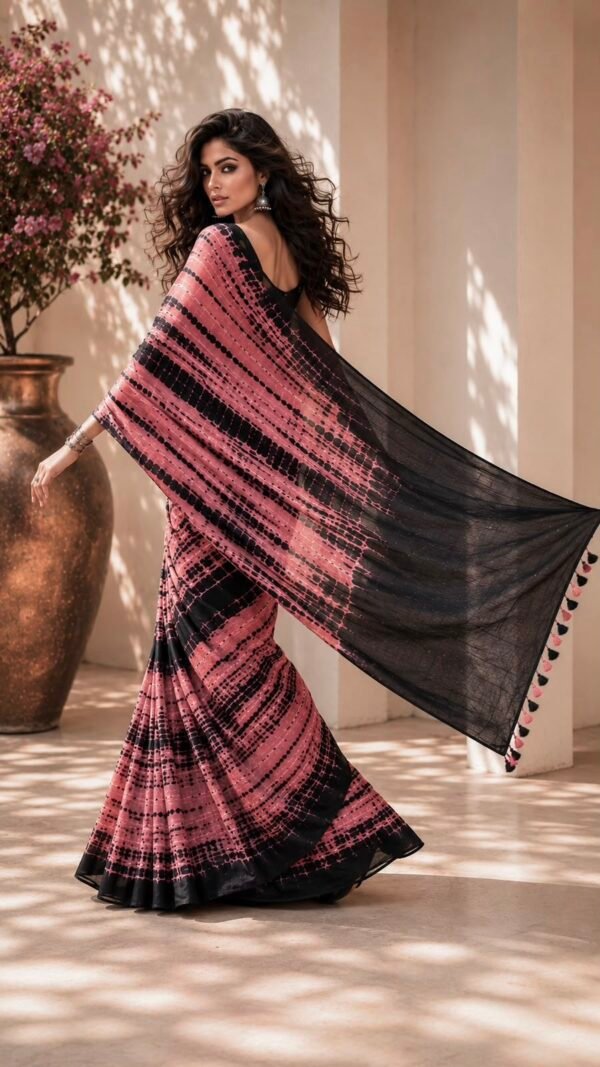
The shibori pattern advances across the dusty rose body in broad horizontal bands of deep black oval-chain forms — the characteristic resist-zone sequence of the shibori tradition, each band a separate layer of the pattern building from the hem toward the shoulder. The full pallu section is the deepest zone: the black at maximum density, the dusty rose almost entirely covered, the mul fabric in this section reading as near-solid black with the shibori pattern visible as slightly lighter relief at close range. The transition from the dusty rose body to the black pallu is the saree’s most dramatic compositional moment: the evening arriving at the end of the fabric the way it arrives at the end of the day.
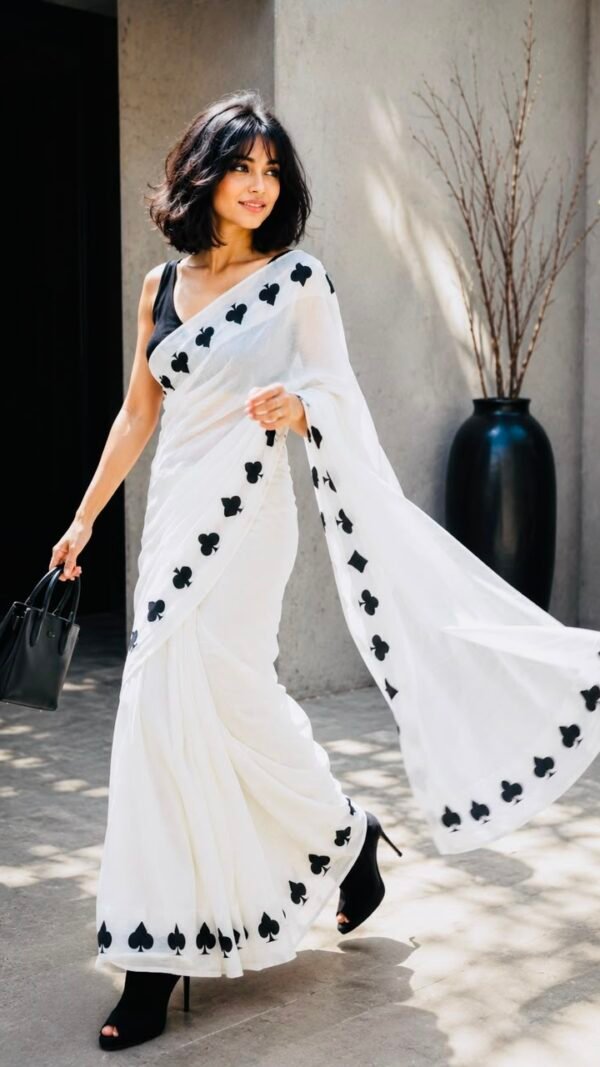
In the reference image, the woman walks through the terracotta courtyard, the pallu extended in motion, the black pallu against the warm terracotta wall and the dappled shadow on the stone. The mul cotton in motion shows the shibori pattern in movement — the horizontal bands shifting as the fabric moves, the pattern that was horizontal in drape becoming curved and flowing in extension. The name is Sayam. The evening hour. The specific transition that the colour was made for.
The shibori tradition described in Varsha (Saree 42) applies here in its full context. The resist-dyeing logic — fabric tied, clamped, or wrapped to protect specific areas from the dye bath, the pattern appearing when the resist is removed — is the same technique. What changes between Varsha and Sayam is the colour relationship and the pattern scale.
Sayam’s shibori pattern runs in broad horizontal bands across the full body: wide swaths of black oval-chain resist patterns alternating with sections of the dusty rose ground. Where Varsha’s arashi pole-wrap shibori produced vertical chains of closely spaced ovals, Sayam’s pattern reads as horizontal bands of larger, more open oval forms — the specific binding and compression technique producing a wider, more spacious shibori form. At the pallu, the resist is minimal: the black dye bath reaches most of the pallu surface, the dust rose ground retreating almost completely, the shibori pattern visible only in the ghost form of the resist zones at close range.
Mul cotton as the shibori base has the same qualities described in the Sitara and Rani pages: the fine, open weave of mul allows the dye to penetrate the full fabric depth quickly and evenly, the resist zones protected by the binding pressure from the dye bath. The shibori pattern on mul has a softness at its edges — the resist boundary slightly less defined than on denser cotton — that gives the oval forms their characteristic fuzzy edge, the blur that is the signature of the resist technique. The pattern on Sayam’s mul looks like it has been breathed onto the fabric rather than printed. That is the resist technique’s specific quality on fine cotton.
• Wash: Hand wash in cold water with a very mild detergent. The dusty rose and the black shibori are each active dye lots; cold water and gentle handling protect both.
• First wash: Wash separately in cold water. The black shibori areas will release colour on the first wash and may affect the dusty rose ground if the saree soaks for any length of time. Wash quickly, do not soak.
• Colour transfer: The black shibori and the dusty rose are in close proximity across the full body. In water, some colour migration between the two can occur if the saree is left wet and folded. Lay flat immediately after washing.
• Mul cotton: Do not wring. Press water out gently. Mul cotton loses its structure when twisted while wet.
• Do not: Machine wash, bleach, or use fabric softener.
• Iron: Low heat on the reverse side only. Never iron mul cotton at medium or high heat. Never iron on the black shibori sections from the front.
• Dry: In shade immediately. The dusty rose is UV-sensitive and will shift toward a paler, more neutral tone under extended direct sun exposure. The black shibori fades under UV over time.
• Store: Folded loosely in clean dark muslin, away from light. Keep away from light-coloured garments permanently — the black shibori transfers in humid storage.
Sayam means evening.
The specific hour between the orange of sunset
and the full arrival of the dark.
The sky at sayam is exactly this colour:
the dusty rose that holds the warmth
before the dark advances into it.
The shibori pattern is the dark advancing.
Horizontal band after band,
the black moving up from the hem
the way the night moves up from the horizon.Mul cotton is woven air.
At sayam it is the lightest garment
in the warmest light.
The shibori moves with it.
The evening moves with her.
Reviews
There are no reviews yet.