
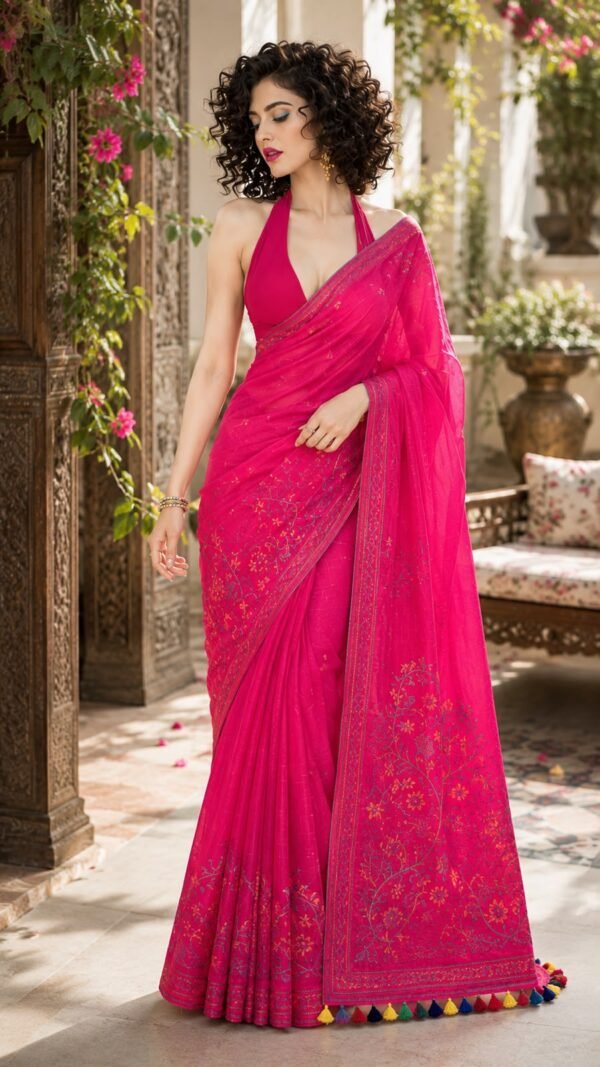
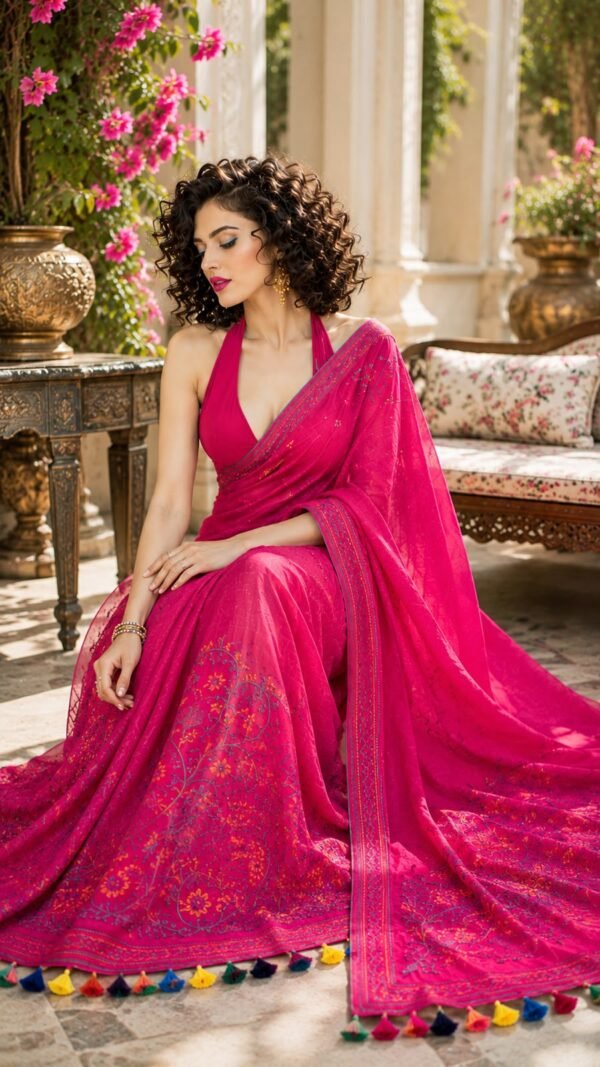
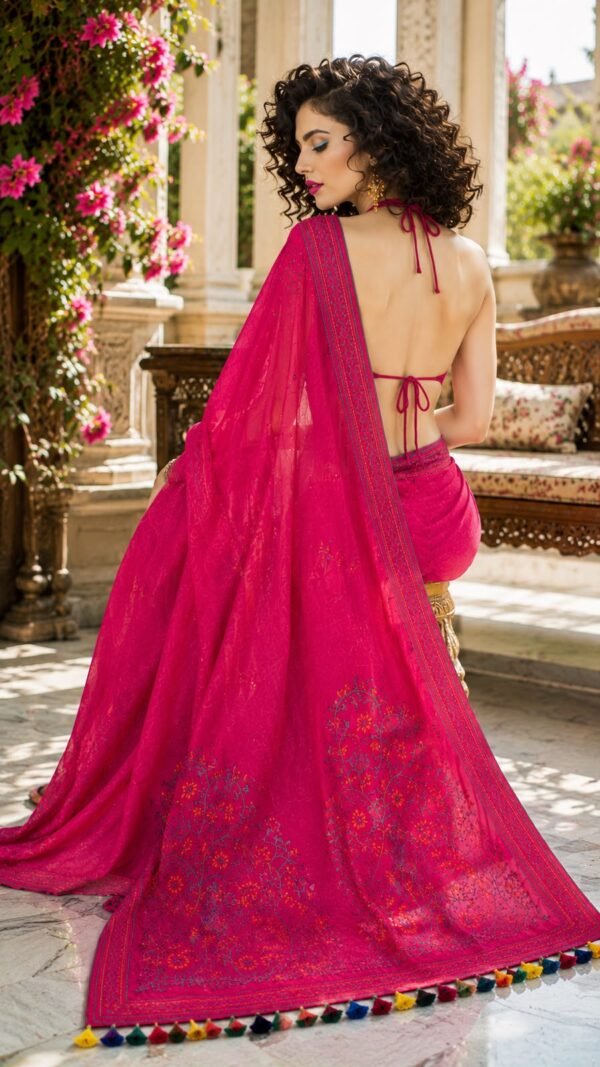
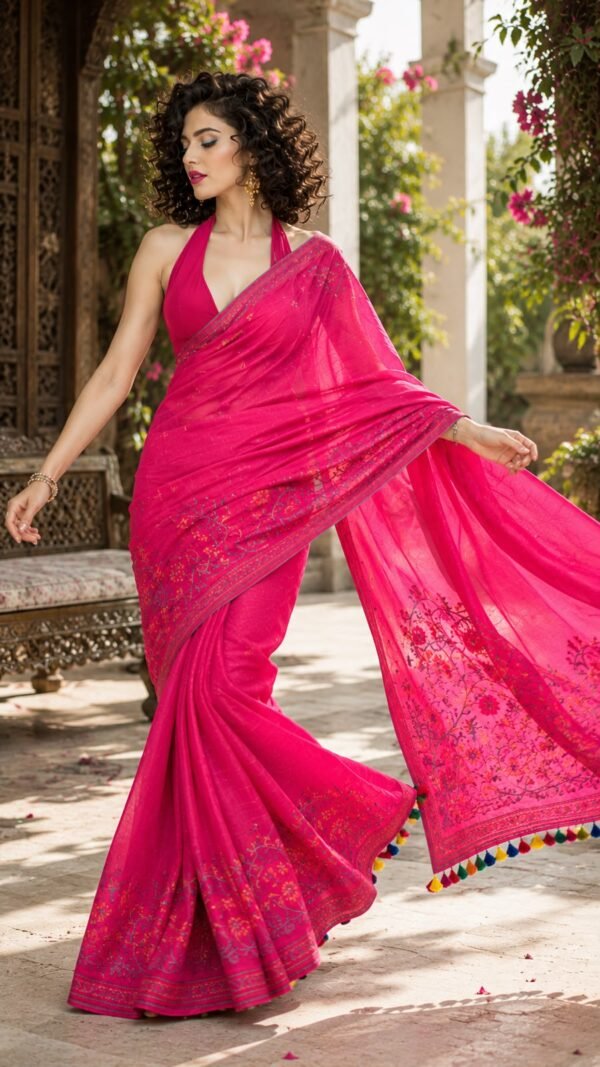
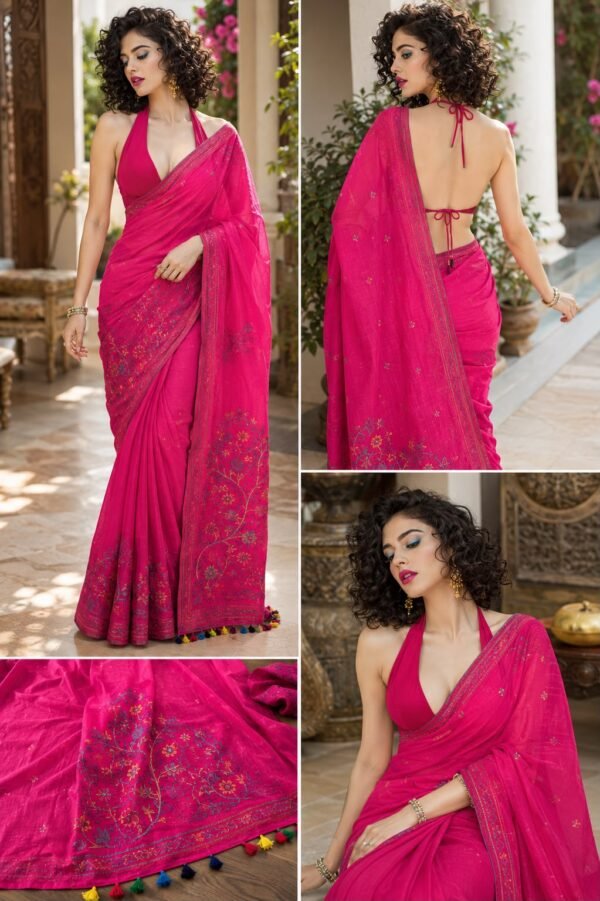

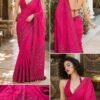
Rani Mul Cotton Saree in Rani Pink with Kantha Hand Embroidery and Multicolour Tassels
Sarees₹2,250.00
& Free ShippingRani means queen.
It also means this specific pink:
the hot pink-magenta that does not soften
and does not ask permission
and has been the colour of Rajasthani royalty
for as long as royalty has chosen its own colours.
Mul cotton is woven air.
The lightest cotton in the collection.
The rani pink on mul is not solid.
It moves with the fabric.
In afternoon light it is one colour.
When the woman moves it becomes another.The Kantha needlewoman took this pink
and put every other colour into it.
Yellow, orange, blue, green —
each one a running stitch on the rani ground.
The flowers are not softening the pink.
They are celebrating it.
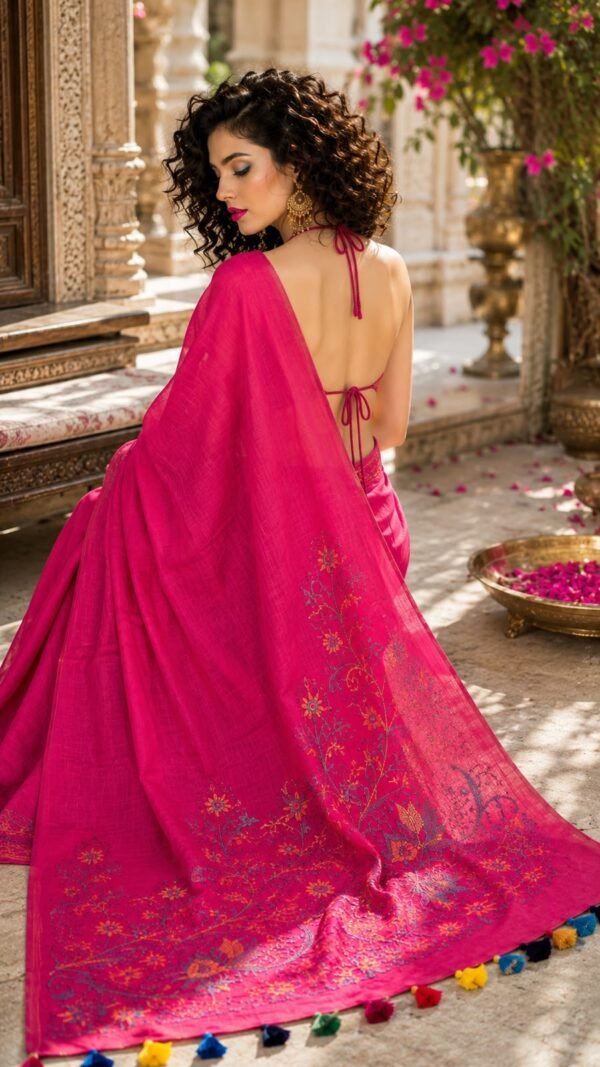
Rani pink is not a name given to a shade that happened to exist. It is the colour the queens of Rajasthan chose for ceremony and celebration — the specific hot pink-magenta that stands alone without needing any other colour to define or moderate it. At full saturation on mul cotton, it reads as one of the most vivid colours in the collection: louder than the coral of Phool, more commanding than the rose-pink that appears in other sarees, completely certain of its own authority. The mul fabric amplifies this quality: the fine-count cotton, with its open weave and natural drape, carries the rani pink in folds that shift colour slightly as the fabric moves, the same magenta reading as slightly different values in direct and indirect light.
Mul cotton is the lightest fabric in this Kantha section of the collection. The Kantha embroidery tradition began on old cotton cloth — layers of worn sari cotton stitched together to create quilts with the running stitch. On mul cotton, the embroidery has a different character than on heavier cotton: the fine ground fabric shows the thread shadow from behind, giving the embroidery a slight luminosity at the stitch line. The needle that carried the thread through was passing through a fabric light enough to read the thread’s shadow through it. The stitches are lighter for it.
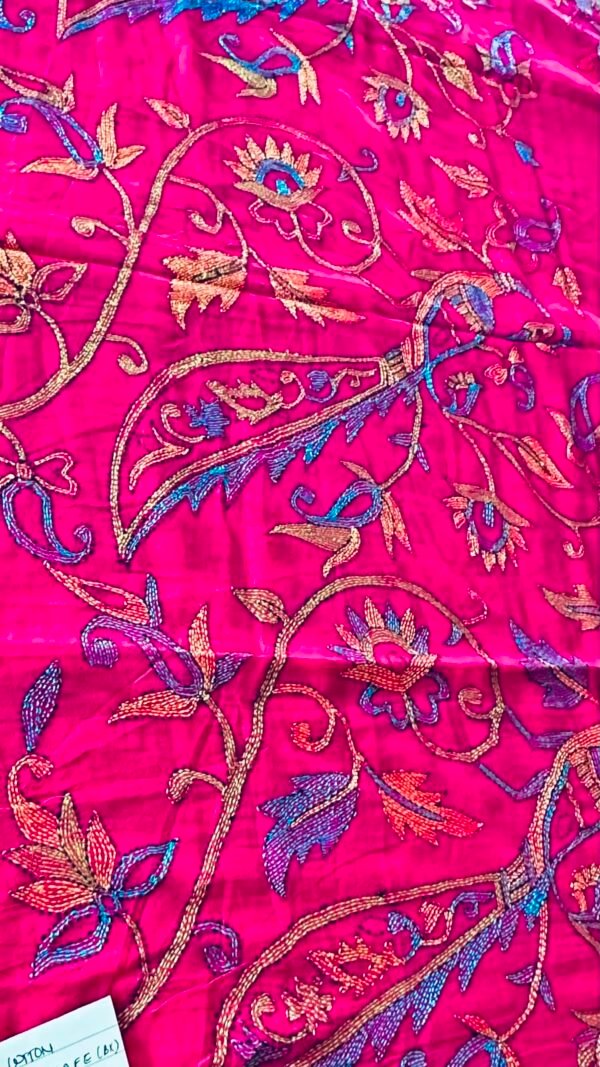
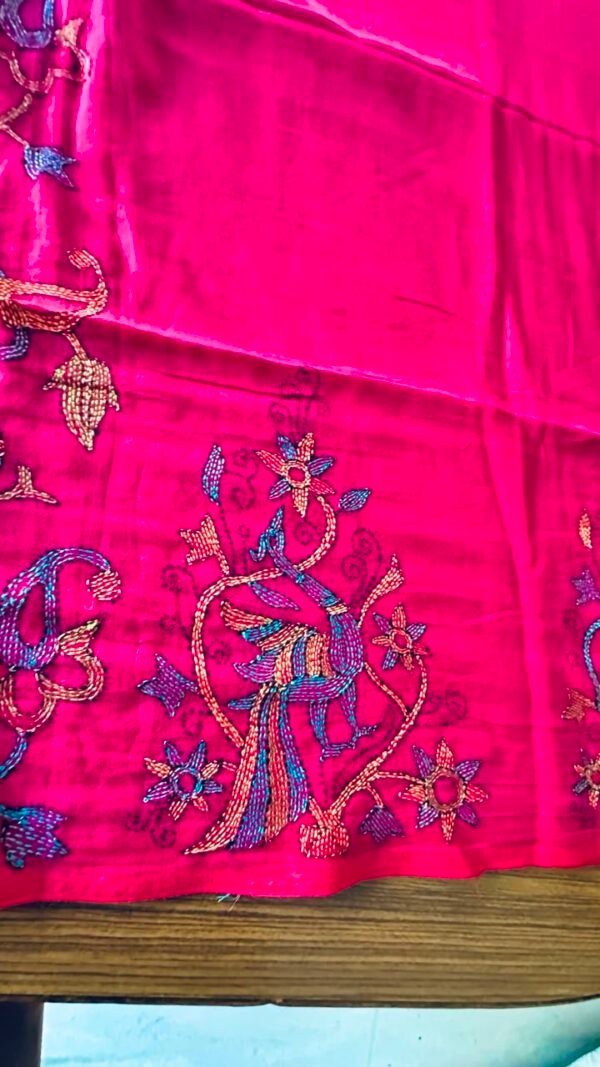
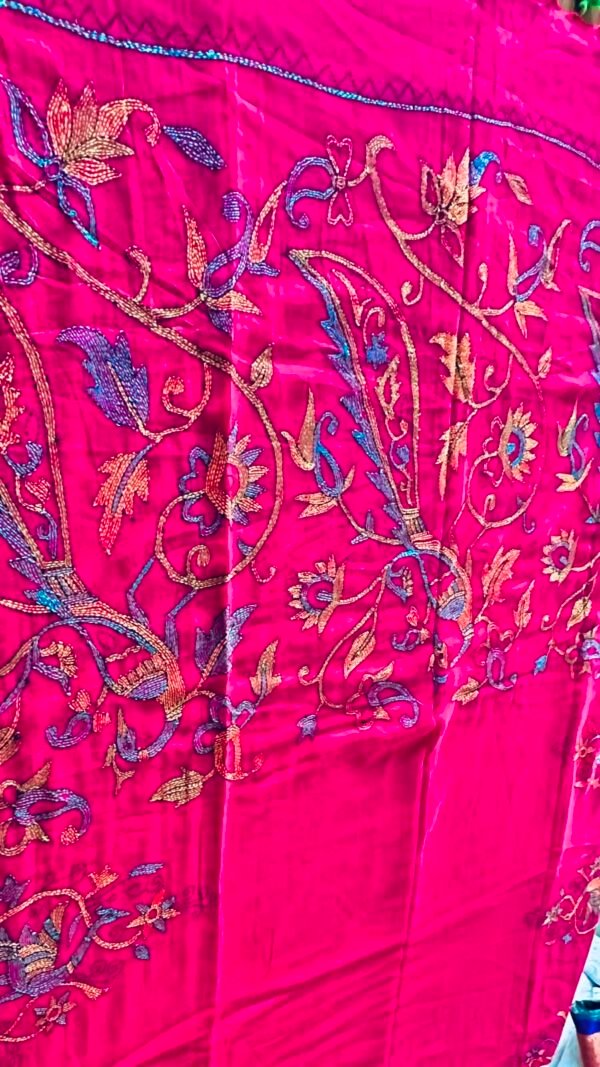
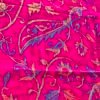
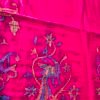
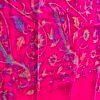
The Kantha embroidery on this saree is the multicolour floral vine tradition: the running stitch building upward from the hem along vine stems, the stem supporting flower and leaf forms in yellow, orange, blue, and green thread. Each colour was chosen by the needlewoman as a counterpoint to the rani pink ground — the warm yellows and oranges sitting on the warm pink, the cool blues and greens providing the contrast the ground colour needs to keep reading as vivid rather than uniform. The border carries a denser concentration of the embroidery, the vine forms visible as a running border at the hem. The multicolour tassels at the pallu hem carry all four embroidery colours simultaneously: yellow, blue, green, and red-orange, each tassel a concentrated point of the same vocabulary at the fabric’s edge.
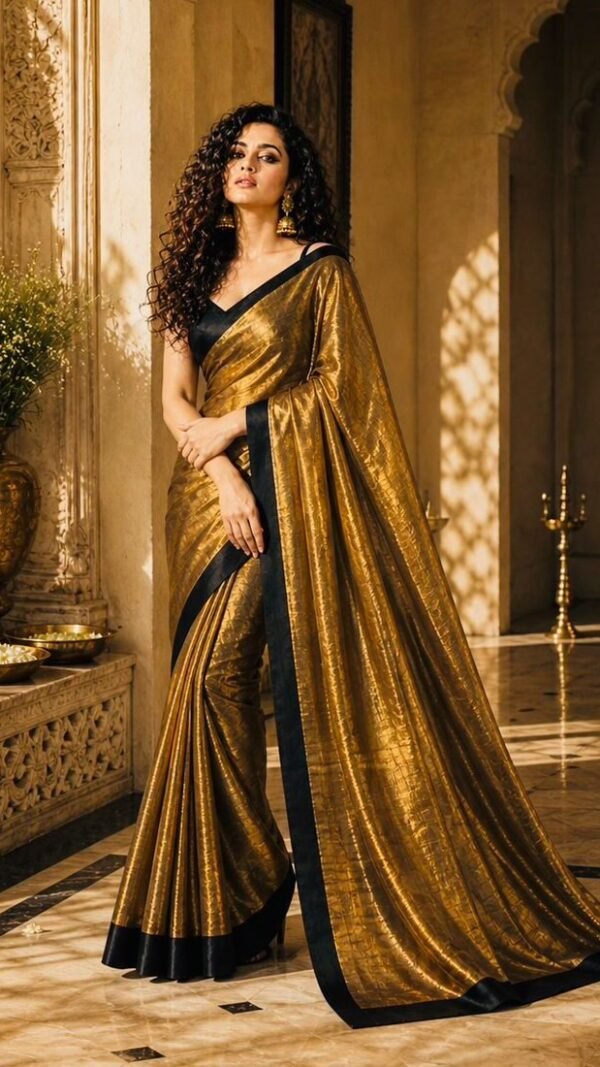
In the reference image, the carved Rajasthani architecture frames the rani pink with the deep teak of the columns, the green of the bougainvillea overhead, and the warm stone of the terrace floor. Rani pink against teak, against green, against stone. The colour does not need the frame to justify it. The frame simply confirms that the colour was always correct. The name is Rani. The queen. This is her colour.
Kantha embroidery on a coloured cotton ground is a specific contemporary evolution of the tradition. The historic Kantha was made on white or natural cotton — the layers of old cloth stitched together with the running stitch to create quilts, the embroidery motifs built from the same running stitch in thread salvaged from the cloth borders. On white cotton, the Kantha thread colours are primary events: the first colour on a light ground. On rani pink mul cotton, the relationship changes. Each embroidery thread colour must negotiate with the ground: the yellow becomes warmer against the pink, the blue colder, the orange merges with the pink at close range and separates from it at a distance.
The Bengal Kantha needlewoman who worked this saree chose the colour palette for this specific ground. The multicolour floral vine on rani pink is a different composition from the same vine on white or cream — each colour decision made in full knowledge of what the pink would do to it. The density of the embroidery — scattered buti on the body becoming denser at the border and pallu — is the standard Kantha composition for a saree: the body establishing the vocabulary, the border concentrating it, the pallu carrying the full design weight at the end.
Mul cotton as the embroidery base requires a specific technique from the needlewoman: the fine, open weave of the mul means each needle passage covers slightly more thread than on a denser cotton ground. The running stitch on mul is proportionally slightly larger than on standard cotton, and the spacing between stitches slightly more open. The result is an embroidery that looks exactly right on mul — the stitch scale matched to the fabric weight — but would look loose on a denser fabric. This embroidery was made for this fabric.
• Wash: Dry clean recommended for the first wash. The rani pink and the multicolour Kantha thread are each sensitive colours; professional care protects both on the first wash.
• Hand wash: After the first dry clean: cold water, mild detergent, no soaking. The rani pink may release slight colour on early hand washes. Wash separately from light fabrics.
• Mul cotton: Do not wring. Press water out gently. Mul cotton loses its structure when twisted while wet.
• Kantha embroidery: Do not scrub the embroidered areas. The running stitch sits on the surface of the mul; mechanical abrasion pulls the stitch threads out of position over time.
• Tassels: Handle the multicolour tassels gently. The different-coloured threads may bleed onto each other when wet. Separate them gently and lay flat to dry.
• Do not: Machine wash. The agitation and spin cycle are damaging to both the mul cotton and the Kantha embroidery.
• Iron: Low heat on the reverse side only. Never iron directly on the Kantha embroidery from the front. Never iron mul cotton at medium or high heat — the fine count fabric is heat-sensitive.
• Dry: In shade immediately. Rani pink is UV-sensitive and will shift toward coral over extended direct sun exposure.
• Store: Folded loosely in clean dark muslin. Keep away from direct light. Tissue paper between folds at the embroidered sections.
Reviews
There are no reviews yet.