
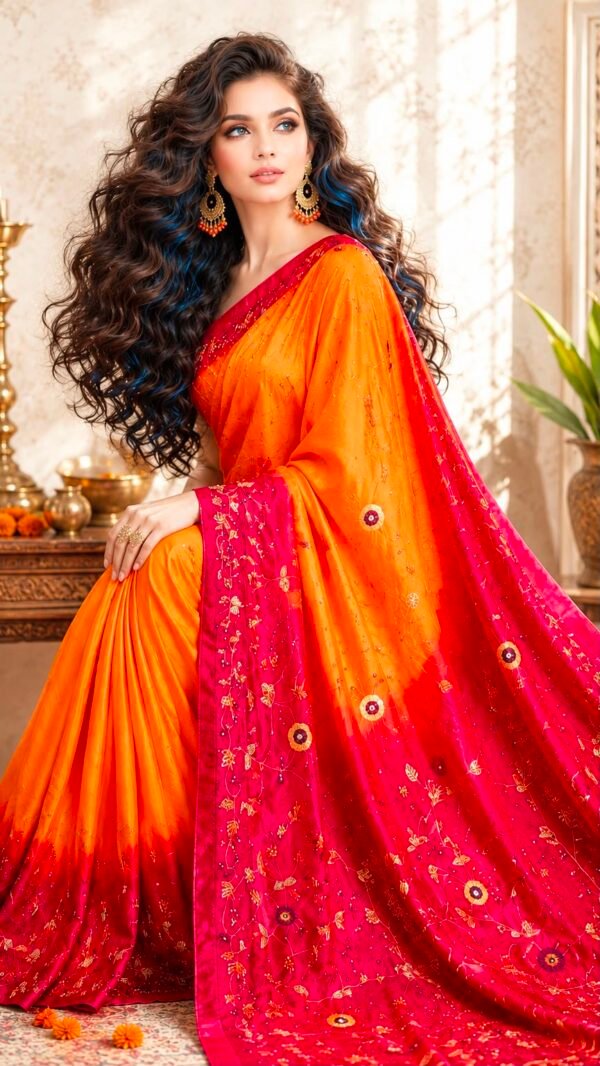



Agni Crepe Saree in Orange-to-Magenta Ombre with Hand Embroidery and Sequin Pallu
Sarees₹12,000.00
& Free ShippingAgni means fire.
The Sanskrit word for the fire that holds
two colours simultaneously —
the warm orange at the centre
and the bright magenta at the edge.Crepe holds the ombre the way fire holds its gradient:
not as a line between two colours
but as a continuous movement from one to the other,
the orange becoming magenta
through every tone between them.The gold embroidery arrived at the magenta pallu
where the fire is hottest.
The vine, the leaf, the sequin, the gold wheel:
the fire’s own vocabulary
placed at the end of the cloth
that burns brightest.
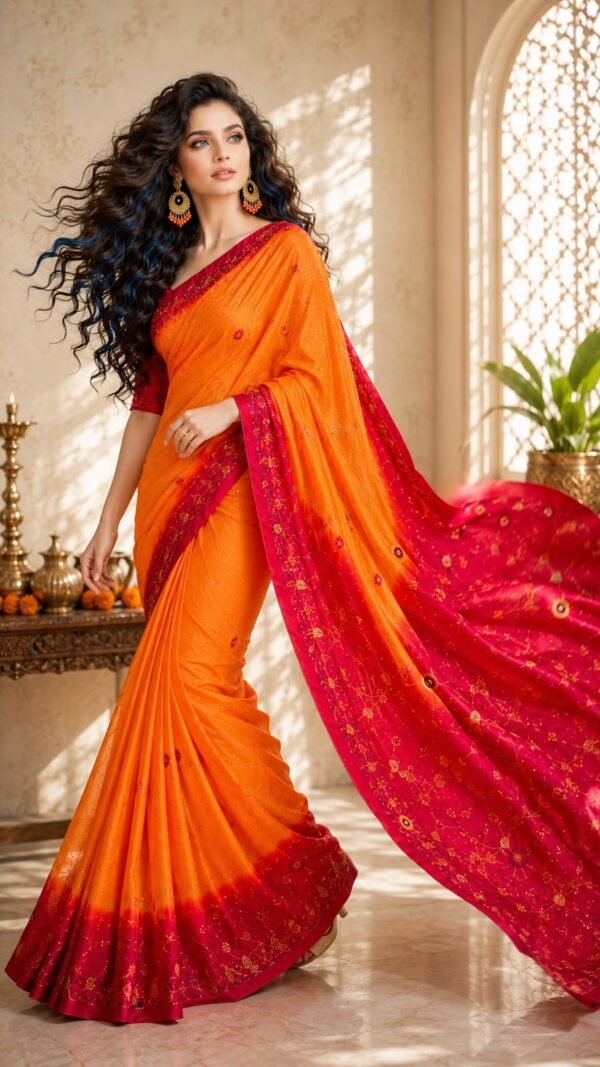
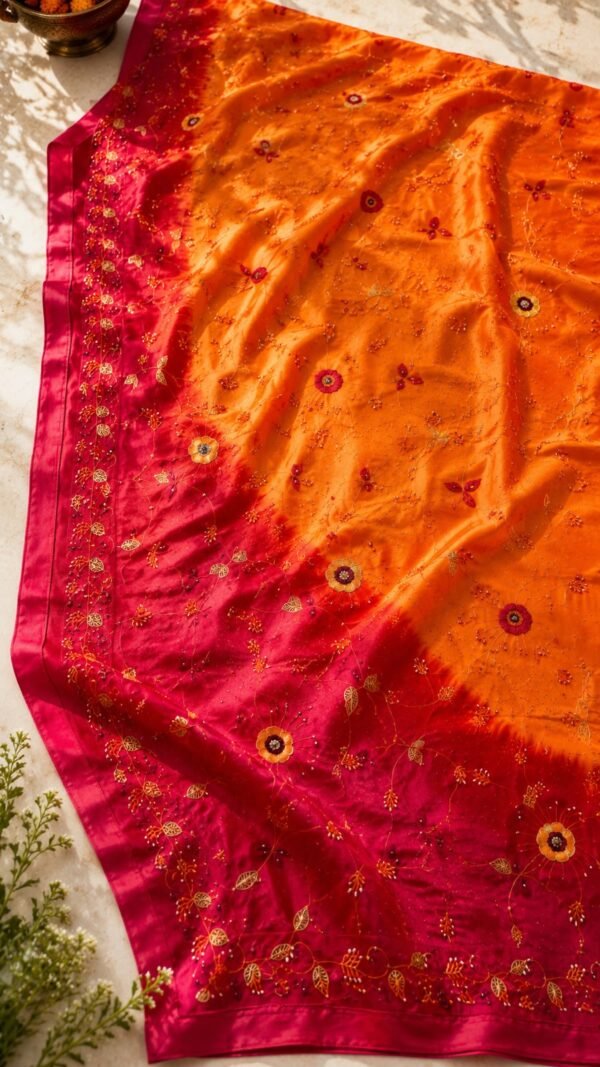
The ombre saree is one of the most technically demanding dying constructions in Indian textiles: the continuous gradient from one colour to another across the full length of 5.5 metres requires the dyer to maintain a changing dye bath concentration as the fabric moves through it, the transition between the orange body and the magenta pallu achieved without a visible line. The crepe ground — a fabric with a characteristic pebbled surface created by the twisted thread construction — holds the ombre dye with a depth that flatter fabrics cannot achieve: the pebbled surface creates micro-variations in the dye uptake, the gradient reading as warmer and more complex at close range than a smooth fabric would produce.
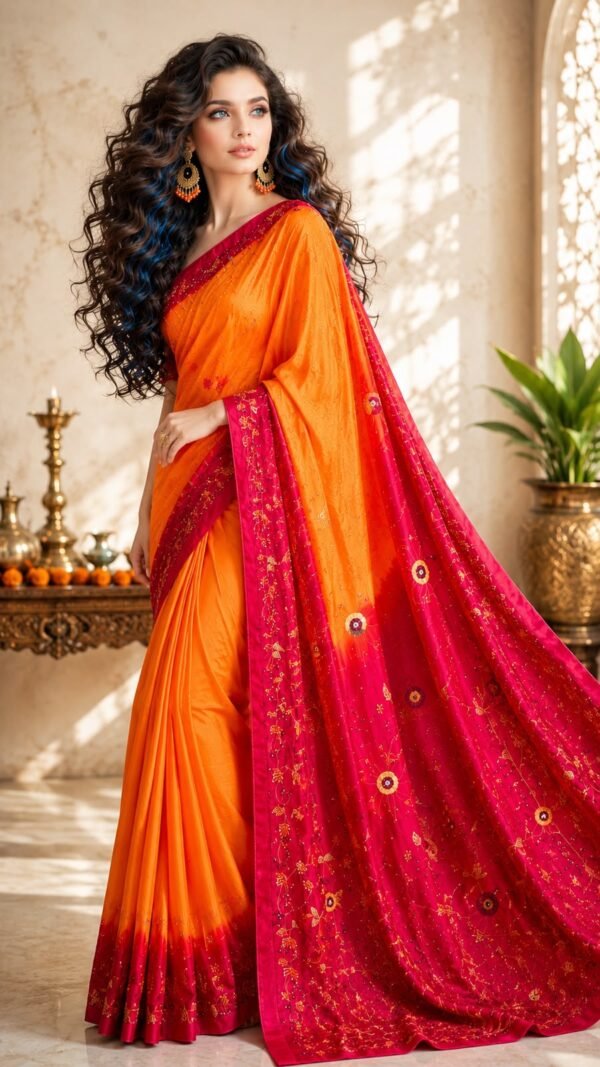
The orange body of the crepe carries the ombre from its warmest point: the specific orange that sits midway between yellow and red, the colour of a flame at its core. As the saree moves toward the pallu, the orange shifts through a brief zone of coral before arriving at the hot pink/magenta. The magenta pallu is the saree’s most active surface: the embroidery, the gold, and the sequins are all concentrated here, the decoration placed at the colour that commands the most attention. This is the correct design decision — the plain orange body allows the eye to travel toward the embroidered magenta pallu without distraction.
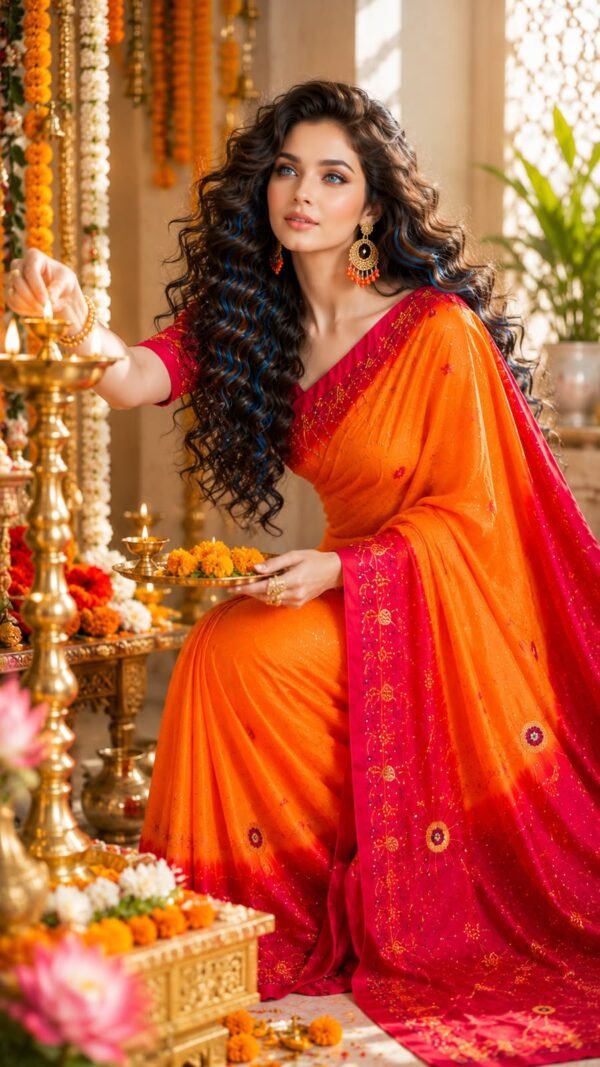
The pallu embroidery is built from two techniques. The hand-embroidered gold zari trailing vine carries the Parsi-influenced floral vocabulary: delicate gold thread tracing the vine line and the leaf forms, butterfly and insect motifs at the vine junctions, the embroidery light and open rather than dense and covering. At intervals across the pallu, large circular chakra motifs in gold thread surround a deep red or maroon centre — the wheel form that appears in both Mughal decorative art and in the Parsi embroidery tradition, the gold surrounding the deep centre the way the flame surrounds its dark core. Scattered sequins across the pallu catch and scatter the light as individual points between the larger embroidered elements.
The full composition — plain warm orange body, gradient transition, embroidered magenta pallu with gold and sequin — is the saree of the festive occasion: the one that reads across the room as fire, at close range as gold. The name is Agni: the fire that is simultaneously the orange at the centre and the magenta at the edge, the warm and the bright at once.
The hand embroidery on the Agni pallu uses the zari and resham vocabulary of North Indian decorative embroidery traditions: the gold metallic thread forming the vine and leaf structures, the resham (silk thread) used for any coloured accent elements, the sequins applied as individual points of metallic light. The trailing vine composition — a continuous scrolling line carrying leaf and flower forms — is among the most ancient embroidery vocabularies in Indian textile art, appearing in Mughal jama embroideries, Kashmiri shawl borders, and Parsi gara sarees. On the magenta crepe of Agni, the gold vine trails across the pallu surface in the open composition style — the ground visible between the embroidery elements, the vine chosen for its movement rather than its coverage.
The circular chakra motif is the pallu’s focal point. The gold thread building outward from the deep red centre, the wheel structure radiating to its border, the full motif a complete composition placed at intervals across the pallu. These motifs carry the embroidery’s maximum gold thread density — they are the places where the fire burns brightest.
- Wash: Dry clean only. The ombre crepe, the gold zari embroidery, and the sequins all require professional care.
- Ombre dye: The orange-to-magenta gradient is a specific dye construction. Water immersion and mechanical agitation can affect the gradient transition zone. Dry clean protects the ombre permanently.
- Sequins: Applied individually. Do not catch, pull, or rub the sequin areas.
- Gold zari: Do not expose to moisture. Tarnishes on contact with water. Dry clean only.
- Do not: Machine wash, hand wash, wring, bleach.
- Iron: Low heat on the reverse side. Never iron on the embroidered pallu or sequin areas from the front. Never iron gold zari directly.
- Dry: In shade. The magenta is UV-sensitive.
- Store: Folded in clean acid-free tissue. Tissue paper between the embroidered pallu and the body to protect the gold from the crepe surface.
Reviews
There are no reviews yet.