
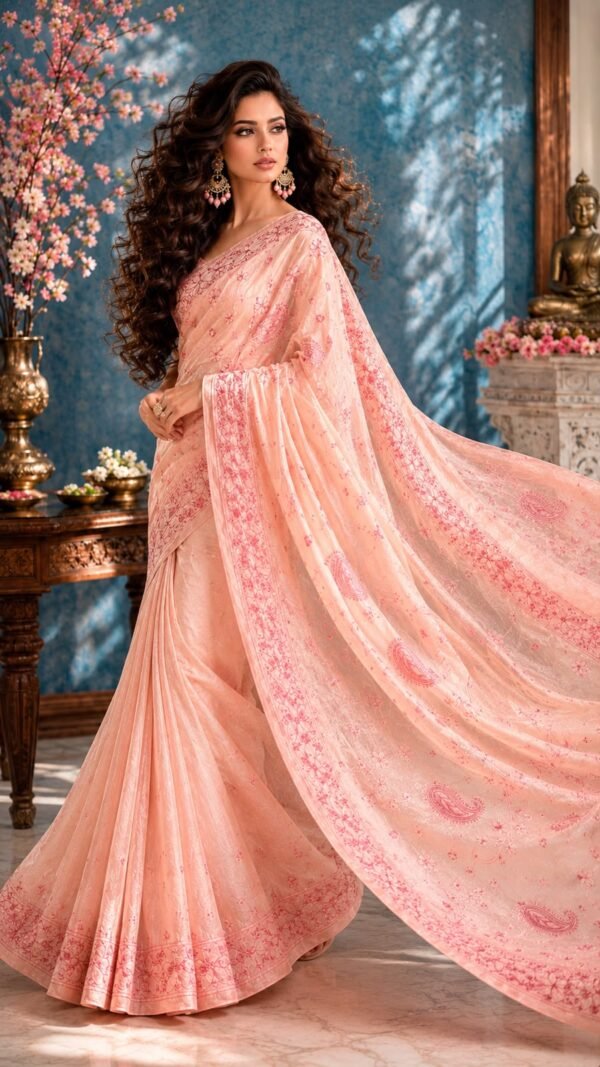
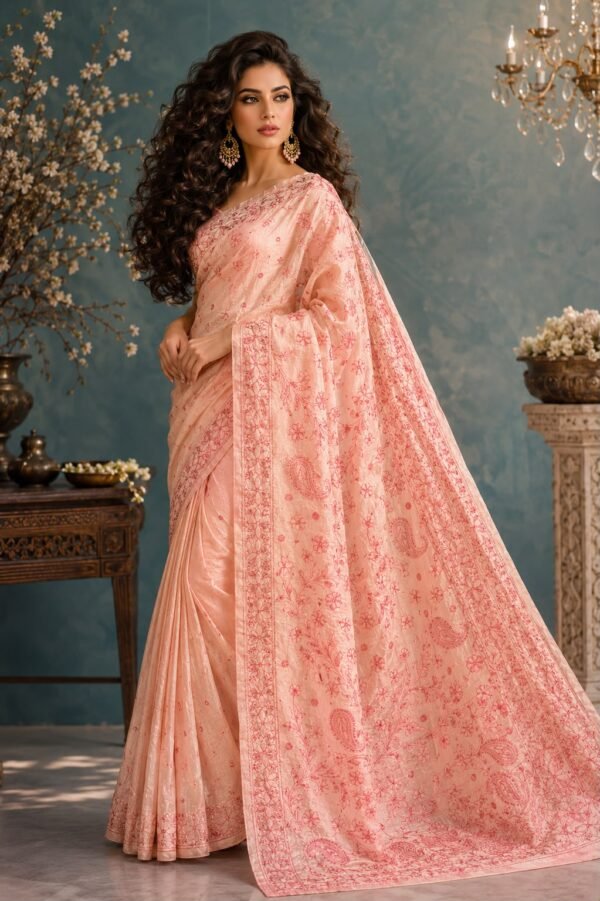
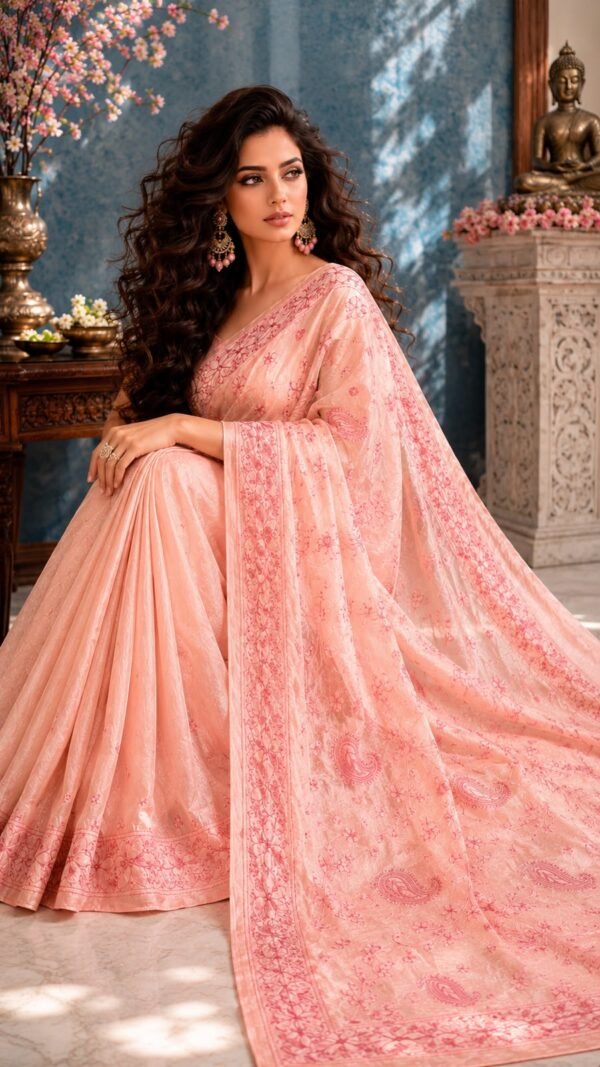
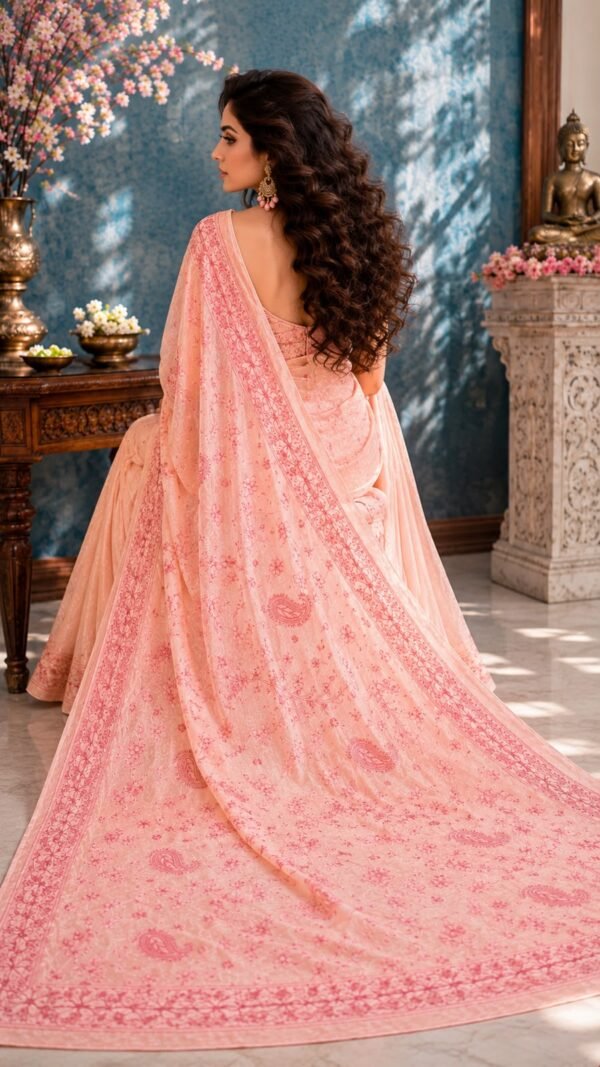
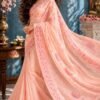
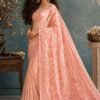
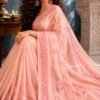
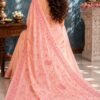

Keri Tussar Silk Saree in Blush Pink with Hand Chikankari
Sarees₹18,500.00
& Free ShippingKeri is the mango bud.
The paisley form — the teardrop that curves at its tip,
the form that Indian textile art
has been repeating for a thousand years
because it has never found a reason to stop.
The Chikankari tradition of Lucknow
placed the keri at the center of this saree
the way it has always placed it:
large, confident, surrounded by the smaller vocabulary
of the scattered buti and the flower border.The tussar beneath it came from Jharkhand.
The silk of the wild silkworm, dyed blush pink,
carrying the embroidery tradition
of a city three states away.
Two Indias. One saree.
The Chikankari tradition of Lucknow has worked on cotton muslin for centuries. The fine white muslin was the original ground — the needle passing through the loose plain weave, the shadow stitch visible from the front as the thread colour shows through from below, the flat stitch sitting on the surface, the pulled-thread jali opening the weave where the needle pulled adjacent threads apart. The embroidery was designed for cotton. Putting it on tussar silk is a specific departure from the tradition’s original material conditions — and the departure produces a result that the cotton ground cannot produce.
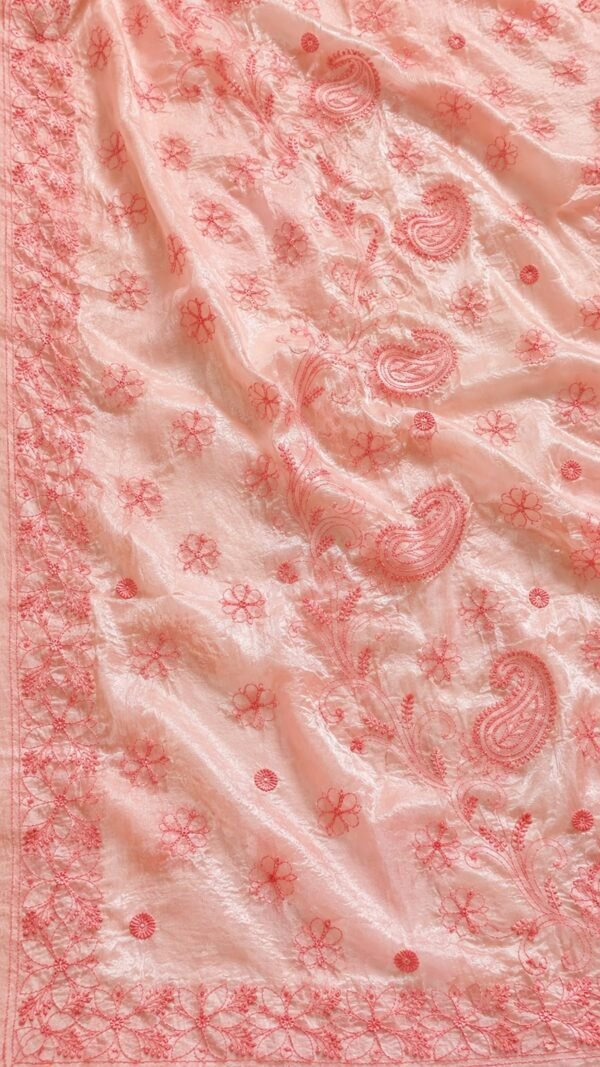
Tussar silk is not smooth. The wild Antheraea mylitta silkworm produces a thread with natural variation in diameter along its length, the resulting fabric carrying a slight surface unevenness — the slub — that is visible as a texture across the full cloth. The Chikankari stitch on this surface does not sit against a uniform ground: it sits against a surface that is itself patterned by the weave and by the thread variation. The coral-pink Chikankari thread on the blush pink tussar reads as a slightly deeper tone against a surface that has interior movement — the slub creating a constant subtle light variation beneath the embroidery.
The keri motifs — the large paisley forms that dominate the saree’s upper body — are the Chikankari tradition’s most recognisable form. The keri is the stylised mango bud: the teardrop that curves at its tip, the form that entered Indian textile art through Mughal Persia and has never left. In the Chikankari vocabulary, the keri is typically built from multiple stitch types: the outline in a stem stitch, the interior filled with flat stitch or jali openwork, the tip and the curved edge in murri or phanda raised stitches. On the blush tussar of Keri, the large keri motifs in coral-pink thread carry the full vocabulary: the outline, the fill, the raised detail. Each keri is a complete Chikankari lesson.
The scattered buti between the keri motifs carry the smaller Chikankari forms: the five-petalled flowers, the circular murri buti filled with the raised seed stitch, the small daisy forms that the Chikankari embroiderer places between the larger motifs to cover the ground completely without any single buti touching another. The floral border at the hem runs the full saree length: alternating larger and smaller flower forms in the same coral-pink thread, the border vocabulary consistent and continuous. The name is Keri: the mango bud, the form that the tradition placed at the center and kept there.
Keri brings together two craft traditions that have never appeared on the same surface in this collection until now. The Chikankari embroidery of Lucknow belongs to the Awadhi cultural tradition — the embroidery refined in the nawabi courts of 18th and 19th-century Lucknow, practised in the mohallas of the old city, the stitch vocabulary transmitted within families and communities over generations. The tussar silk belongs to the eastern Indian forest tradition — the wild silk of Jharkhand, whose cultivation and weaving has its own distinct regional heritage.
The stitches used in the keri embroidery are among the most complex in the Chikankari vocabulary. The large keri motif typically combines: the flat stitch (murri) for the raised seed points; the shadow stitch (tepchi) for the interior fill, where the thread passes below the silk surface and shows through as a softer tone; the stem stitch for the keri outline; and possibly jali openwork at the interior where the needlewoman decides the ground should breathe. On tussar silk rather than cotton, the shadow stitch shows through differently — the silk’s slight translucency at the slub points creating a more complex shadow effect than the uniform cotton ground produces.
- Wash: Dry clean only for the first wash. The blush pink dye on tussar and the coral-pink Chikankari thread are both active dye lots. Professional first wash essential.
- Hand wash (after first dry clean): Cold water only, mild detergent, no soaking. Turn inside out. Do not scrub the Chikankari embroidery areas.
- Chikankari on tussar: The raised murri stitch elements are the most delicate. Do not pull or catch. Handle through non-embroidered areas when wet.
- Shadow stitch: The tepchi/shadow stitch passes below the silk surface. Do not stretch the saree body when wet — stretching can distort the shadow stitch passes.
- Tussar silk: Do not wring. Press water out gently. Lay flat to dry.
- Colour: The blush pink and coral-pink are close tones; any colour release from the coral thread will be less visible than on white, but still wash separately from white or very light garments.
- Do not: Machine wash, bleach, wring.
- Iron: Low to medium heat, reverse side only. Tussar silk benefits from ironing. Never iron on the Chikankari embroidery from the front.
- Dry: In shade. Blush pink is UV-sensitive.
- Store: Folded in clean muslin, away from direct light.
Reviews
There are no reviews yet.