
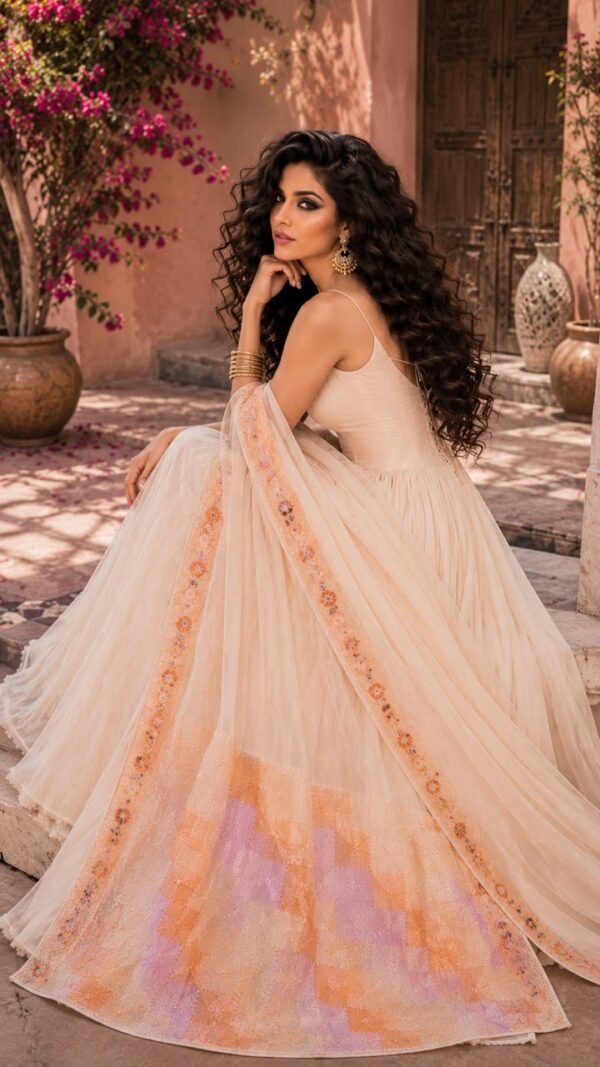
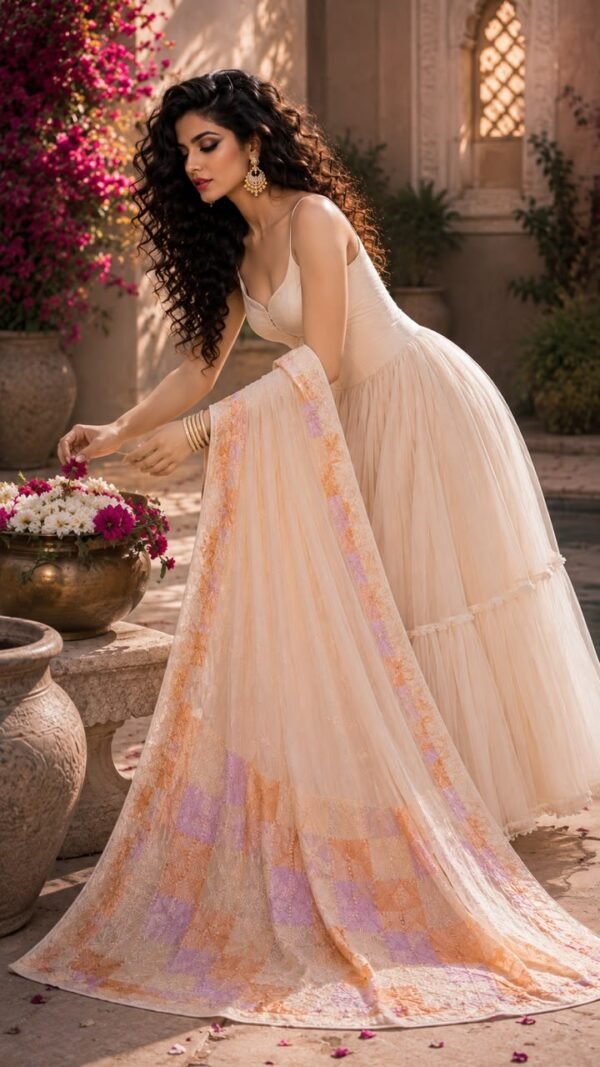
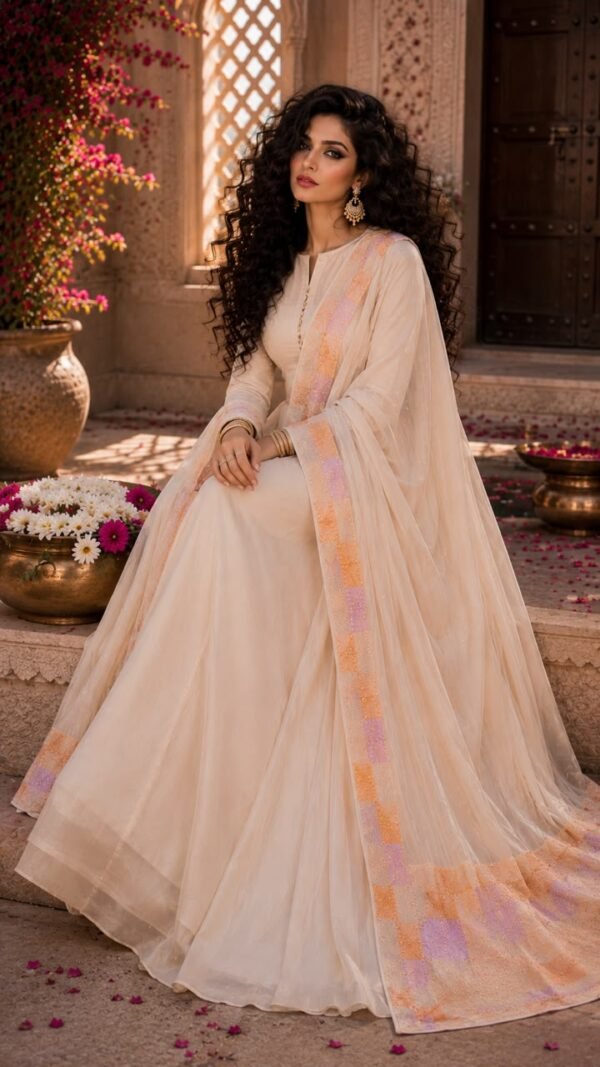






Komal Chiffon Dupatta in Peach with Two-Tone Phulkari Block Border in Peach and Lavender
Dupattas₹8,250.00
& Free ShippingKomal means soft.
The Sanskrit word for the quality of things
that hold their shape without insisting on it —
the petal, the early light,
the colour between two seasons.
The Phulkari tradition has a vocabulary for warmth
and a vocabulary for cool.
Most dupattas in this collection chose one.
Komal chose both.Peach and lavender in alternating blocks:
the warm block, then the cool block,
the warm block, then the cool block,
the border moving between the two colours
the way the light moves between
the morning and the afternoon.
Every other Phulkari dupatta in this collection uses a single colour family for its embroidery: turquoise on white, copper-peach on white, multicolour on white, teal on chiffon, peach-and-silver on tussar. Komal is the only one that places two different colour temperatures side by side in the same border and asks them to coexist. The peach and the lavender are not complementary colours in the strict optical sense. They are complementary colours in the emotional sense: warm and cool, each one the exact colour the other needs beside it to be fully itself.
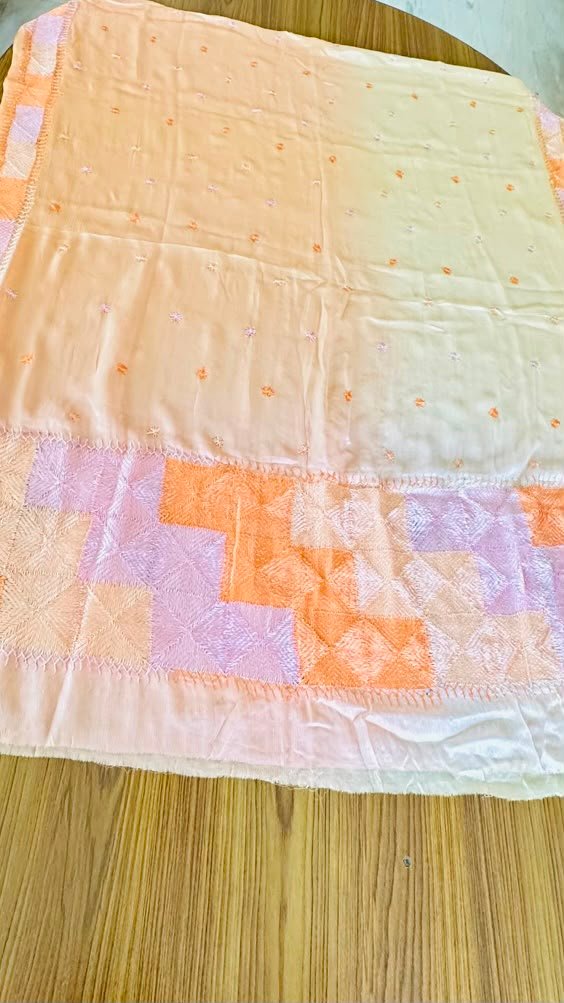
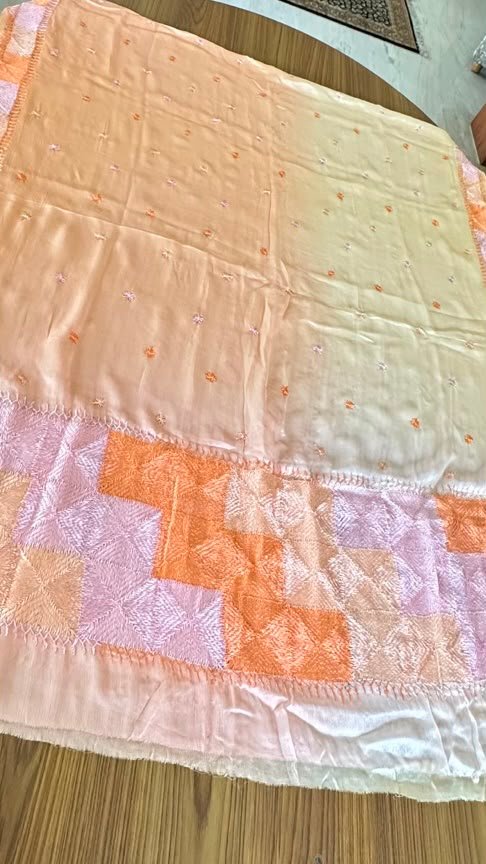
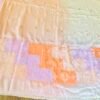
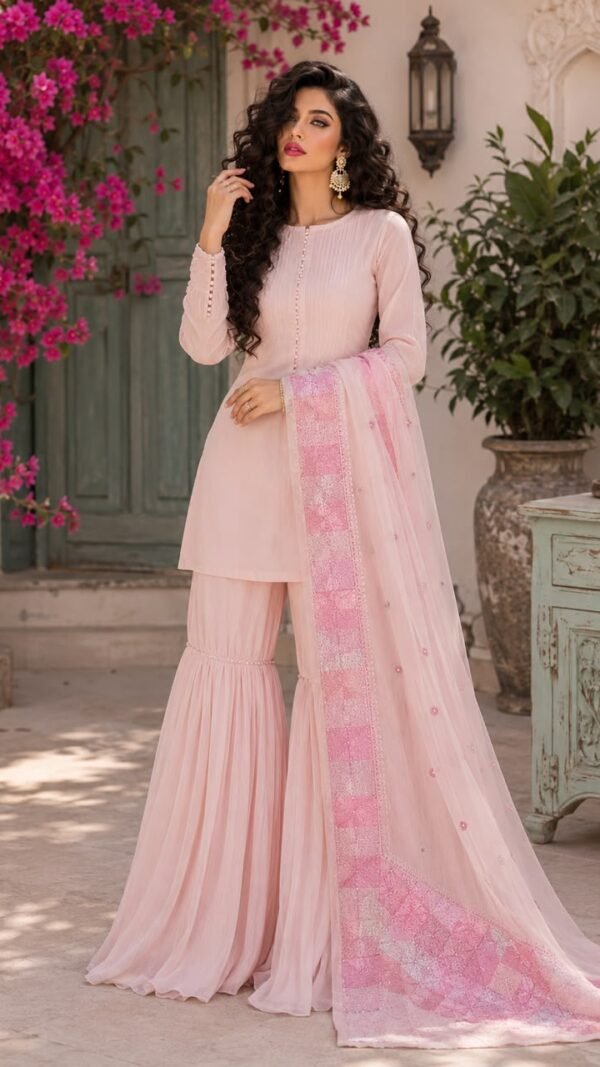
The hem border is the dupatta’s central composition: large geometric square and rectangular blocks alternating in warm peach/orange and cool lavender/lilac, each block filled with Phulkari running stitch geometric forms in the block’s own thread colour. The peach blocks carry the warm Phulkari vocabulary; the lavender blocks carry the cool. At the border scale, the two-colour alternation reads as a pattern of colour rather than a pattern of form — the eye moves from warm to cool and back before the specific geometric detail of each block is processed. The blocks are large enough to establish the colour relationship as the primary statement and detailed enough to reward close inspection.
The soft peach chiffon body is the ground that makes both colours possible. Against a white ground, the lavender would read as the dominant cool. Against a deeper ground, the peach blocks would lose their warmth. The soft peach chiffon is exactly between the two embroidery colours in temperature — warmer than the lavender, softer than the orange-peach of the blocks. The scattered small buti across the body are in the same warm peach as the warm blocks, maintaining the thread palette’s consistency across the full surface.
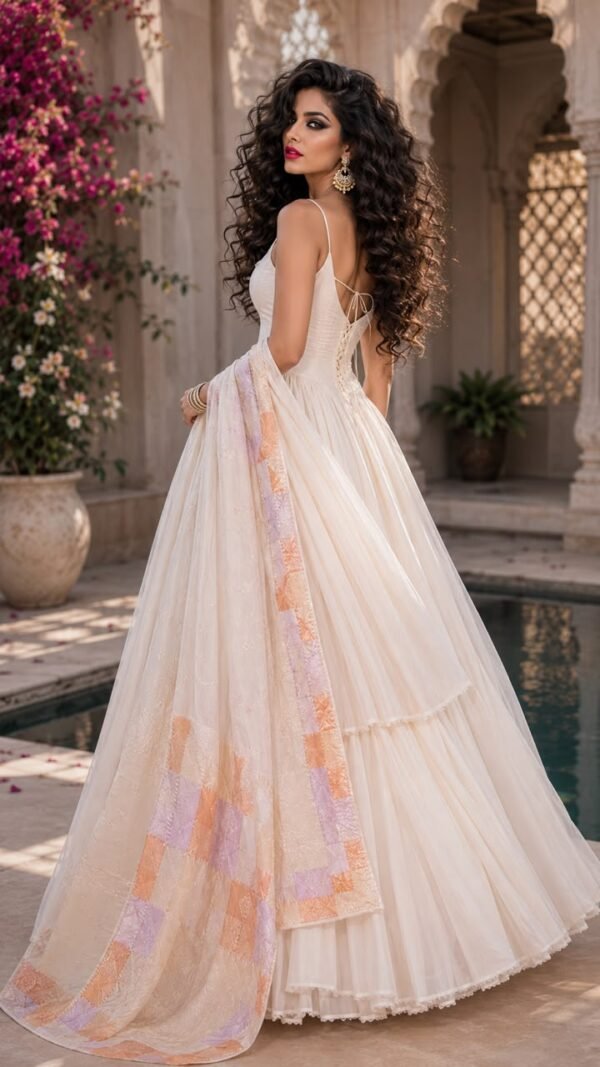
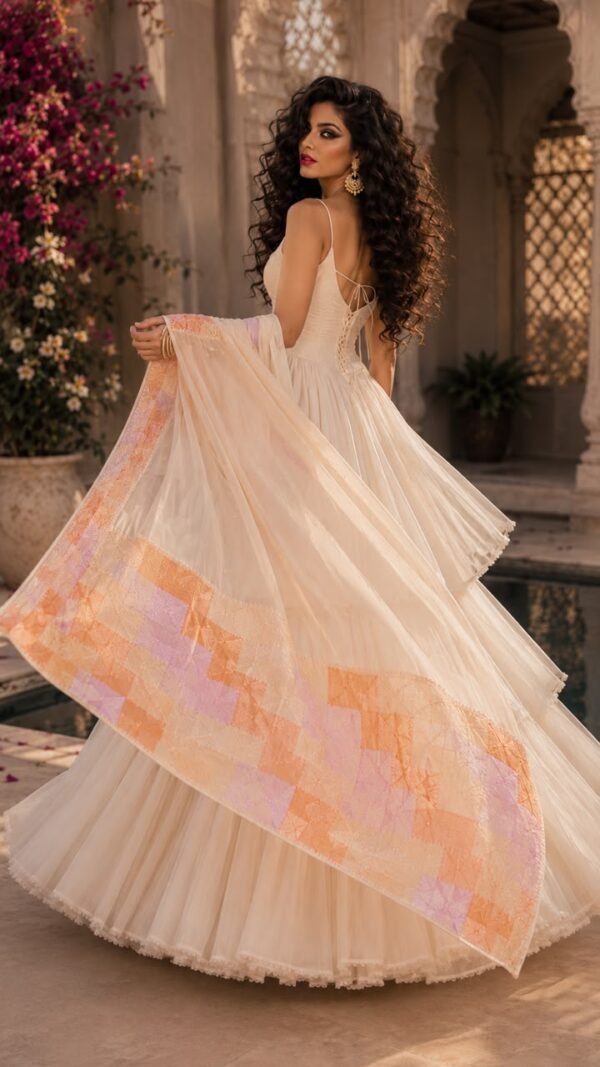
In the reference image, the dupatta is extended in the Rajasthani baoli setting — the warm amber stone of the carved screens, the blue-green of the reflection pool, the afternoon light on the cream anarkali. The two-tone block border in this light reads as the Rajasthani palette itself: the warm sandstone and the cool water, the peach of the Rajasthan afternoon and the lavender of the shadow. The name is Komal: the quality of holding both without asking either to be different.
The two-tone block border on Komal requires the Phulkari needlewoman to work in two separate thread colours across the same border band, maintaining the colour discipline of the alternating blocks without the two threads contaminating each other’s sections. Each block is a complete embroidery unit: the peach thread covers the peach block’s geometric interior, and the lavender thread covers the lavender block’s interior, the boundary between them a clean line where one thread ends and the other begins. At close range in the flat-lay image, the boundary between adjacent blocks is visible as a thread colour change within a continuous geometric structure — the Phulkari form running through both colours without interruption.
The geometric forms within each block are built from the Phulkari running stitch float in the same way as all the collection’s Phulkari borders: the float covering the warp or weft threads in parallel passes, the geometric shape built by the changing length of the float from row to row. The diamond and square forms within each block are visible in the flat-lay at close range. The two-tone execution at the block scale is the specific technical achievement of this dupatta — the warm-cool colour conversation conducted within a single embroidery tradition’s geometric vocabulary.
- Wash: Dry clean only. The peach and lavender threads are different dye families. Any colour release from either onto the soft peach chiffon ground would be visible.
- First wash: Dry clean only, no exceptions.
- Colour separation: The peach and lavender blocks are in close proximity across the full border. Do not allow the dupatta to remain wet and folded — the lavender thread is the higher colour-release risk against the peach ground.
- Chiffon: Do not wring. Do not twist. Press water out between dry towels if ever dampened. Lay flat immediately.
- Do not: Machine wash, hand wash, wring, bleach.
- Iron: Low heat, reverse side only. Never iron on the two-tone block border from the front.
- Dry: In shade. The soft peach chiffon is UV-sensitive and will shift toward a cooler, less warm tone under extended direct sun.
- Store: Rolled in acid-free tissue, then clean muslin. Never fold through the block border. Store away from direct light.
Reviews
There are no reviews yet.