
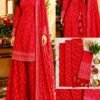





Gulmohar Chanderi Kurta and Cotton Sharara Suit Set in Crimson with Zari Border
Suits & Kurtas₹4,200.00
& Free ShippingThe gulmohar flowers in May.
When every other tree has retreated to green,
the gulmohar opens crimson.
It does not ask the season for permission.
Chanderi is the fabric the Malwa court chose
when it needed something light enough to breathe
and present enough to be seen across a room.
The all-over print is the climbing vine —
tiny, repeated, running across the full fabric
the way the gulmohar’s own branches run.
The zari border at the hem is the answer
the tree gives when asked why it blooms red.
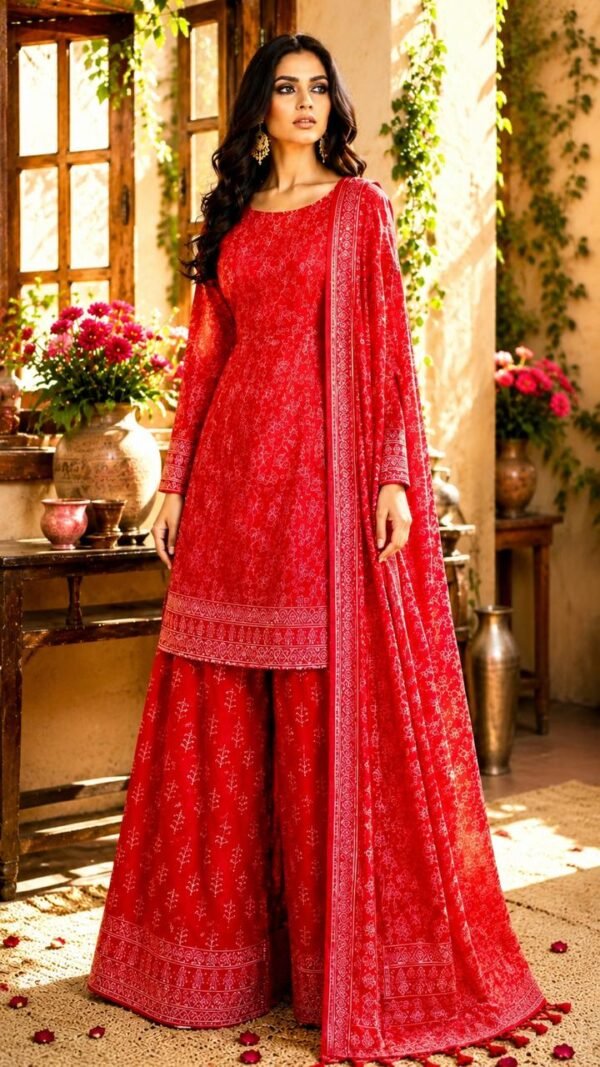
Chanderi has been weaving fine fabric in Madhya Pradesh since the 11th century — the Malwa court’s fabric, the tradition that made cloth light enough for the heat of the Deccan plateau and rich enough for formal occasion simultaneously. Pure Chanderi has a specific quality: a natural luminosity in the plain weave that gives the fabric a soft, quiet sheen. It catches indirect light without demanding it. In this crimson, the Chanderi sheen deepens the colour rather than brightening it. The kurta fabric is the same shade from every angle, but not the same surface.
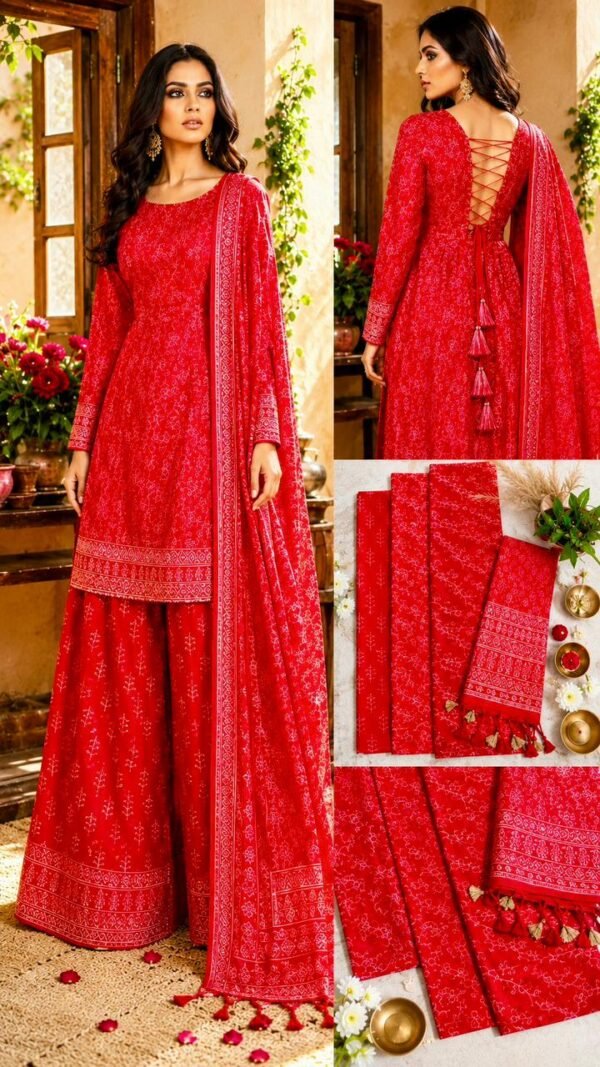
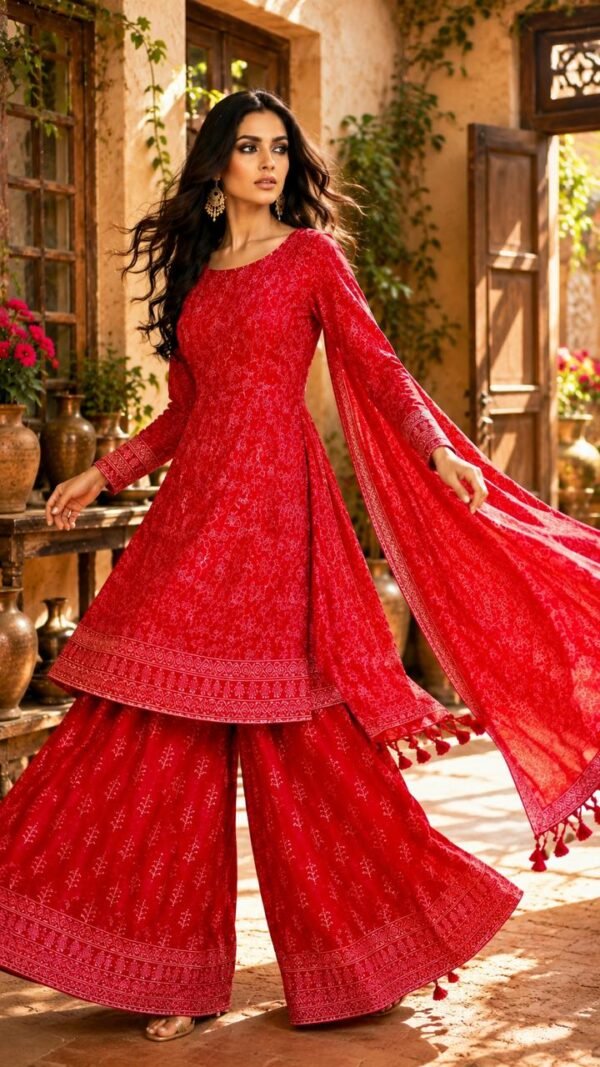
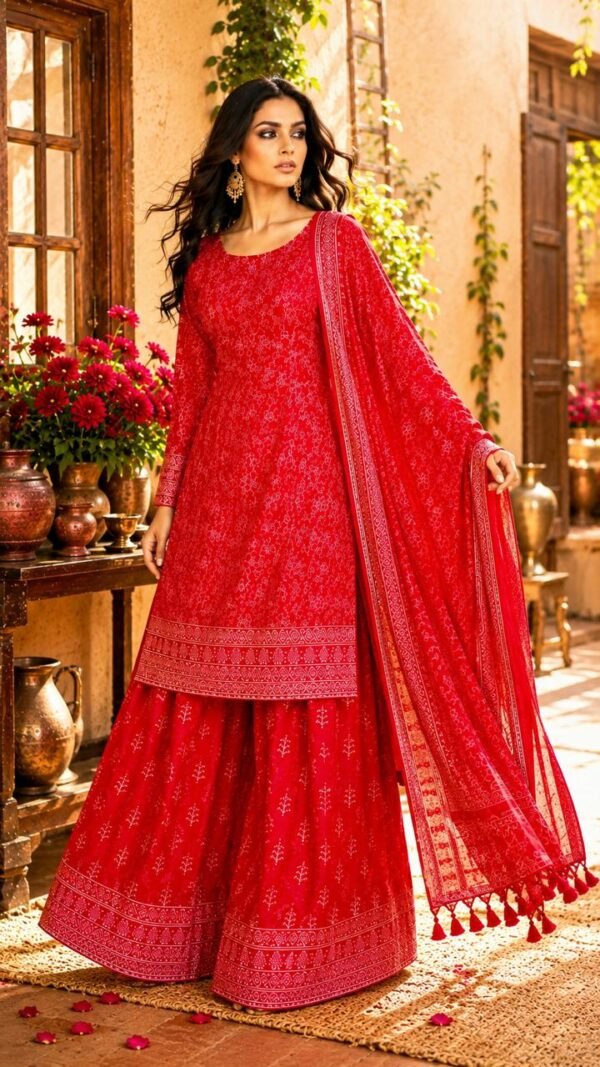
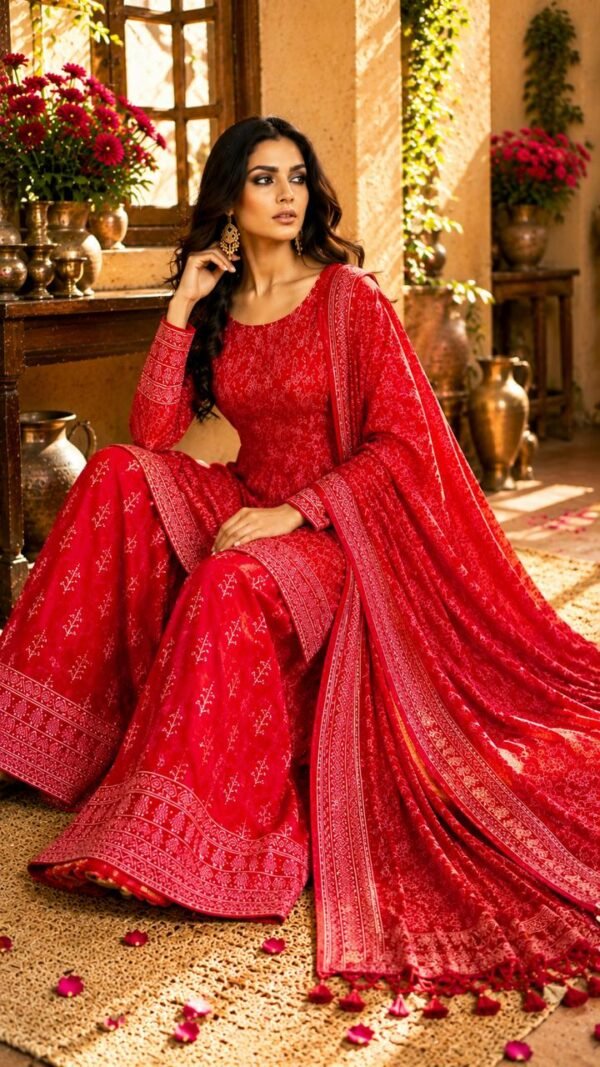
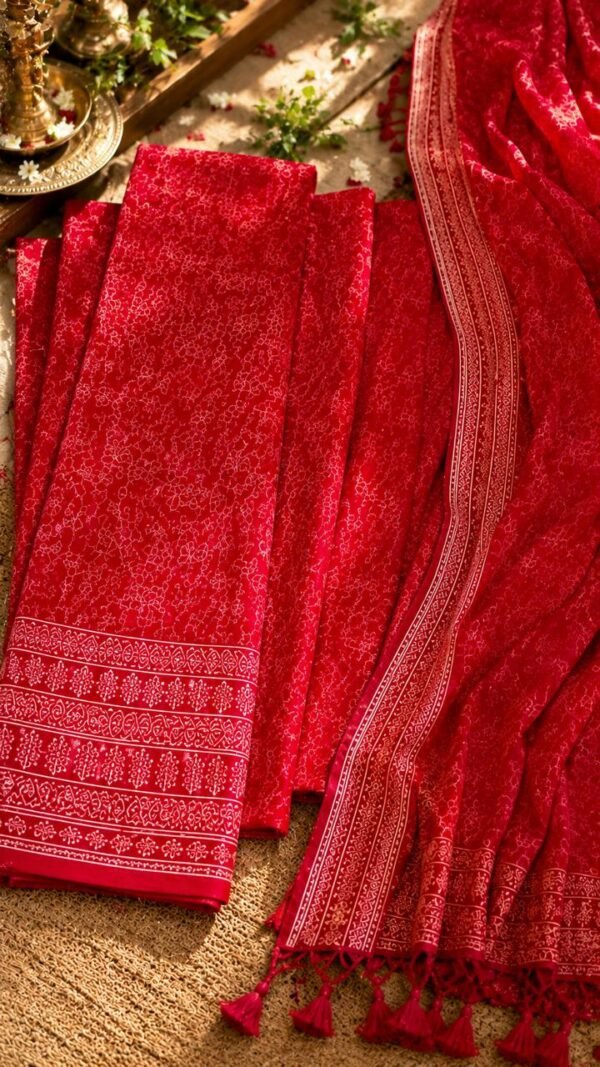
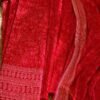
The all-over print is a delicate vine pattern in a slightly lighter crimson — tone-on-tone, visible at close range as a continuous climbing motif across the full fabric body, reading as textured field from a distance. The print covers the kurta fabric from shoulder to hem; the design is everywhere and requires no border to complete it. The zari border is at the hem — a geometric band in gold running along the base of the kurta and the cuffs, the width of the kind of border that knows it does not need to be wider.
The sharara bottom is cotton — the same crimson, the same tone-on-tone vine print, a heavier weight than the Chanderi above it. Cotton carries the gathered silhouette of the sharara correctly: the volume of the wide leg requires a fabric with enough body to swing rather than cling. In the reference images, the sharara falls in broad folds from the hip, the print reading consistently across the full width of each fold. The matching dupatta is cotton with a matching zari border and crimson-and-gold tassels at both ends.
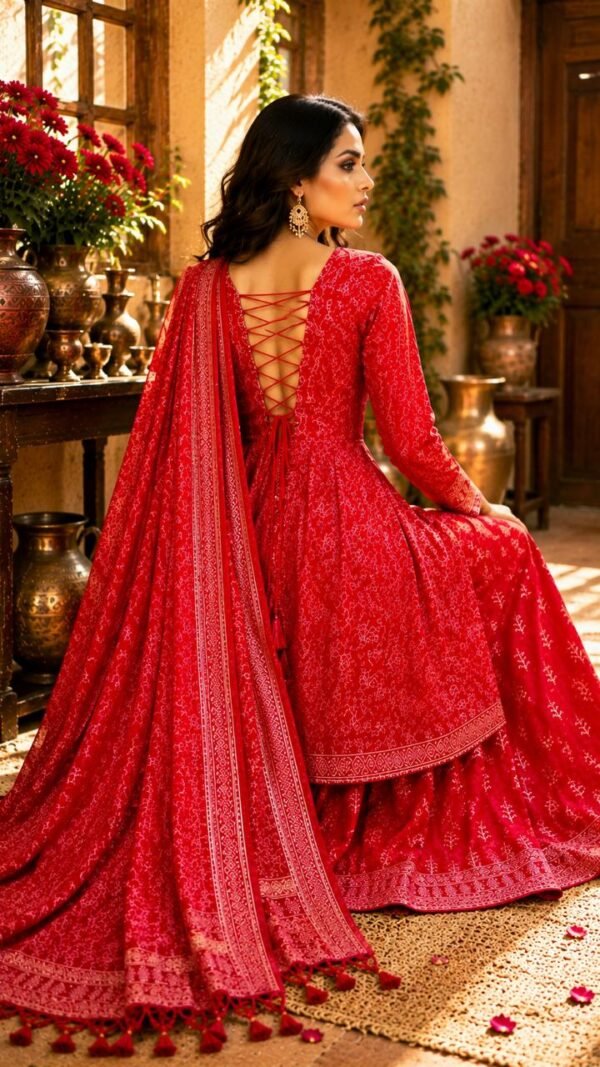
The back of the kurta has a lace-up tie detailing — crimson cord threaded through the back yoke, tied at the centre, with small tassels at the tie ends. This is not a standard kurta back. It is a decision: a classic silhouette with a single point of drama placed where it will only be seen when the wearer moves away. The name is Gulmohar. The tree that flowers red in May when everything else has already decided it is not the season for that.
Chanderi is a town in the Vindhya hills of Madhya Pradesh, and it has been weaving since before the Mughals arrived to commission their court fabric from it. The Chanderi weave — fine-count cotton in a plain weave that produces the tradition’s characteristic natural luminosity — was the fabric of the Malwa sultanate before it became the fabric of the Mughal zenana. The specific quality of Chanderi cotton is its drape: lighter than it looks, falling in soft folds that hold their shape without stiffening.
The all-over vine print on this fabric is a block print applied to the Chanderi cotton after weaving — the climbing vine motif stamped in a slightly lighter tone of the same crimson, so the print reads as texture rather than pattern from a distance and as design from close range. This tone-on-tone technique is called ‘self-print’ in the Chanderi tradition: the print colour is mixed from the same dye family as the ground colour, producing a surface that is both plain and patterned simultaneously. The zari border at the hem and cuffs is a woven gold border attached to the Chanderi fabric at the finishing stage.
The cotton sharara fabric is a heavier plain weave in the same crimson — the same tone-on-tone vine print applied by the same block-printing method. Cotton at this weight carries the gathered silhouette of the wide-leg sharara without losing structure. The dupatta is the same cotton with a woven zari border on both short ends and hand-knotted tassels in crimson and gold at each corner. All three pieces are unstitched — the kurta shape, the sharara cut, and the dupatta dimensions to be tailored to fit.
• Wash: Dry clean recommended for the Chanderi kurta. The fine Chanderi weave and the woven zari border both benefit from professional care.
• Hand wash: If hand washing: cold water, mild detergent, do not soak or wring. The Chanderi drape and the zari border cuff detailing both require gentle handling.
• Iron: Low heat on the reverse side. The Chanderi’s natural luminosity is a surface quality; direct high heat dulls it permanently.
• Dry: Always in shade. Crimson Chanderi is UV-sensitive.
Cotton Bottom and Dupatta
• Wash: Hand wash in cold water with a mild detergent. The cotton sharara and dupatta are more robust than the Chanderi; handle gently to preserve the tone-on-tone print and the tassels.
• First wash: Wash separately. The deep crimson may release slight colour on the first wash.
• Tassels: Handle the dupatta tassels gently. Do not pull or wring. Press gently and lay flat to reshape.
• Iron: Medium heat on the cotton body. Iron from the reverse side over the print areas.
• Dry: In shade. Store all three pieces together in clean muslin to prevent colour transfer in storage.
| Dimensions | 5.5 cm |
|---|---|
| Saree Length | 5.5 metres |
| Blouse Piece Length | 0.8 metres |
Related products
-
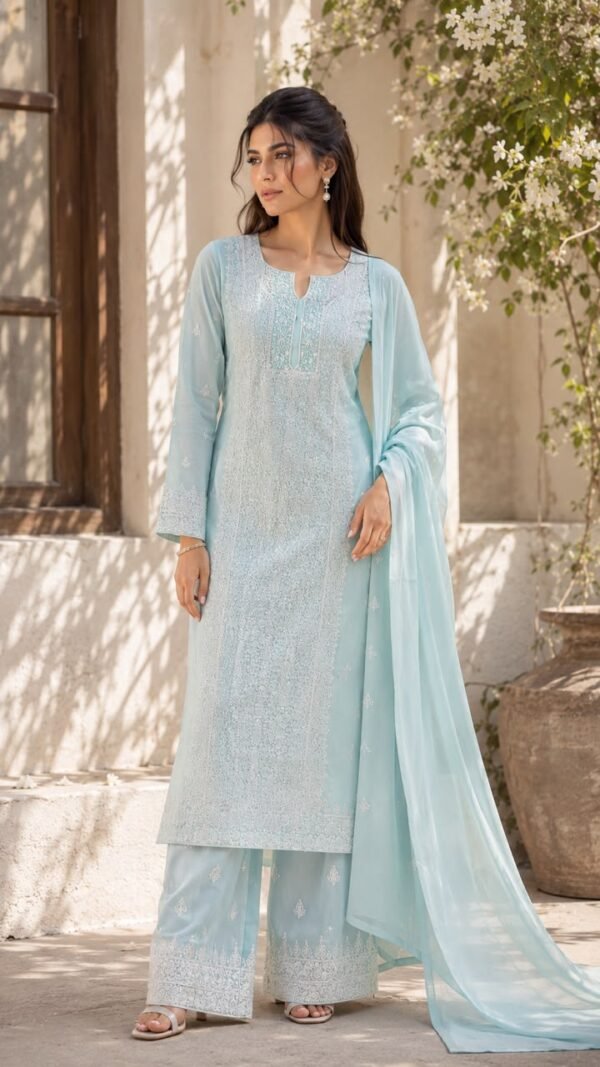
ShabnamChikankari and Kashmiri Kadai Embroidered Suit in Ice Blue
Suits & Kurtas ₹6,800.00 Add to cart
Reviews
There are no reviews yet.