
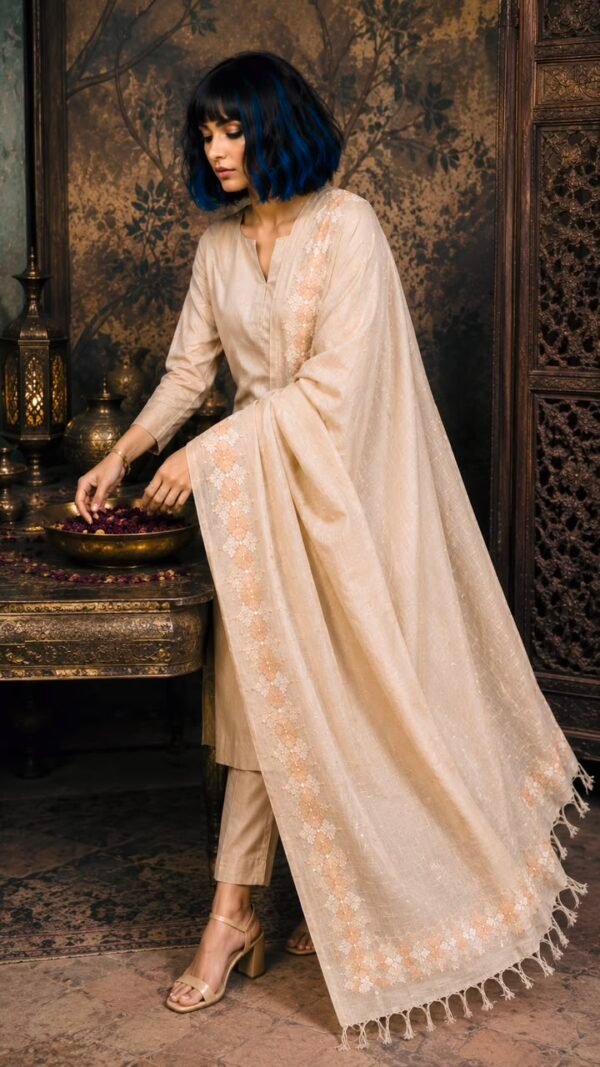
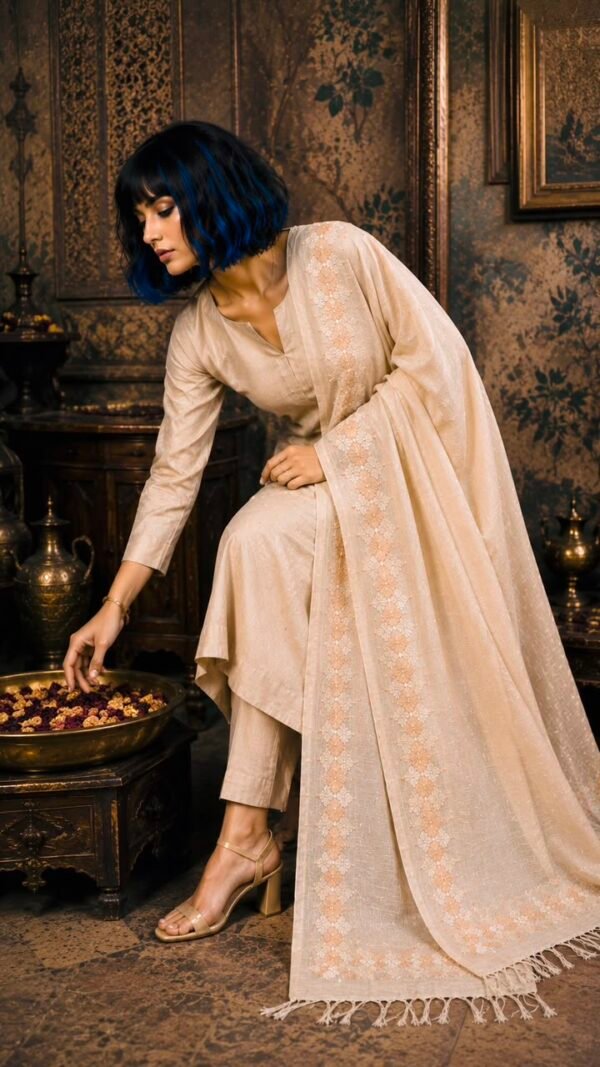
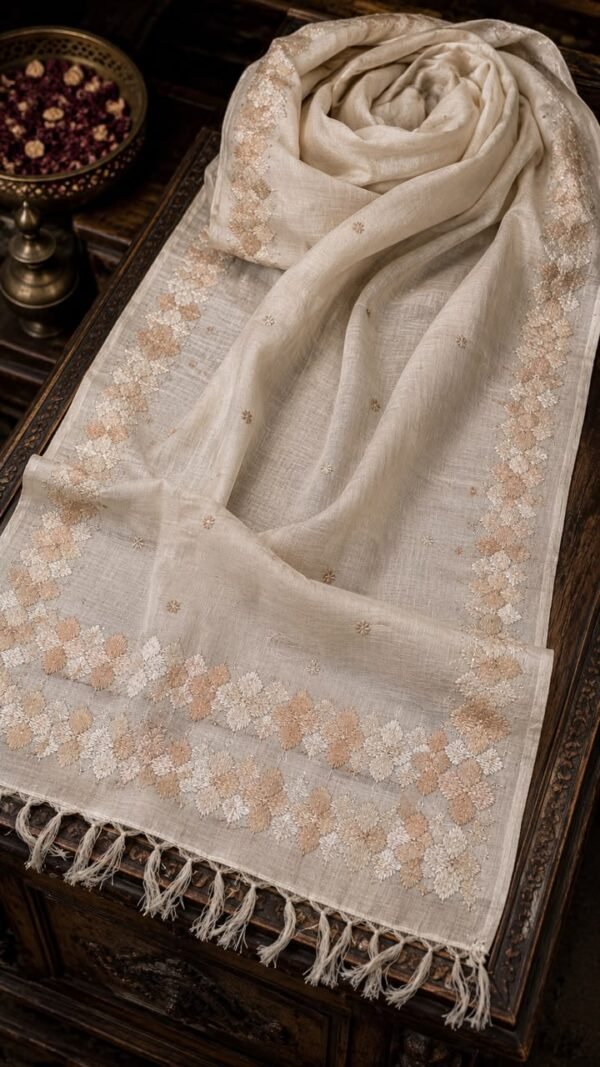
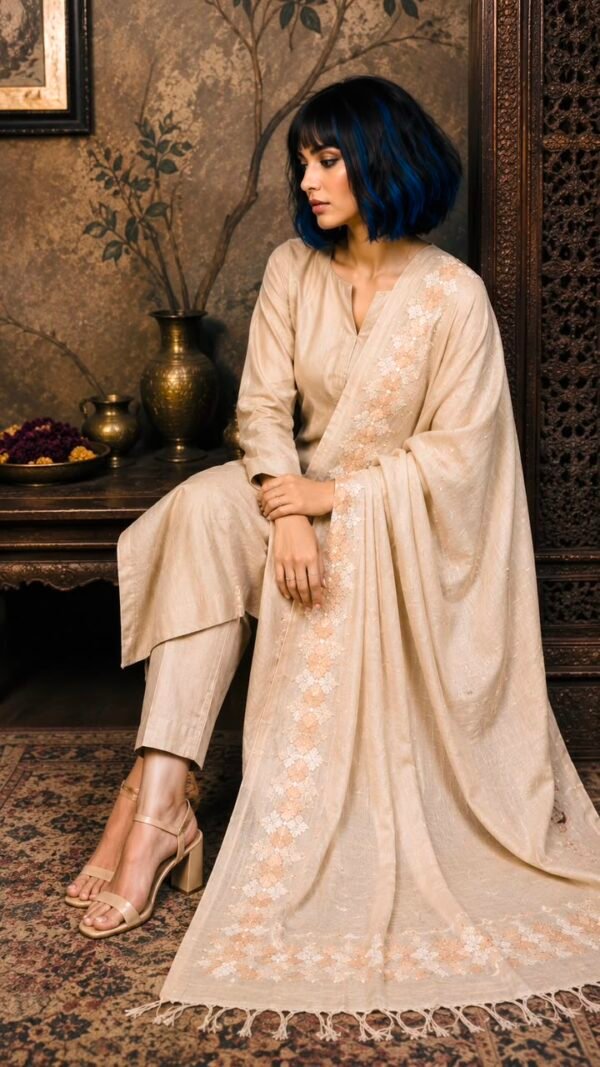
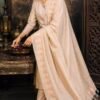

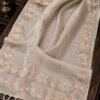
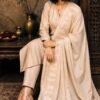
Tara Chiffon Dupatta in Teal with Multicolour Phulkari Star Embroidery
Dupattas₹8,250.00
& Free ShippingTara means star.
The Sanskrit word for the point of light
that holds its position in the sky
regardless of the season,
regardless of what is moving around it.The teal chiffon is the sky after dark —
the specific blue-green that the night sky holds
in the hour before midnight,
when the blue hasn’t left and the black hasn’t fully arrived.Each Phulkari star is a different colour.
Hot pink. Orange. Green. Gold.
The needlewoman chose a different thread for each one
because the stars are never all the same colour.
Only the sky they live in is.
The third Phulkari chiffon dupatta in the collection differs from the first two in every colour dimension. Noor was white ground with single-colour turquoise embroidery — the restraint of one colour on one ground. Prachi was natural tussar ground with the muted palette of dawn. Tara is the dupatta that has chosen the sky itself as the ground and put every colour of the star field onto it.
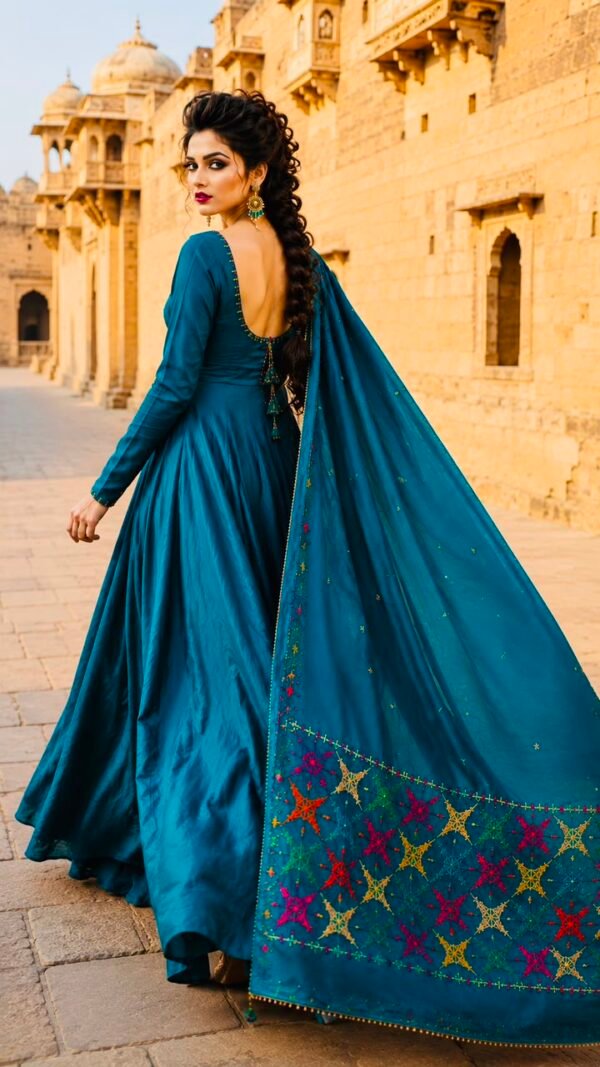
The teal chiffon is the sky at the specific hour between blue and black: the peacock blue-green that is the deepest shade before the night becomes genuinely dark. On chiffon, this teal is translucent — in the reference images, the fort stone is visible through the dupatta where it extends in the afternoon light, the stone warm amber through the cool teal. The depth of the teal is not the depth of opacity but the depth of something that lets the world behind it change colour.
The Phulkari star motifs are the specific geometric form called the tara in the tradition’s vocabulary: thread floats radiating outward from a central point in the characteristic Phulkari running stitch, the star points extending to their full length before the float returns to the fabric. Each star on this dupatta is embroidered in a different colour of thread: hot pink stars, orange stars, green stars, gold-cream stars — no two adjacent stars the same colour, the distribution of colours across the dupatta body the needlewoman’s specific composition decision. At the border, the same stars are set into a diagonal diamond lattice in multicolour thread, the stars connected by the lattice lines, the full border forming a continuous composition of intersecting coloured stars.
The edge of the dupatta carries a fine gold picot border — the gold gota running the full perimeter, providing the warm metal edge against the cool teal. Small teal tassels at the corners are the same colour as the chiffon ground, the finishing touch that returns the eye to the starting colour. In the reference images, the dupatta is worn with a teal anarkali at a Rajasthani fort. The fort stone, the teal gown, and the teal chiffon with its multicolour stars against the Rajasthani afternoon sky is the most cinematic image in the dupatta collection. The name is Tara: each star a different colour, the sky that holds them all the same deep teal.
The Phulkari star motif — the tara — is among the oldest forms in the tradition’s geometric vocabulary. The star is built from the same running stitch float as all Phulkari forms, but the specific construction requires the floats to radiate from a central point: the first float establishes the centre, the subsequent floats extend from it at equal angular intervals, the complete star formed when the radiating floats have covered the full intended span. The Phulkari tradition on coloured chiffon is a contemporary form: the heritage Phulkari worked on the thick village cotton of Punjab, where the thread floats sat on a heavy ground. On teal chiffon, the same floats sit on a surface that moves with any air current. The star forms shift and catch the light differently as the chiffon moves. The embroidery was designed for a static surface. On chiffon, it becomes a kinetic composition.
The multicolour star palette on Tara is the needlewoman’s specific decision: not a single colour palette applied uniformly, but a colour chosen for each individual star across the full dupatta. The distribution of colours across the body and the border required the needlewoman to maintain the colour composition as a whole while working each star individually. Adjacent stars in contrasting colours — a hot pink star beside a gold star beside an orange star — produce the vibration between colours that makes the field of stars read as a constellation rather than a pattern.
• Wash: Dry clean only. Pure chiffon and hand Phulkari thread floats require professional care.
• First wash: Dry clean only. The teal dye and the multicolour embroidery threads are each different dye lots. Professional first wash protects all of them.
• Phulkari thread floats: Never catch, snag, or pull the star radiating floats. A single pulled float shortens the star arm permanently. Handle through non-embroidered areas.
• Chiffon: Do not wring. Do not twist. Press water out by sandwiching between dry towels. Lay flat immediately.
• Gold picot border: Do not pull the gold picot edge. The gota stitching is delicate at the fold points.
• Do not: Machine wash, hand wash, wring, bleach.
• Iron: Low heat, reverse side only, away from the Phulkari stars. Never iron the star floats from the front.
• Dry: Lay flat in shade immediately. Do not hang — chiffon stretches when hung wet.
• Store: Rolled in acid-free tissue, then clean muslin. Never fold through the star embroidery. Keep away from direct light — the teal is UV-sensitive.
Related products
-
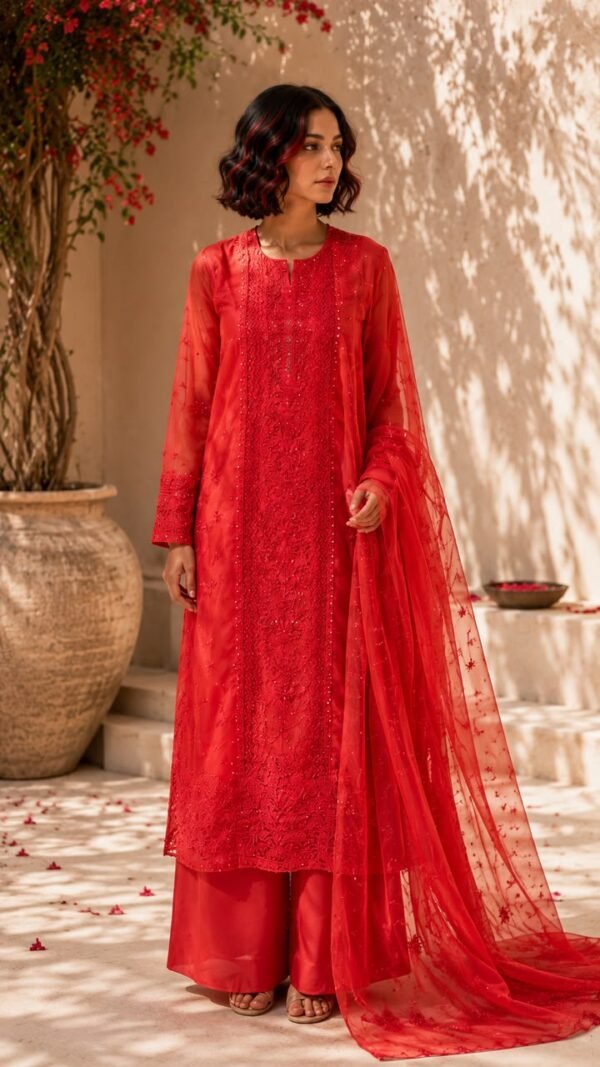
AnarOrganza Chikankari 3-Piece Stitched Suit in Tomato Red with Cotton Lining
Suits & Kurtas ₹18,000.00 Add to cart
Reviews
There are no reviews yet.