







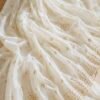
Chandni Pure Georgette Saree in Ivory with All-Over Mukaish Gold Work
Sarees₹16,000.00
& Free ShippingChandni means moonlight.
The Urdu word for the specific light
that has no source you can point to —
present everywhere on the ivory
but arriving from no single direction. The mukaish craftsman of Lucknow
pressed fine gold foil into the georgette
at thousands of individual points.
No needle. No thread.
Each point of gold physically embedded
in the weave of the ivory cloth.
In direct light: every point fires simultaneously.
In low light: the georgette holds the shimmer
inside itself, releasing it only
when the light finds it at the right angle.
Moonlight on water.
Chandni on georgette.
Every embellishment technique in the collection has used a needle. The block printers pressed the block. The Kantha needlewoman ran the stitch. The Chikankari tradition passed the thread below the fabric surface. The sitara worker secured the disc. The Phulkari needlewoman built the float. The mukaish craftsman of Lucknow does not use a needle. The mukaish — also known as badla work — is a metallic wire or foil embellishment technique where a fine piece of gold or silver metallic material is pressed between the warp and weft threads of the fabric at a single crossing point, pinched into place by the weave itself. The metal holds without thread. Each mukaish point is a separate metallic element embedded in the fabric structure.
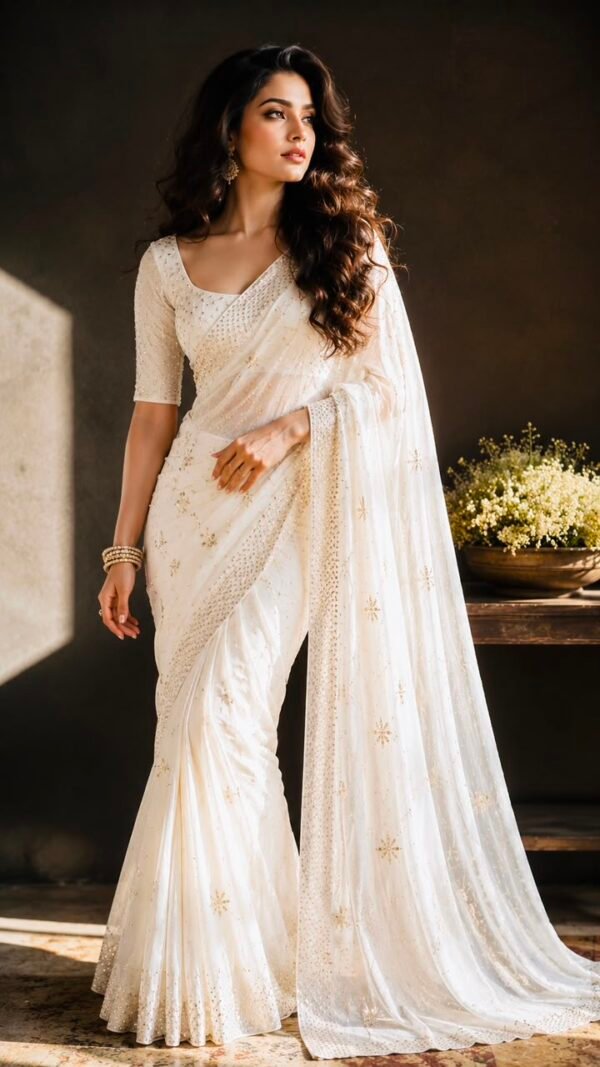
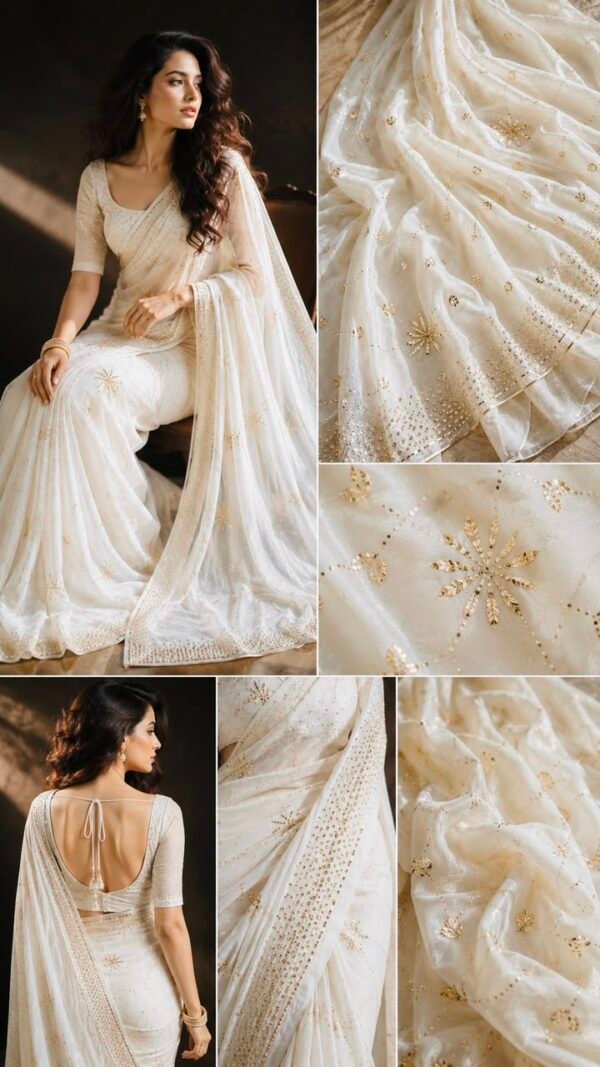
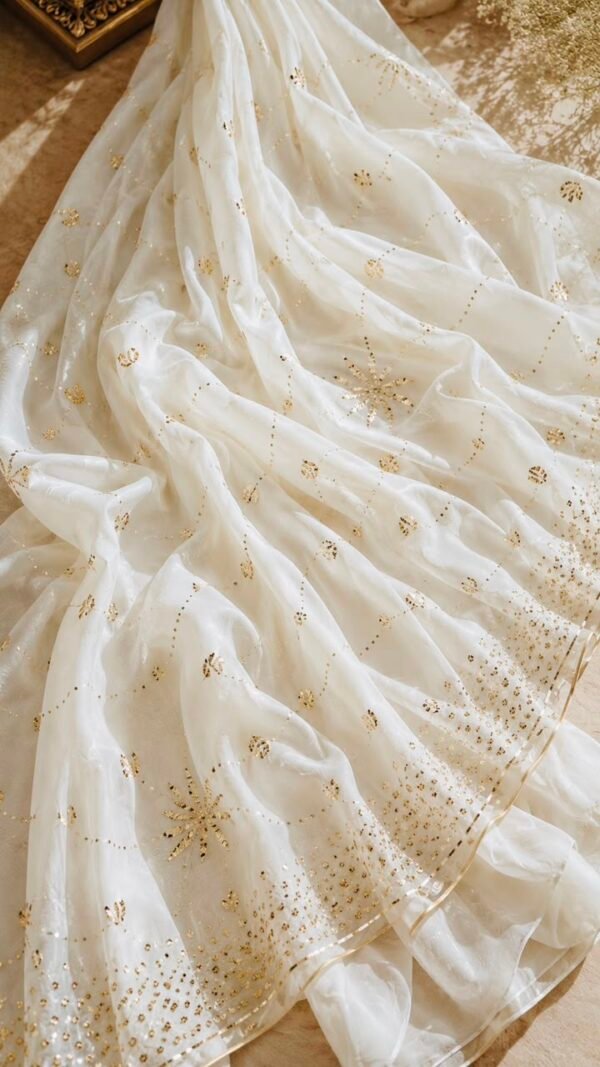
The result on the ivory georgette of Chandni is a surface that shimmers without being embroidered: thousands of tiny gold metallic points across the full 5.5 metres, each one independently catching and releasing the light. The distribution is not random — the mukaish craftsman places each point according to the design, the all-over scatter creating a field of gold that covers the georgette body completely without density. Between the scattered points, small mukaish snowflake and star forms appear: multiple points arranged in a radiating pattern, the accumulated metal creating a slightly larger focal element within the all-over scatter. At the border, the mukaish points are concentrated into running diagonal bands — lines of gold building the border as the body scatter builds the field.
Pure georgette is the correct base for mukaish. Georgette’s characteristic crepe-like surface — produced by the alternating S- and Z-twist of the weft threads — creates a slightly pebbled surface with a matte quality that the mukaish gold reads against most vividly. The ivory colour is the deliberate choice: the mukaish gold on ivory reads with a specific warmth that white would not produce. On white, gold reads as yellow. On ivory, gold reads as gold.
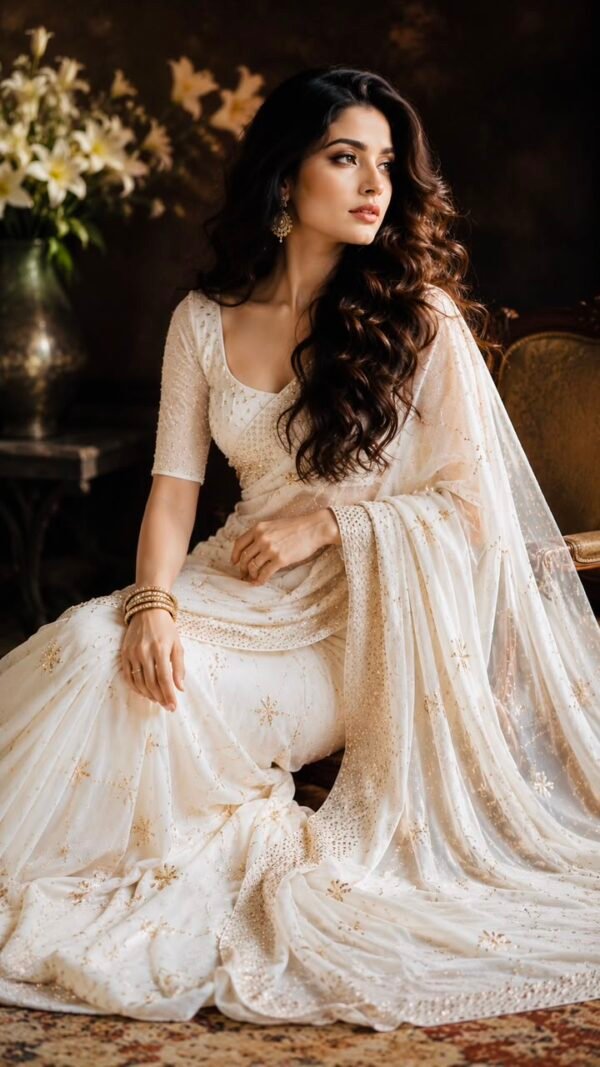
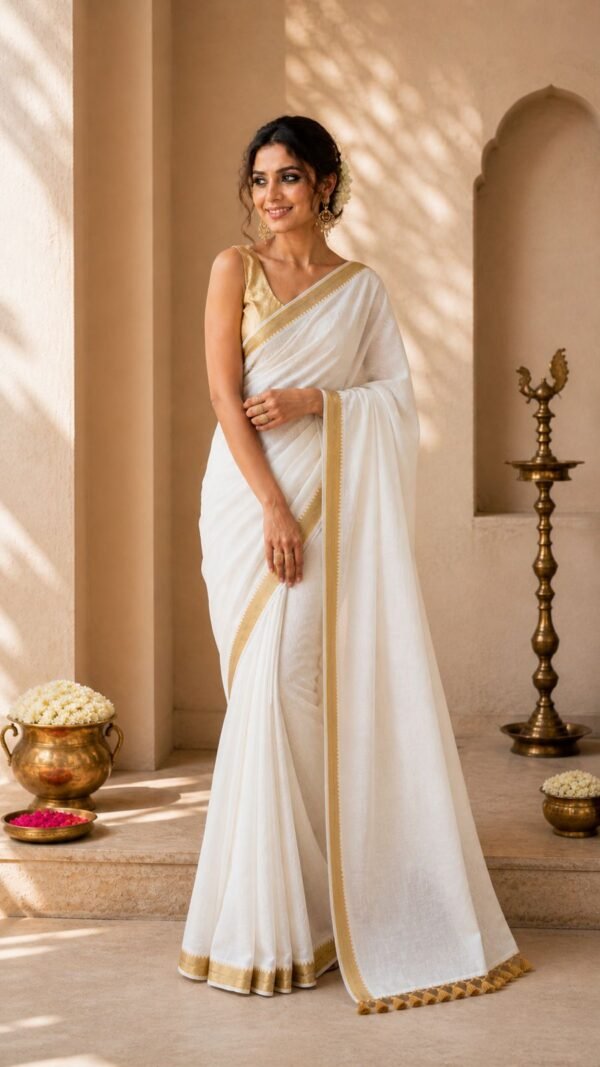
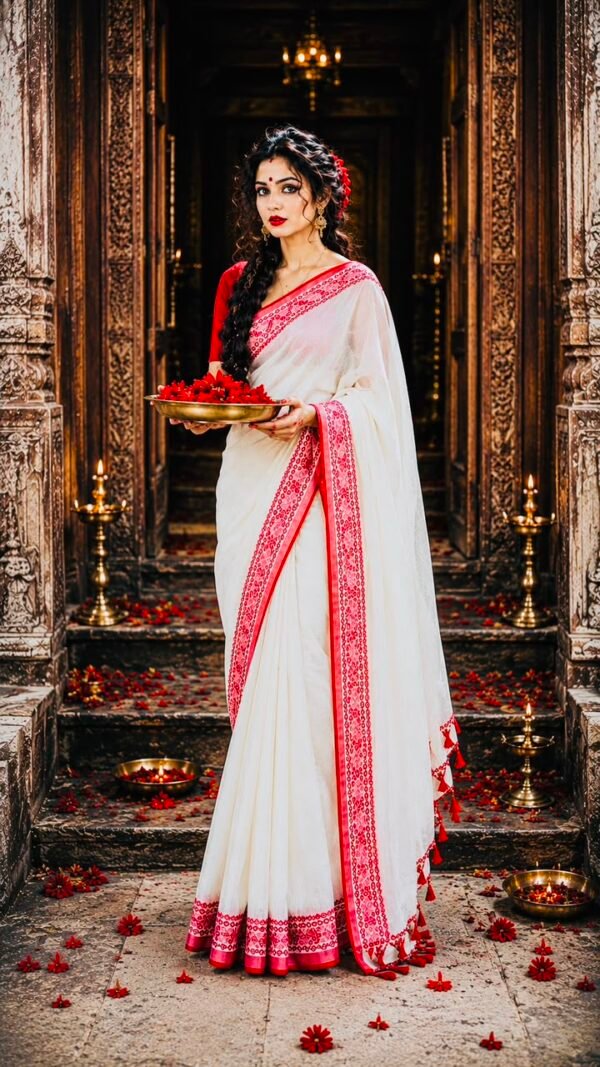
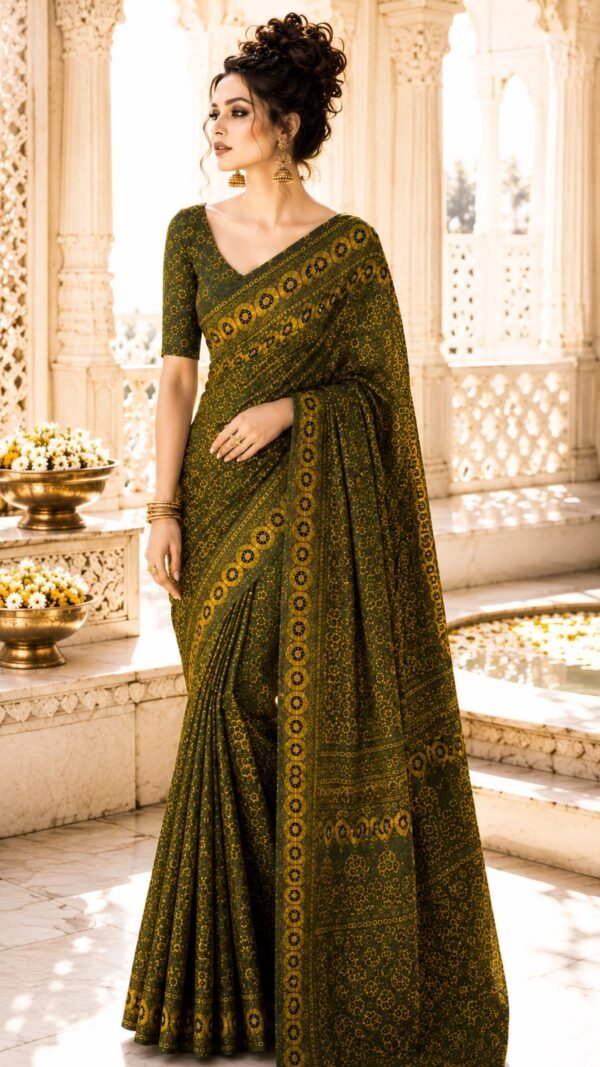
In the reference images, the saree is worn in a dramatic dark interior, the mukaish shimmer visible as distributed light across the full ivory georgette body. In a brightly lit room, the mukaish fires at every point simultaneously — the saree luminous as a whole. In a low-lit festive space, the points catch the ambient light individually — the saree appearing to hold its own light source. Both qualities belong to the name: Chandni, the moonlight that is everywhere and nowhere at once.
Mukaish — also known as Badla, Kamdani, or Mukhaish — is among the most ancient embellishment traditions in the Lucknow craft vocabulary. The technique pre-dates the Mughal period in its origins and reached its highest elaboration in the Nawabi court culture of 18th and 19th-century Lucknow. The badla craftsmen of Lucknow work with fine strips of metallic wire or cut metallic foil, pressing each piece into the fabric weave at a single point with a specialised tool. The pressing motion places the metal between two adjacent fabric threads; the tool then crimps or flattens the metal around the thread, holding it permanently without any additional securing element. The metallic point sits flush with the fabric surface, catching the light from its flat, reflective face.
The mukaish work on Chandni is the all-over scatter design — the most labour-intensive mukaish format because it covers the full 5.5 metres of georgette rather than concentrating the work at the pallu or the border. Each metallic point on the saree was placed individually by the craftsman’s tool. The density of the all-over scatter on this saree means the craftsman worked across the full fabric length at the point interval visible in the close-up reference — the labour equivalent of working at the density of the Chikankari jaal but without the thread. The saree’s price reflects this.
Mukaish is among the most vulnerable embellishment techniques to incorrect care. The metallic elements are held in the fabric by mechanical pressure alone — there is no thread securing them. Water immersion, agitation, and abrasion can dislodge individual points. Dry clean is the only appropriate care for a mukaish saree.
- Wash: Dry clean only — no exceptions. Mukaish metallic points are held in the fabric by mechanical pressure. Water immersion and agitation dislodge them. Once dislodged, mukaish points cannot be replaced.
- Mukaish points: Never rub, scrub, or apply friction to the mukaish surface. Each gold point is mechanically embedded without thread. Handle the saree body with extreme care — even folding through the mukaish areas repeatedly can loosen points over time.
- Georgette: Do not wring. Do not fold sharply. Georgette holds sharp fold marks permanently. Store unfolded or rolled.
- Do not: Machine wash, hand wash, wring, bleach, rub the fabric surface.
- Iron: Low heat on the reverse side only. Never iron the mukaish surface from the front. Direct heat can flatten and discolour the metallic foil points.
- Dry: In shade if ever dampened. Ivory georgette yellows under extended UV exposure.
- Store: Rolled around acid-free tissue paper — never folded through the mukaish body. Each fold point concentrates pressure on the metallic points at the crease. Store in complete darkness to protect the ivory ground and the metallic work.
Reviews
There are no reviews yet.