






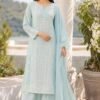
ShabnamChikankari and Kashmiri Kadai Embroidered Suit in Ice Blue
Suits & Kurtas₹6,800.00
& Free ShippingShabnam means morning dew.
The water that arrives on every surface
before the sun has asked for it,
that covers the leaf and the petal and the stone
with the same quiet completeness. The Chikankari needlewoman understood this.
She covered the full front of the ice blue
thread by thread, stitch by stitch,
until every part of the surface had been seen.
Then: the neckline.
The Kashmiri kadai arrived at the neckline
with a different vocabulary —
the chain stitch of the mountains,
firmer and denser than the Chikankari plain.
Two traditions. One collar. One morning.
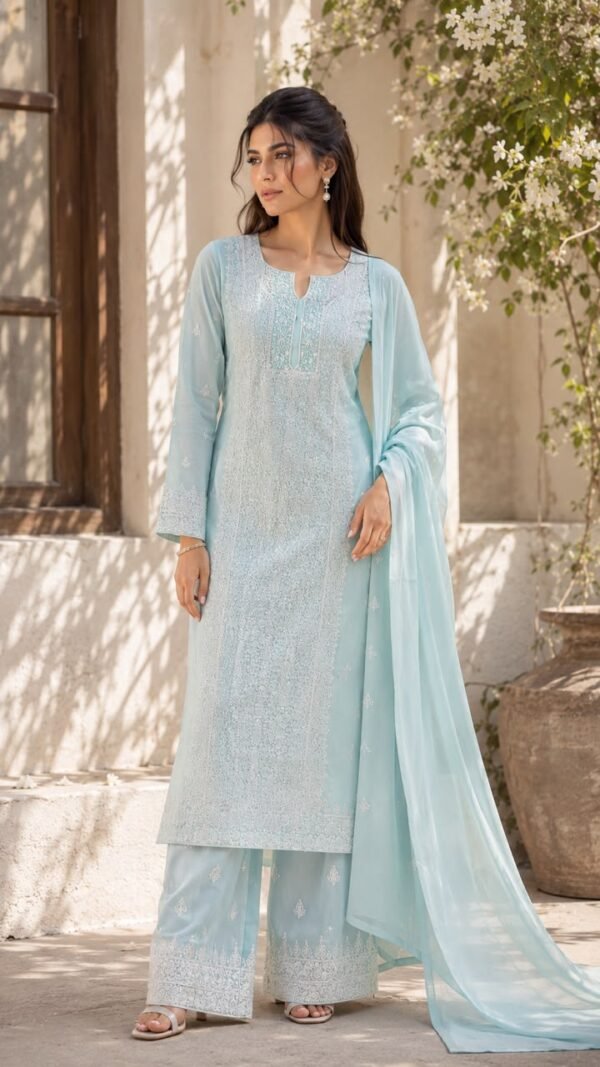
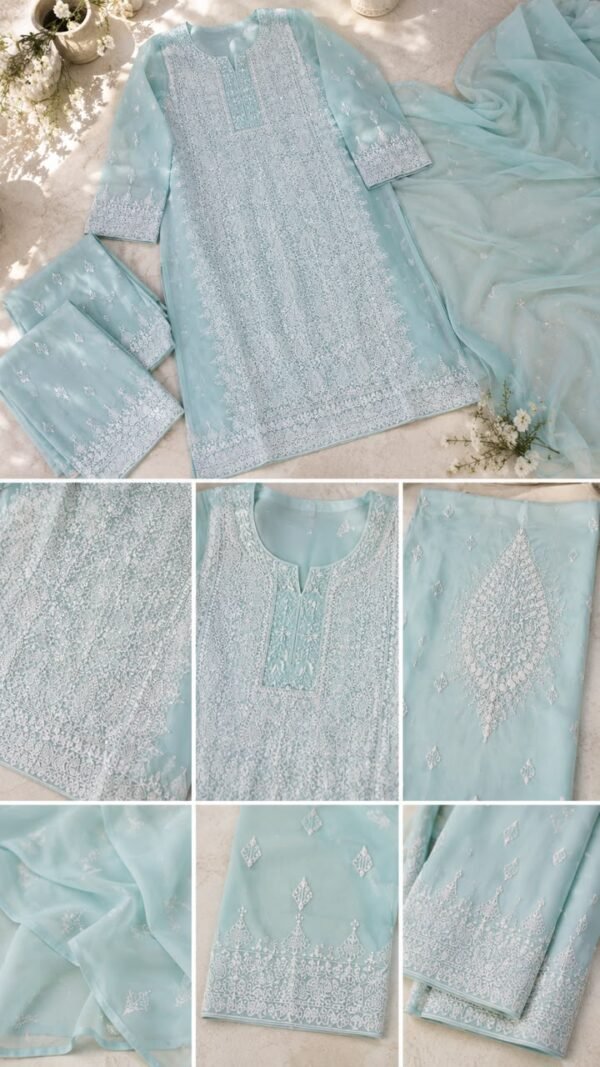
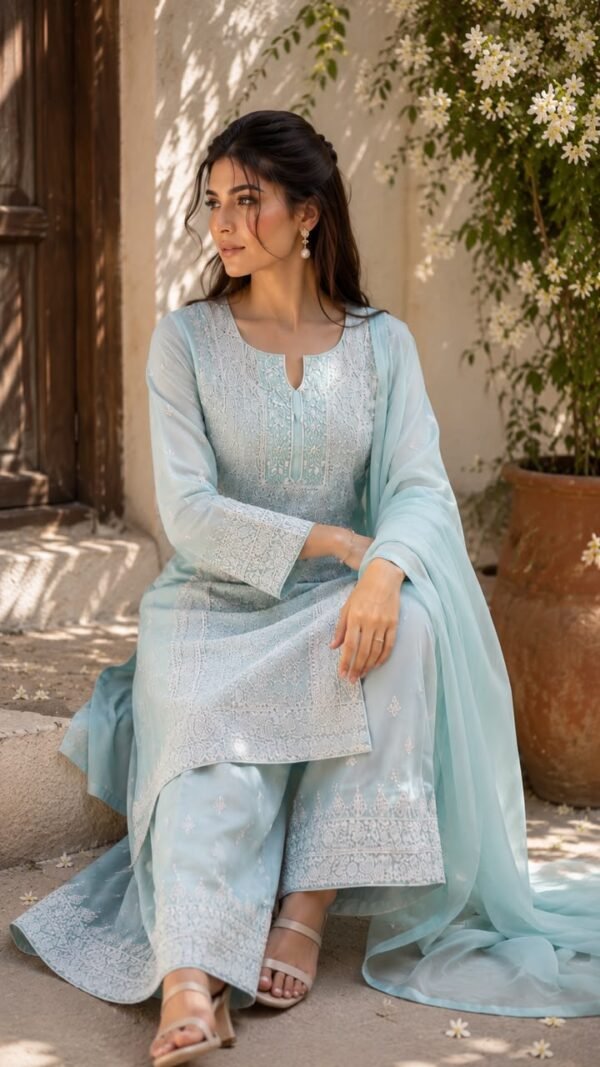
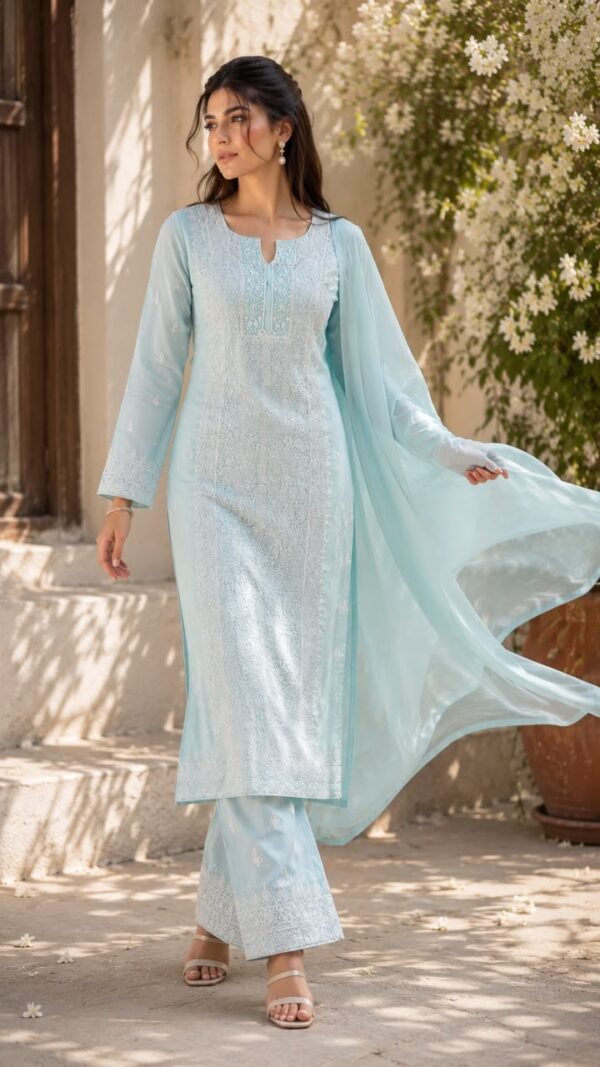
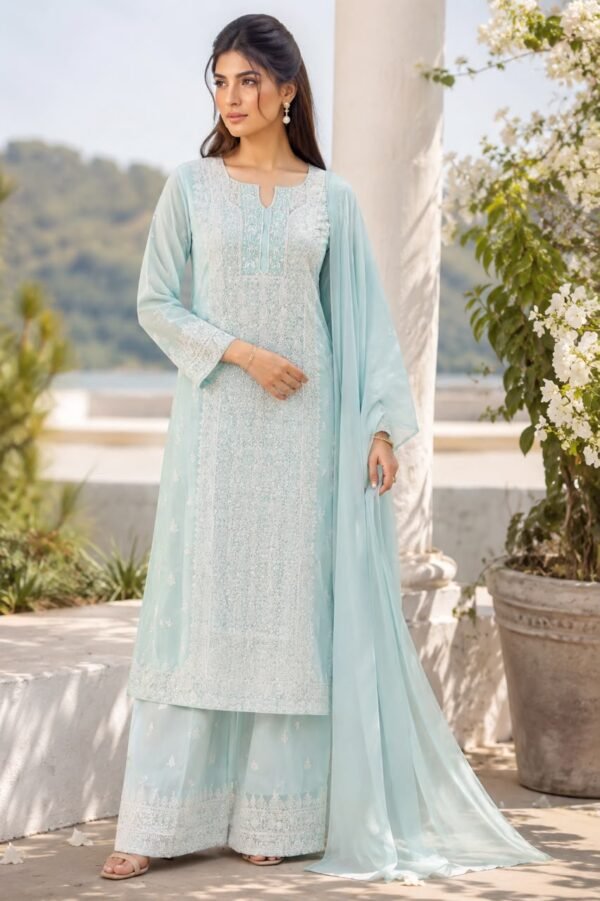
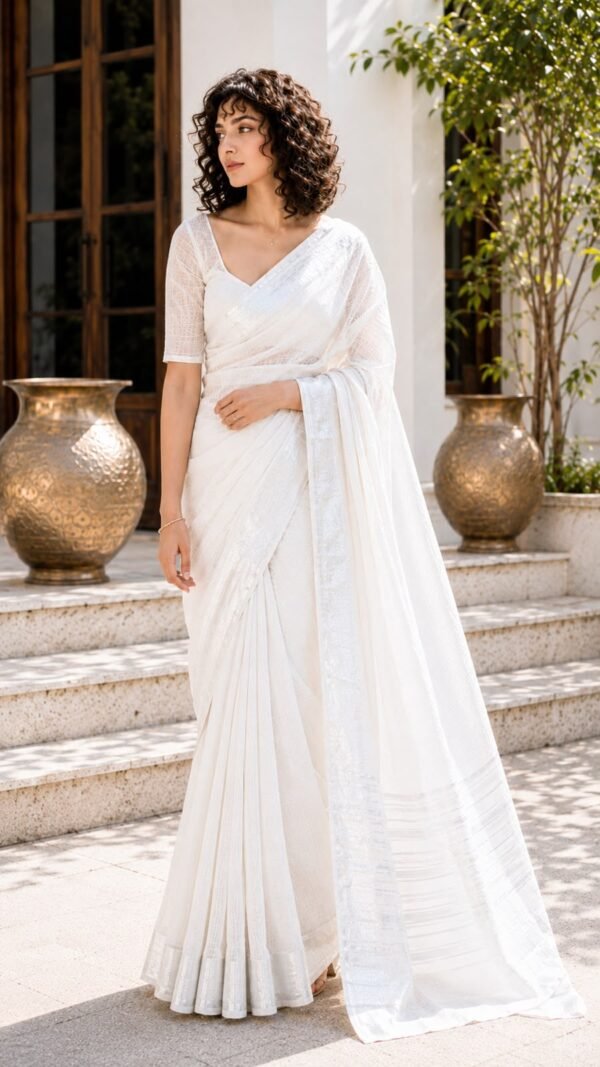
Two embroidery traditions worked the same ice blue suit. The Lucknow Chikankari tradition covers the front panel, the sleeves, and the back. The Kashmiri kadai tradition holds the neckline. They do not compete: they are from different cities, working in different stitches, at different densities, and they share only the thread colour and the fabric ground. Together, they are the most embroidery-intensive piece in the collection.
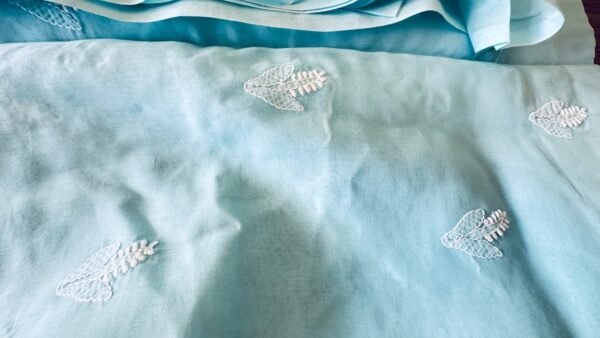
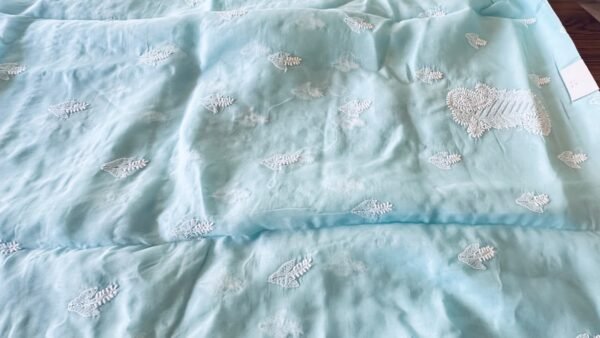
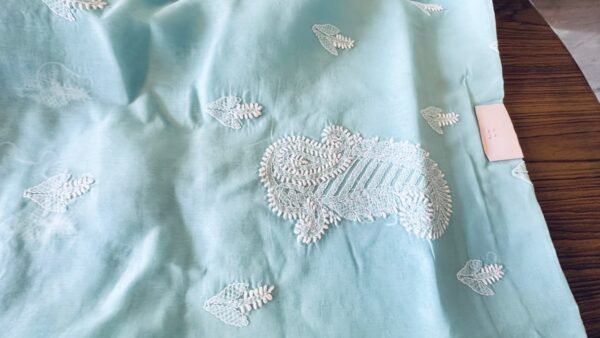
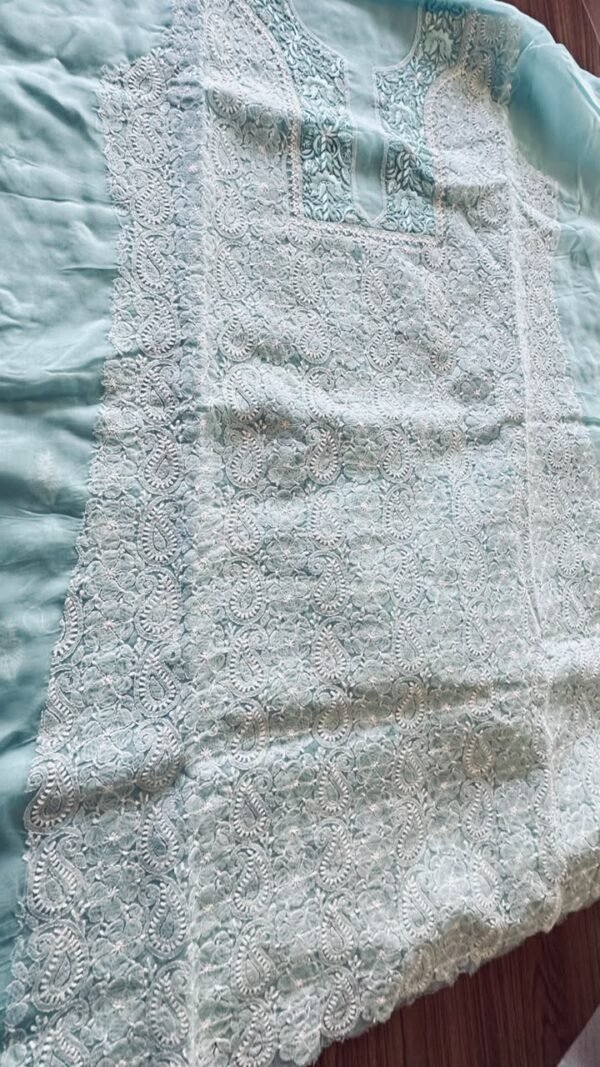
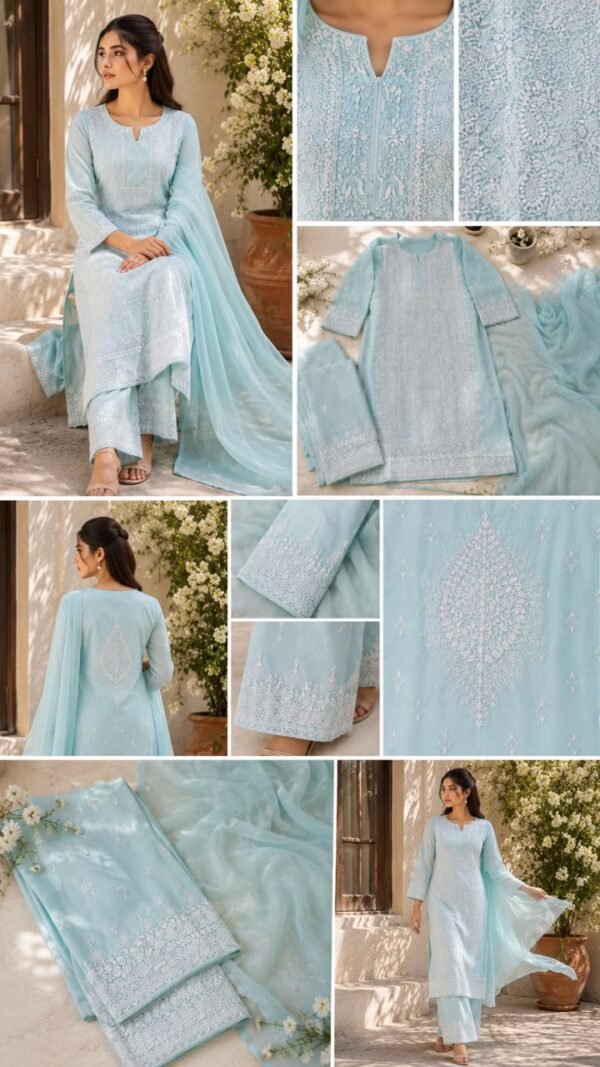
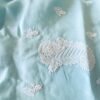
Chikankari is the white thread embroidery of Lucknow: fine white cotton thread worked onto fabric in a vocabulary of flat stitches, shadow stitches, pulled thread work, and raised chain stitches that produce the characteristic Chikankari texture — white on white in the traditional form, white on colour in the contemporary. On this ice blue kurta, the white Chikankari covers the entire front panel in an all-over densely worked composition of floral forms, scrolling vines, and paired-leaf clusters. At the distance of the reference images, the white on ice blue reads as a continuous embroidered surface. At close range, the flat-lay reveals the individual stitch forms: the shadow stitches at the petal interiors, the raised chain along the vine stems, the pulled-thread openwork at the flower centres. The full front was worked entirely by hand.
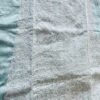
The neckline carries a distinct register: the Kashmiri kadai, or Kashmiri chain stitch embroidery, in white thread on the ice blue. The Kashmiri chain stitch is worked with a hooked needle (the aari) that pulls the thread into a continuous chain of interlocked loops, producing a smooth, slightly raised surface quite different from the flat and shadow stitches of the Chikankari body. In the neckline close-up, the Kashmiri kadai is visible as a denser, more precisely outlined construction at the collar: the chain stitch outlining the motif forms with a clarity that the Chikankari flat stitch cannot achieve at this scale. The two embroideries are visually distinct at close range and unified at a distance.
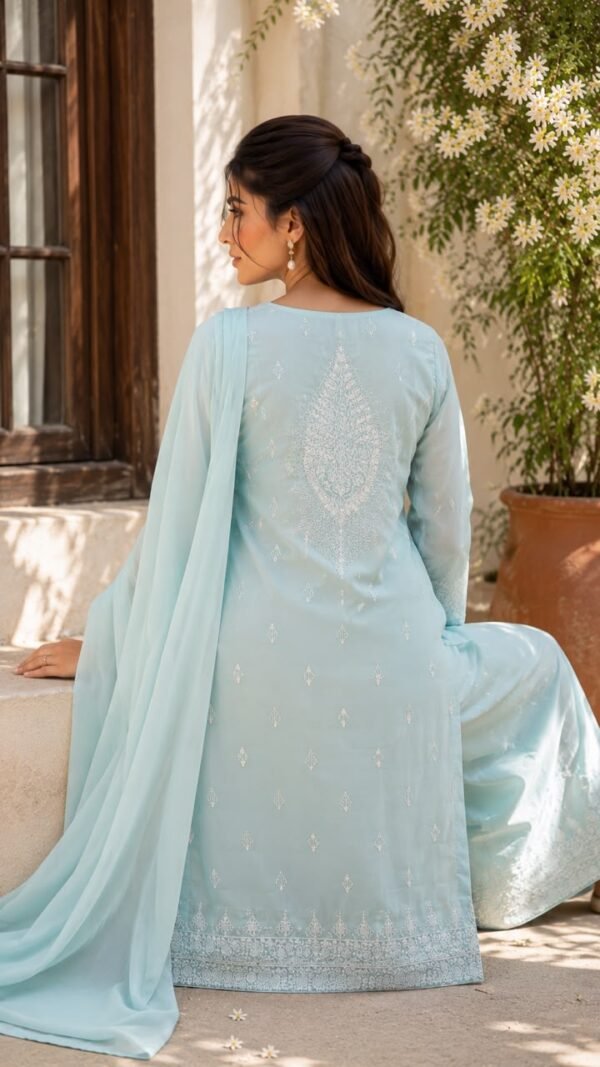
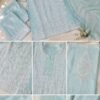
The sleeves carry scattered small buti — individual embroidered motifs in Chikankari white, placed at regular intervals across the sleeve body. Near the cuff, a denser embroidery band carries a running floral border, the same vocabulary as the front panel concentrated at the sleeve’s final edge. The back has the kurta’s most dramatic single element: a large diamond-shaped central booty, the Chikankari motif built at its largest scale in the center back, surrounded by smaller scattered booties on the back sides. The pant hem carries an embroidered border in the same white thread. The dupatta is plain ice blue chiffon: no embroidery, complete in its simplicity against the embroidery-covered suit.
Chikankari is Lucknow’s oldest and most refined embroidery tradition. Documented from at least the Mughal period, the tradition produces white thread embroidery on fine cotton or muslin in a vocabulary of over thirty distinct stitches, each with its own specific application and surface quality. The tradition is centred in the mohallas of Old Lucknow — the Chowk and the surrounding areas where the needleworkers have practiced the same stitches in the same neighbourhoods for generations, the knowledge transmitted by apprenticeship within families.
The Chikankari on Shabnam uses the most recognisable stitches of the tradition: the shadow stitch (tepchi) for the interior fills, where the thread passes under the fabric and shows through as a shadow rather than on the surface; the flat stitch (murri) for the raised seed forms at flower centres; and the pulled-thread openwork (jali) at the open flower centres, where the warp and weft threads are pulled apart by the needle to create the visible voids that give the Chikankari its characteristic lacy quality at close range. Together these three stitches produce the texture visible in the body close-up: the shadow, the raised point, and the void, all in the same white on ice blue.
The Kashmiri kadai at the neckline belongs to a completely different tradition. Kashmir’s embroidery heritage is the oldest in the subcontinent — the namdas, soznis, and chain stitch work of the Valley have been produced for centuries, and the Kashmiri aari chain stitch is among the most distinctive. The hooked needle (aari) is pressed through the fabric from the front, catches the thread from below, and pulls it up through the fabric into a loop that the next stitch catches and interlocks. The resulting chain is smooth, slightly raised, and continuous. At the neckline of Shabnam, the Kashmiri chain stitch produces the firm, precise outlines and fills that complement the Chikankari body with a different weight and density.
• Wash: Dry clean recommended for both the embroidered kurta and pant pieces. The density of the Chikankari embroidery on the front and the Kashmiri kadai at the neckline both benefit from professional care.
• Hand wash (if dry clean unavailable): Cold water, very mild detergent, no soaking. Turn the kurta inside out. Do not rub the embroidered surfaces. The shadow stitch and pulled-thread openwork are particularly vulnerable to abrasion.
• First wash: Dry clean only. The ice blue fabric and the white thread are both stable but professional first-wash care protects both.
• Chikankari embroidery: Never scrub the embroidered areas. The pulled-thread openwork (jali) sections can distort if the fabric is stretched or scrubbed while wet. Handle the kurta fabric through the non-embroidered sections when wet.
• Kashmiri kadai neckline: Do not pull or stretch the neckline area. The chain stitch lies on the fabric surface; pulling distorts the chain lock.
• Dupatta: Hand wash the chiffon dupatta separately in cold water. Do not wring. Press water out gently. Lay flat to dry.
• Do not: Machine wash any piece. Wring. Bleach.
• Iron: Kurta and pant: low heat on the reverse side only. Never iron directly on the Chikankari embroidery from the front — direct heat distorts the raised elements permanently. Never iron the Kashmiri kadai from the front. Dupatta: low heat, reverse side.
• Dry: All pieces in shade. Ice blue is UV-sensitive.
• Store: Each piece folded separately in clean muslin. Tissue paper between the embroidery zones to protect the raised elements from pressure. Do not fold through the large back diamond booty
Reviews
There are no reviews yet.