
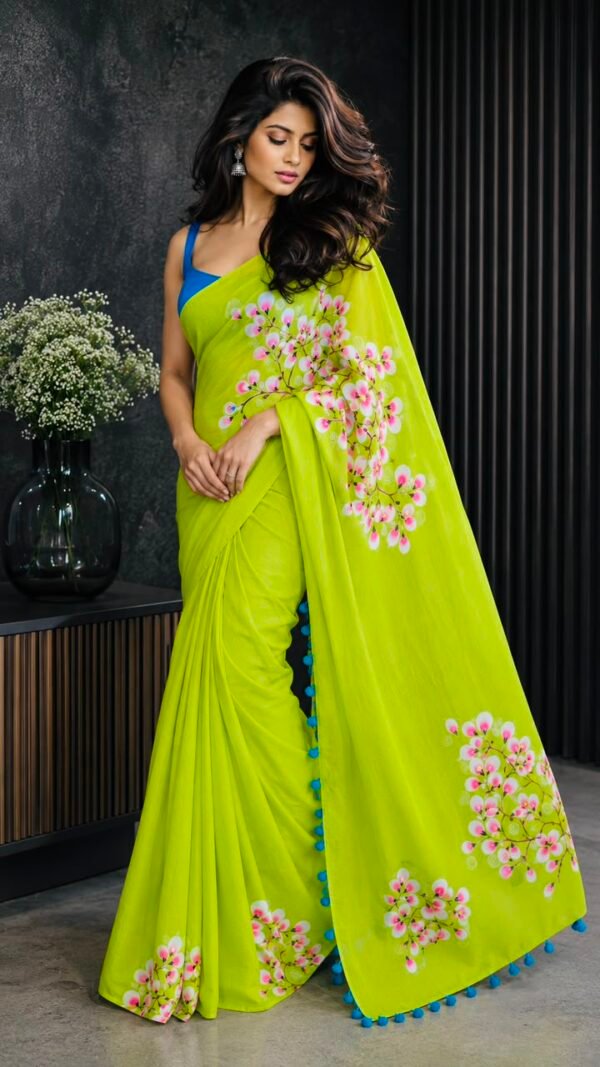
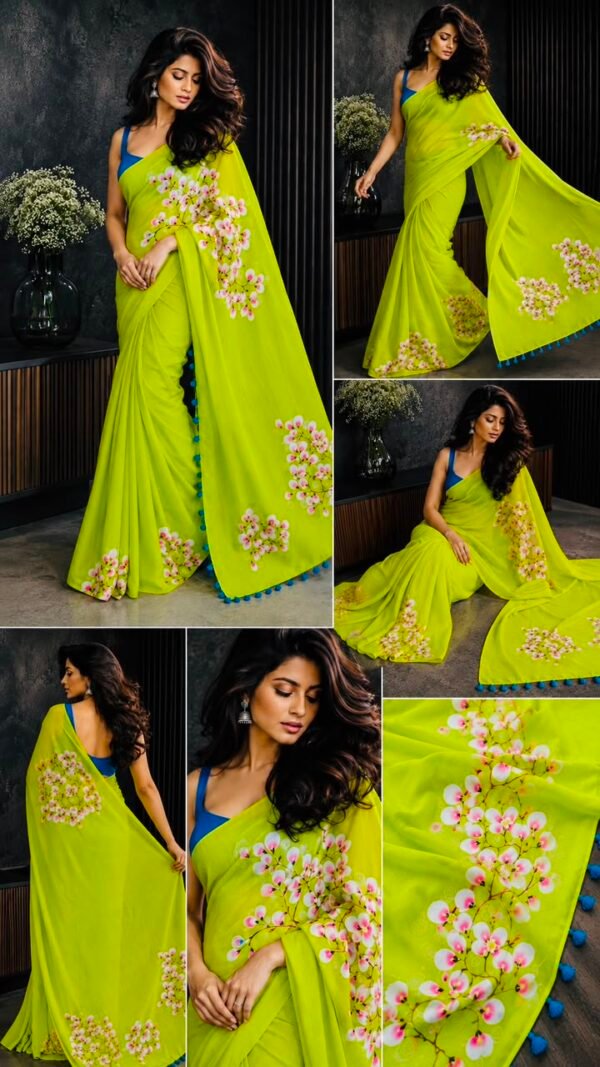
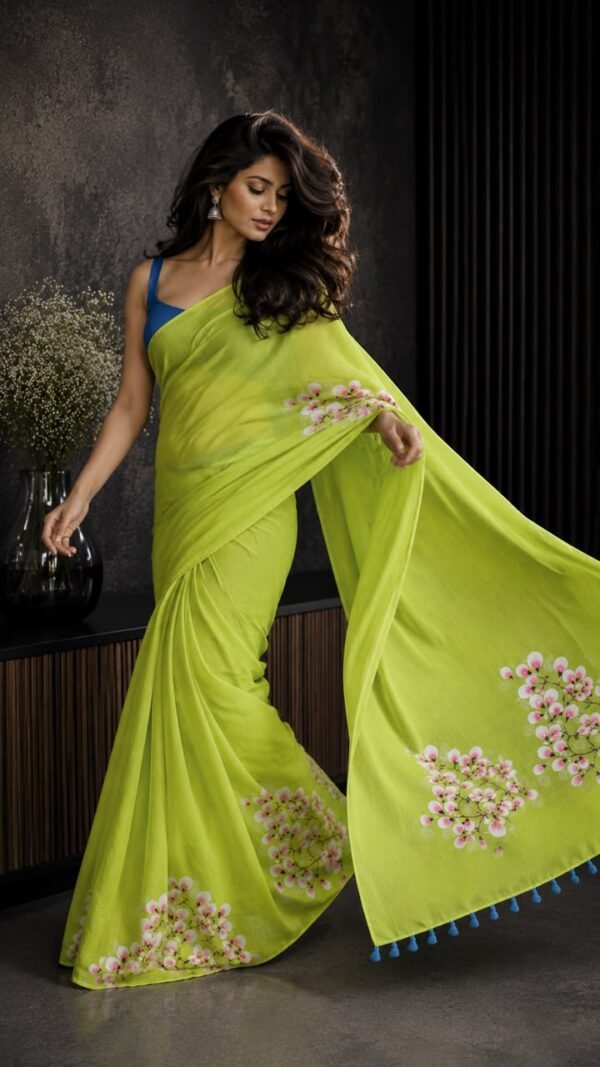
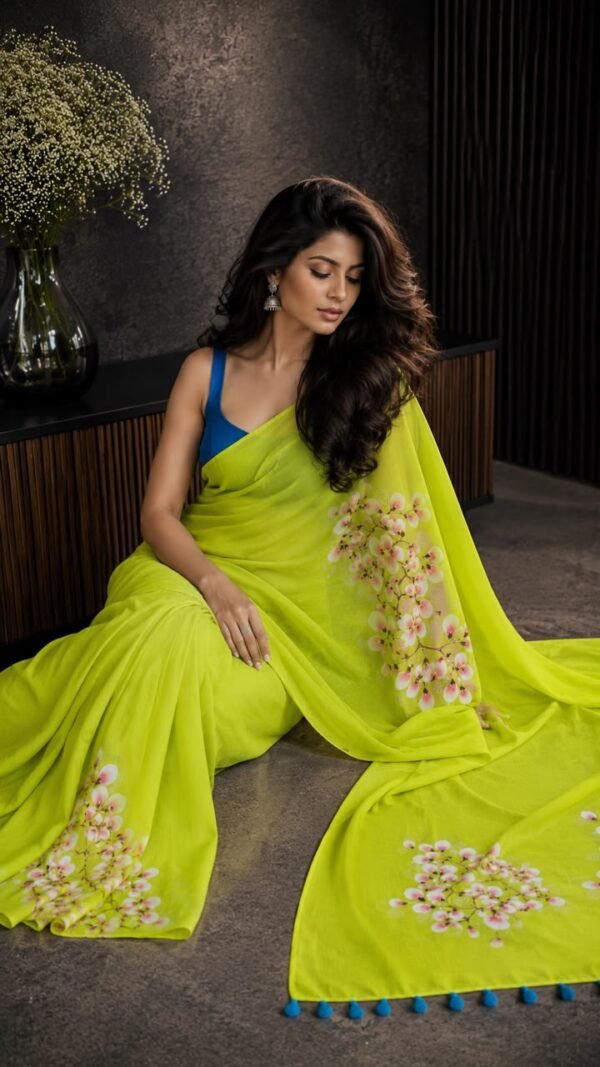
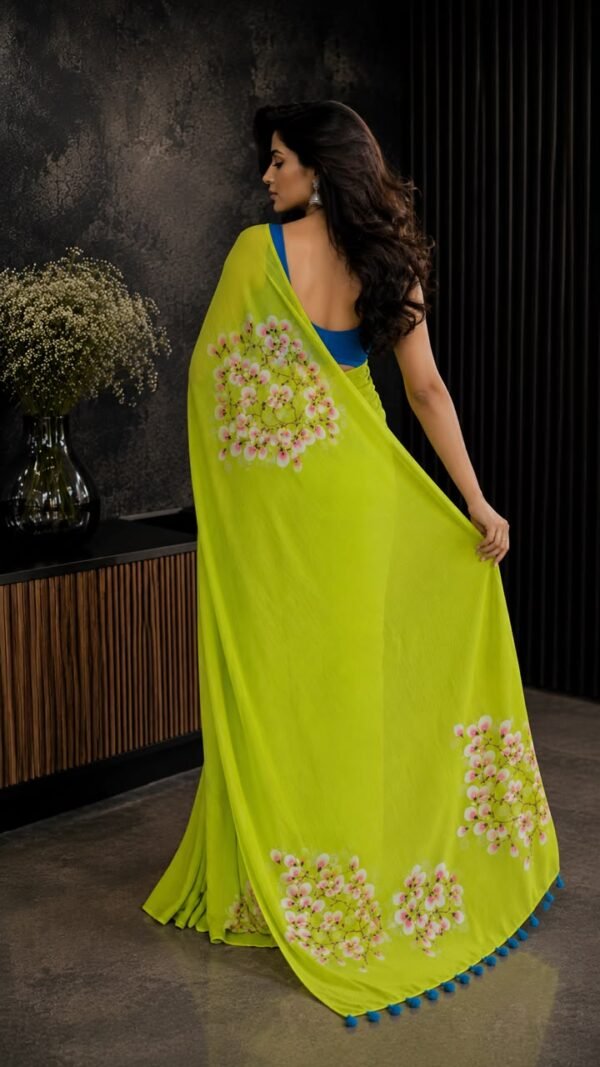





Kusum Mul Cotton Saree in Lime Green with Hand-Painted Blossom Branch and Teal Tassels
Sarees₹2,200.00
& Free ShippingKusum means blossom.
The Sanskrit word for the flower at its moment —
not the bud, not the fallen petal,
but the flower fully open,
present before the season changes. Mul cotton is woven air.
The lime green on mul
is the colour of new leaves
when the light is directly above.
The painter set the branch across the pallu
and then painted every flower by hand.
The branch does not repeat.
No block was pressed to make it.
The painter moved across the fabric
as the branch moves across the sky.
Every surface technique in this collection has been a form of repetition: the block pressed in the same pattern across the full body, the thread counted the same way for each buti, the resist tied to the same form at each binding point. Hand painting on fabric works differently. When the painter set the blossom branch across the lime green mul cotton, there was no block to align, no resist to tie, no warp count to maintain. There was a brush, a colour, and the decision about where the branch goes. The branch in this saree goes where the painter chose. It will never be in exactly that position again.
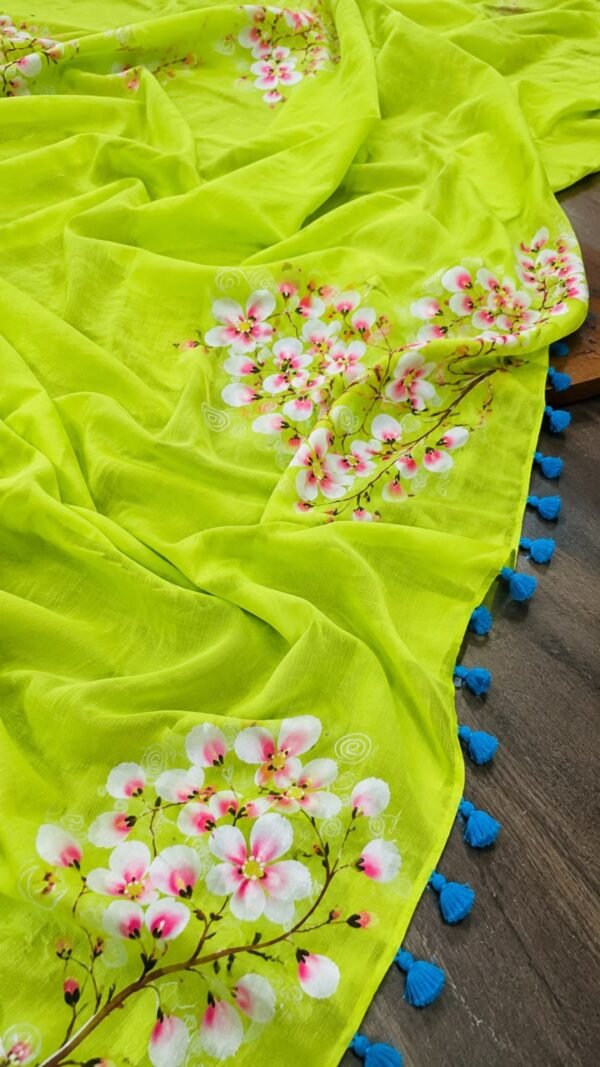
The design is a flowering blossom branch — a brown-grey painted branch spreading across the upper body and pallu, carrying clusters of pink-and-white flowers at its tips and along its length. Each flower is individually painted: a white base with a pink gradient wash from the petal edges inward, a yellow centre, black detail at the petal margins. The flowers are not identical. They are the same flower at slightly different stages of bloom, painted by the same hand at slightly different moments in the composition. The branch carries smaller satellite clusters that scatter across the rest of the body, the larger pallu composition continuing in smaller repetitions across the lime green body, each cluster placed by the painter’s judgment rather than a template.
The lime green mul cotton body is the collection’s most electric green: a yellow-green that reads as lime at a distance and as a specific warm chartreuse in close light. On mul cotton, this green has the characteristic lightness of the fabric — the colour moving with the fabric as it drapes, the intensity shifting between direct and indirect light. The painted blossom against this green is not a conventional combination: the pink-and-white blossom vocabulary is more typically seen against dark grounds or neutral surfaces. Against lime green, the pink reads with a sharpness that a neutral ground would not produce — the contrast between the warm pink of the blossoms and the cool electric green of the mul a colour argument that the painter understood when the fabric was chosen.
The teal pom-pom tassels at the pallu hem complete the colour composition: teal is the specific blue-green that sits equidistant between the lime green body and the blue-green of leaves. The three colours of this saree — lime green, pink-white blossom, teal tassel — are the colours of a garden in the specific light of a clear spring morning. The name is Kusum: the blossom at its moment of fullness. Before the season changes.
Fabric painting is one of the oldest surface decoration techniques on cloth. The Indian fabric painting traditions include the Pichwai paintings of Nathdwara on cloth, the Kalamkari pen-and-brush work of Andhra, and the regional traditions of painted cotton across Bengal and Rajasthan. In contemporary form, fabric painting on mul cotton uses textile-specific pigments and fabric medium that bind the colour to the fibre without affecting the drape or hand of the cotton. The correct fabric paint on the correct fabric sets permanently without cracking, fading, or stiffening the cloth.
The blossom branch design on this saree is a single composition painted across the full pallu: the painter established the branch structure first — the main stem and its branching directions — and then added the flower clusters at each terminal and along each branch section. Each flower was built in stages: the white base covering the petal area, the pink wash graduated from the petal edge to the white centre, the yellow centre dot, the black petal-edge detail. The three-stage flower construction is visible in the close-up: each flower carrying its own internal light, the gradient producing the specific three-dimensional quality that distinguishes painted petals from printed flat colour.
The satellite clusters scattered across the body were placed by the painter as extensions of the main pallu composition — smaller versions of the same branch-and-flower vocabulary, distributed across the body to establish the blossom’s presence beyond the pallu. Each cluster is independently composed, not a reduced copy of the pallu. The painter moved across the full 5.5 metres of lime green mul cotton making composition decisions at each point. The finished saree is a single, continuous painted composition — the only one of its kind in the collection.
• Wash: Dry clean only. Hand-painted fabric needs professional care to protect the painted surface. Water immersion and handling can lift or blur paint edges over time.
• Hand wash (if dry clean unavailable): Cold water only, very mild detergent, no soaking, no scrubbing the painted areas. Turn inside out and wash the reverse side. Do not rub the painted areas against any surface.
• First wash: Dry clean only for the first wash, regardless. The lime green dye and the painted pigments both need professional care on the first wash.
• Painted surface: Never scrub, rub, or apply mechanical pressure to the painted blossom areas. The flower petal gradients are the most delicate elements: abrasion at the petal edges will blur the gradient over time.
• Mul cotton: Do not wring. Press water out gently if hand washing. Mul loses its structure when twisted under tension while wet.
• Tassels: Handle the teal tassels gently. The teal dye may bleed onto the lime green body in the first wet washes. Keep the tassels from resting on the saree body when damp.
• Do not: Machine wash, bleach, or wring.
• Iron: Low heat on the reverse side only. Never iron directly on the painted blossom surface — heat permanently alters painted fabric pigments. Never iron mul cotton at medium or high heat.
• Dry: In shade. The lime green is UV-sensitive. The painted pigments are also affected by prolonged direct sun over time.
• Store: Rolled around acid-free tissue paper — do not fold through the painted blossom areas. Folding concentrates pressure on the painted surface, which can cause fine cracks in the pigment over time. Store in a clean dark muslin roll.
Reviews
There are no reviews yet.