

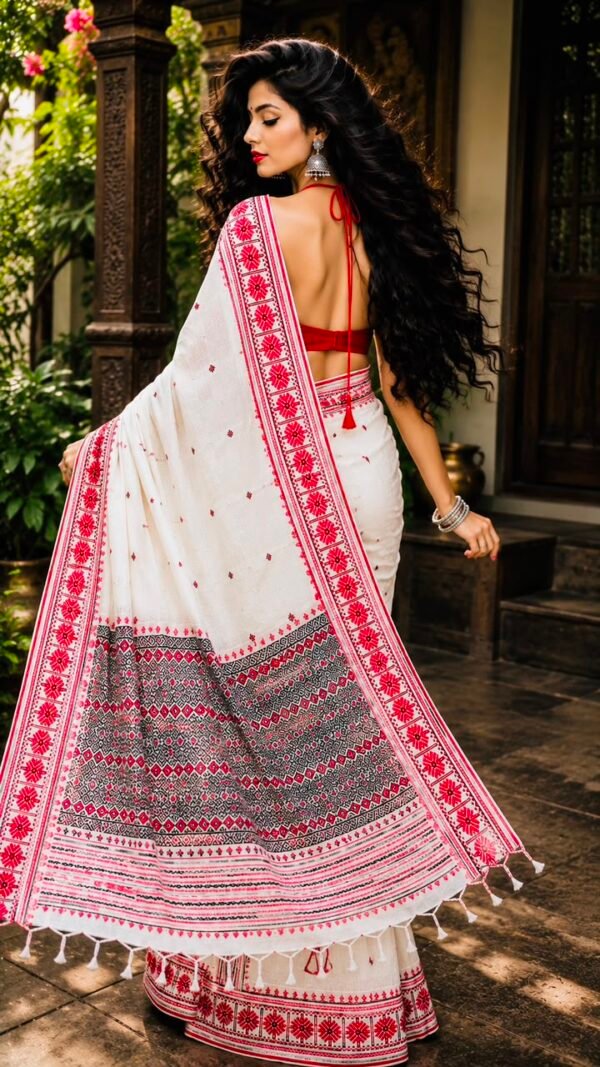


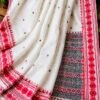



Shreya Assam Khadi Cotton Saree in White with Red Geometric Buti and Border
Sarees₹2,850.00
& Free ShippingShreya means auspicious.
The Sanskrit word for the thing
that carries good with it wherever it goes.
In Assam, white and red have always been
the colours of the occasion.
The gamosa — the cloth of honour,
the cloth you offer a respected guest —
is white with a red border.
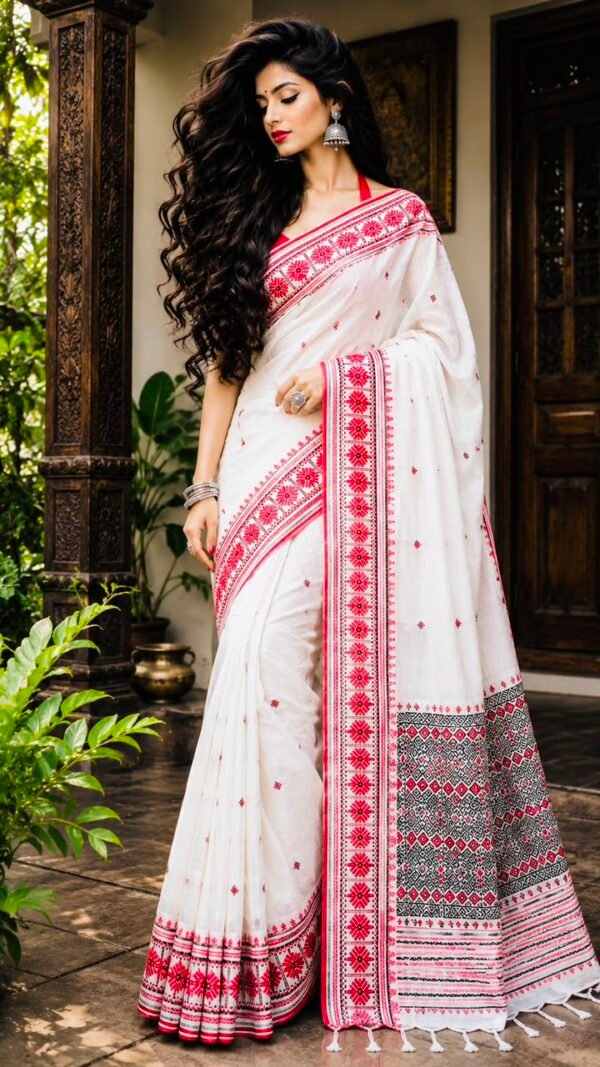
This saree comes from the same understanding.The geometric diamonds in the border
were made on a loom, not a printing table.
Each one placed by a weaver
who was counting threads.
The counting shows.
Assam has its own handloom tradition, distinct from the Bengal khadi tradition of the rest of the collection. The Assamese weaving tradition — centred in the Sualkuchi silk-weaving town and in the cotton handloom villages of the Brahmaputra valley — produces fabrics characterised by their woven geometric motifs, their specific colour vocabulary, and the cultural weight carried by the white-and-red combination that appears across Assamese textile life. The gamosa, the traditional Assamese white cotton cloth with a red border, is the most recognisable expression of this combination: offered to respected guests, worn during Bihu celebrations, used in ritual and ceremony, the white-and-red a language of respect and occasion that the Assamese weaving tradition has maintained for centuries.
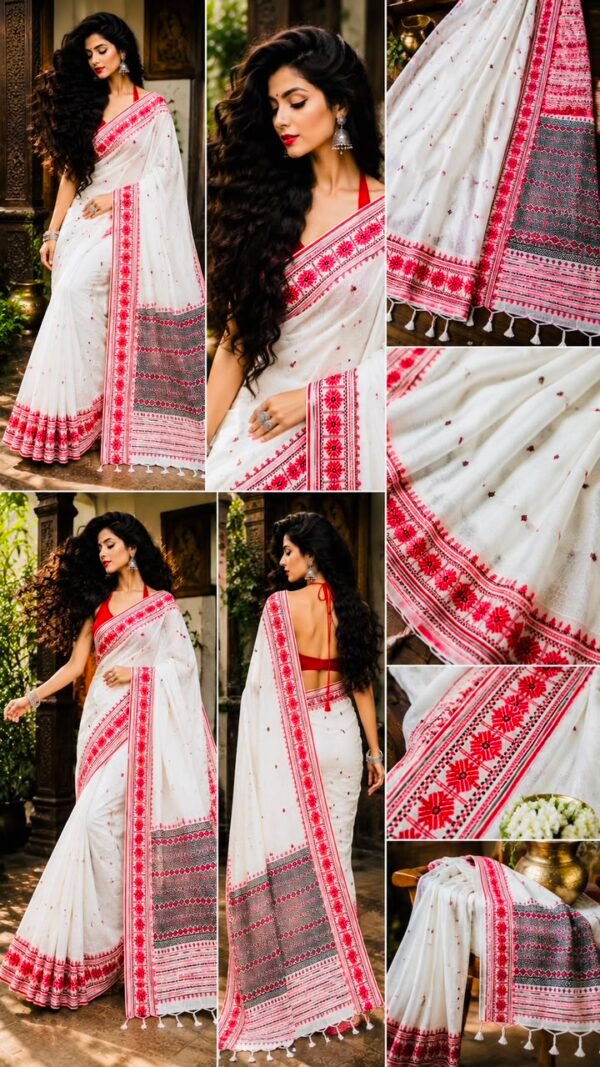
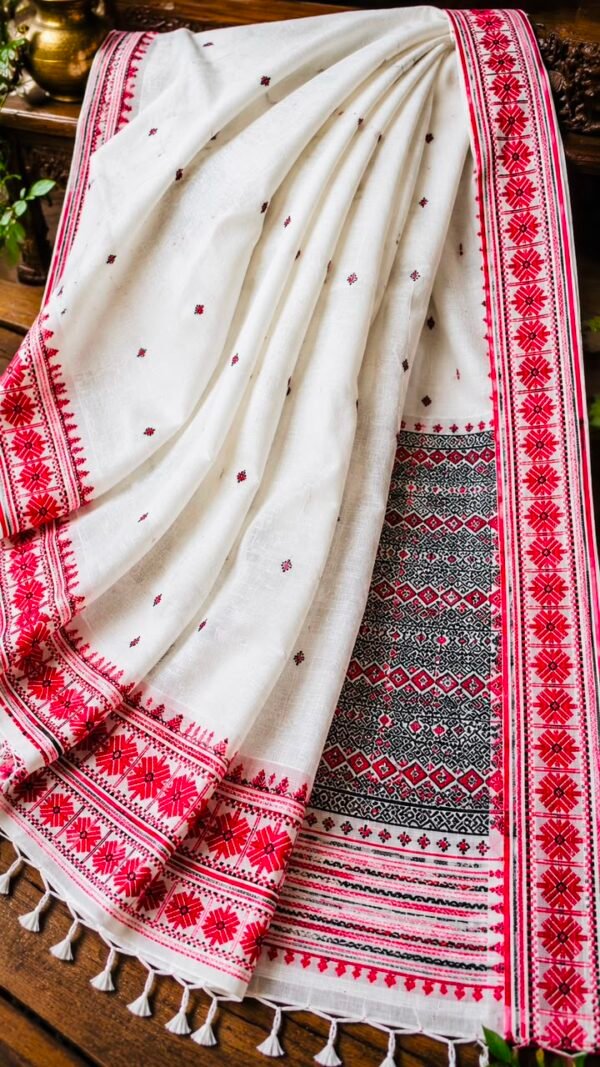
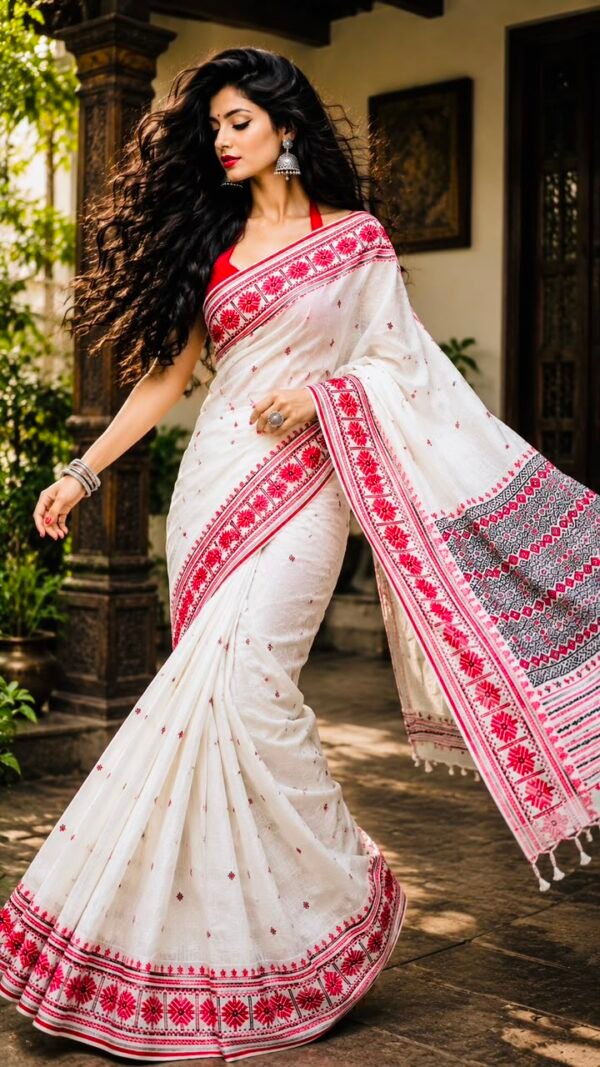
This saree speaks that language in full saree form. The white Assam khadi body is hand-spun: the slight natural variation of the hand-spun thread visible as the characteristic surface texture of khadi, the white not the optically bright white of bleached cotton but the warmer, more natural white of cleaned and finished hand-spun thread. Scattered across the white body are small red geometric buti — compass-star or floral-geometric forms in red supplementary weft thread, placed at regular intervals across the full 5.5 metres. Each buti is a separate weaving event: the red thread introduced at the buti position, built row by row in the supplementary weft, then withdrawn as the body weave resumes.
The running border carries the full Assamese geometric vocabulary: red and black supplementary weft in a sequence of diamond and geometric forms, the same motifs that appear in Assamese Mekhela Chador borders, compressed into the running border band. The pallu section breaks into a completely different register: a dense, all-over black and red geometric diamond weave that covers the full pallu surface, the body of the saree’s white ground replaced by the accumulated weight of the geometric pattern. The white tassels at the pallu hem are the border’s final note: the original white of the body, returned at the very edge.
In the reference image, the woman is seated on a dark carved wood bench in an interior of teak and brass. The white khadi and the red border against the dark wood is the most direct contrast in the collection after Khel (white on stone) — but where Khel was contemporary, Shreya is fully traditional. The name is Shreya. The auspicious one. The saree that carries the occasion with it.
The Assamese weaving tradition is one of the oldest and most geographically distinct handloom traditions in India. The Brahmaputra valley’s climate, its specific cotton and silk traditions, and the cultural centrality of weaving in Assamese domestic and ceremonial life have produced a textile vocabulary that is immediately recognisable: the geometric diamond and angular motifs, the white-and-red or white-and-black colour combination, the supplementary weft construction that places the coloured motif on the woven ground thread by thread.
The geometric motifs in the Assamese supplementary weft tradition are counted constructions: the weaver counts specific warp threads to determine where the supplementary colour thread passes over and under, building the geometric form row by row. For a diamond motif, the count increases by one additional warp thread on each row up to the diamond’s widest point, then decreases symmetrically on the way back down. The precision of the finished diamond — each side perfectly angled, the corners sharp, the interior fill correct — is the product of the count being maintained without error across the full height of the motif. Every border diamond in this saree was built this way.
Assam khadi is hand-spun on the charkha in the same tradition as Bengal khadi, but from Assamese cotton varieties and in the Assamese spinning tradition that has been part of rural women’s domestic practice for centuries. The slightly thicker, more textured hand-spun thread produces a khadi with a more pronounced surface character than fine Bengal khadi — the weave texture more visible, the white warmer. On a dark background like the carved teak interior of the reference images, Assam khadi white reads with the warmth of something that was made by a human hand and knows the difference.
• Wash: Hand wash in cold water with a very mild detergent. The white body and the red supplementary weft require separate care considerations: the white needs protection from the red, and the red needs cold water to prevent bleeding.
• First wash: Wash separately in cold water. The red supplementary weft thread will bleed on the first wash — this is normal and expected for red-on-white textiles. Wash quickly in cold water, do not soak, and rinse thoroughly. The red will not transfer to the white body if the saree is handled gently and not left damp.
• Red-on-white caution: This is a permanent care consideration. Never leave the saree damp with the red border in contact with the white body for extended periods. After every wash, lay flat immediately to prevent bleed transfer.
• Pallu: The dense black and red geometric pallu is a separate, heavier weave section. Wash it gently; do not scrub or wring through the pallu.
• Do not: Machine wash, bleach, or use fabric softener.
• Iron: Medium heat from the front while slightly damp. Assam khadi responds well to front ironing. Avoid ironing on the red supplementary weft buti and border directly at high heat.
• Dry: In shade immediately after washing. Do not leave damp and folded. Lay flat with the border away from the white body.
• Store: Folded in clean white muslin. Keep the red border sections separated from the white body with tissue paper. Store away from humidity and direct light.


Reviews
There are no reviews yet.